Skip Navigation

Log In
  • Scientific Research
  • Training
  • Professional Development
  • Community
  • Advocacy and Outreach
  • Career Paths
  • Image of three blue squares stacked vertically to look like pages. Collections
  • Careers in Neuroscience
  • Community Discussion
  • image of an open book Read
  • image of a play button: a triangle inside a circle Watch
  • an image of a calendar with a check mark signifying events to attend Attend
  • image of a blue microphone Listen
  • Image of two overlapping dialogue bubbles. Discuss
  • About Neuronline
  • SfN Events Calendar
  • Community Leaders Program
  • Community Guidelines
  • FAQ
  • Contact Us
Neuronline logo
SfN's home for learning and discussion
  • image of an open bookRead
  • image of a play button: a triangle inside a circleWatch
  • an image of a calendar with a check mark signifying events to attendAttend
  • image of a blue microphone Listen
  • Image of two overlapping dialogue bubbles.Discuss
Log In
  • Scientific Research
  • Training
  • Professional Development
  • Community
  • Advocacy and Outreach
  • Career Paths
  • COLLECTIONS

Watch

Revisit annual meeting event recordings and watch interviews to discover the latest insights on topics from animal research and impostor syndrome to productive collaborations and leadership in the lab.
Woolley thumbnail
Scientific Research
Sex Differences in the Brain Are Misunderstood
Dialogues thumbnail of speakers talking
Scientific Research
Dialogues Between Neuroscience and Society: Transforming Wine Appreciation from Sensory Experience to Mastery with Nicolas Quillé
ArticleFilter
Filter

Refine by

300 - 312 of 418
  • Susan Andersen talks about animal models of ADHD.
    Scientific Research
    Animal Models of ADHD: Neurodevelopmental Psychiatric Disorders
    Apr 24, 2015
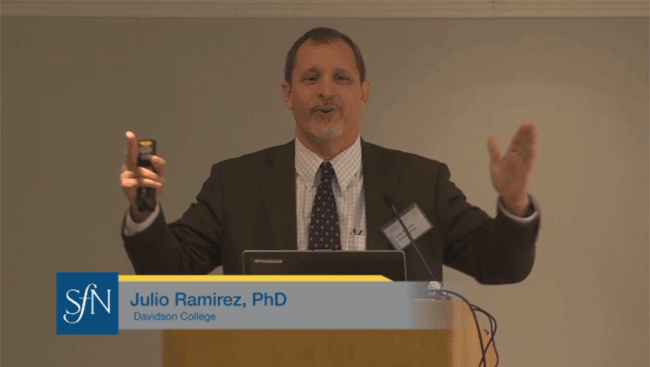
  • Julio Ramirez talks about how neuroscientists can be effective mentors to undergraduate neuroscientists.
    Professional Development
    Opportunity for Impact: Mentoring Undergrads
    Apr 24, 2015
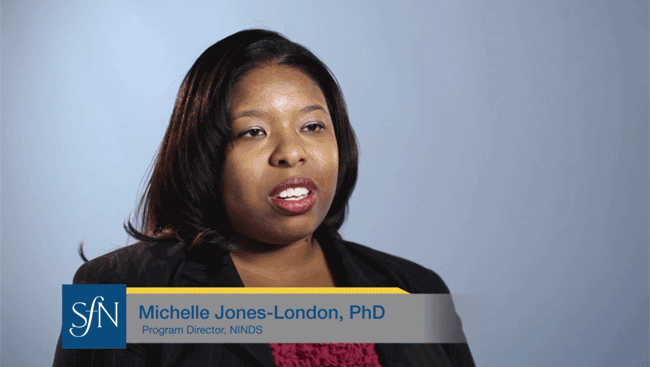
  • Michelle Jones-London talks about a government career as a neuroscience non-academic career.
    Career Paths
    The Ins and Outs of a Career in Government
    Apr 24, 2015
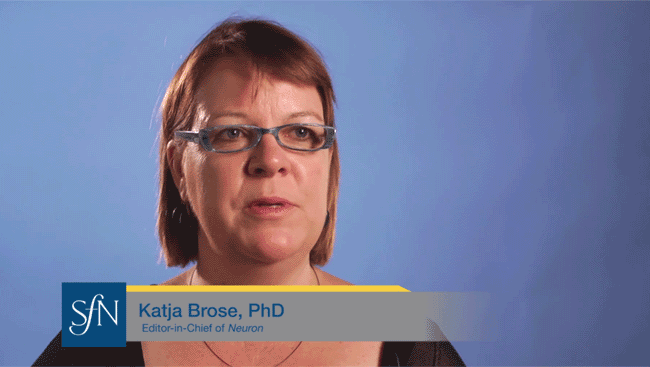
  • Katja Brose explains what being a science editor means for a neuroscience non-academic career.
    Career Paths
    Learn What Being a Science Editor Really Means
    Apr 24, 2015
  • Male neuroscientist smiling
    Professional Development
    From Start to Finish: NIH Peer Review
    Apr 03, 2015
  • A mentor and protégé have a discussion.
    Professional Development
    Are Mentors Still Role Models?
    Apr 03, 2015
  • Viji Ravindranath discusses what you need to know to select a postdoc.
    Professional Development
    All You Need to Know to Select Your Postdoc
    Apr 03, 2015
  • Paul Cammer talks about teaching science at a secondary school as a neuroscience career.
    Career Paths
    You Can Teach Neuroscience at a Secondary School
    Apr 03, 2015
  • 2.	This image shows a cross section of a day 28 human forebrain organoid, showing FOXG1-expressing neural precursors (Red), surrounding a ventricle-like structure outlined by N-Cadherin staining (Green). DAPI staining is blue.
    Scientific Research
    Machine Learning I: Intro Lecture
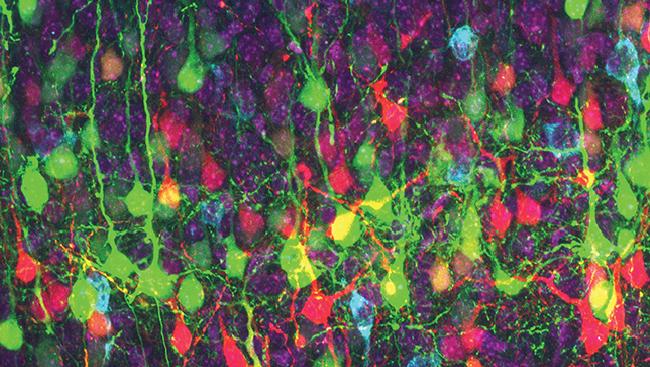
  • This image shows a retinal section from a mouse in which a subset of amacrine cells was labeled with an antibody against the transcription factor Meis 2 (green), which was identified in a single-cell RNA sequencing expression screen that characterized >60 amacrine cell types. The section was also stained to mark two classes of inhibitory neurons, GABAergic (magenta) and glycinergic (cyan).
    Scientific Research
    Tutorial 1: Generalized Linear Models (GLMs)
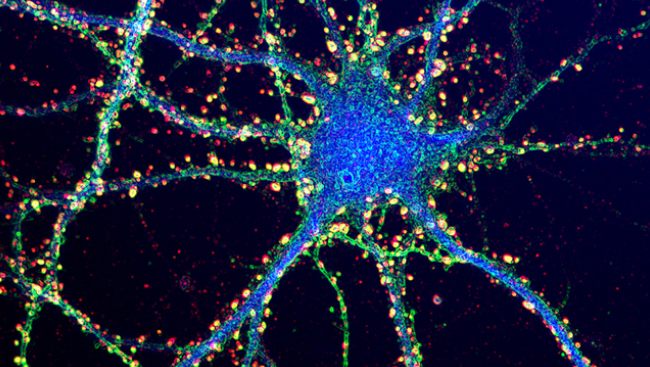
  • This image shows ventral striatal neurons from a rodent brain. The cell bodies are stained in blue using a fluorescent NISSL stain (NeuroTrace). A light sensitive virus for optogenetics was transducted into neurons shown in yellow. Neurons in this area are involved in scaling fear to the degree of threat and in rapid discrimination of uncertain threat and safety.
    Scientific Research
    Tutorial 2: Classifiers and Regularizers
  • This mirrored image shows a CA1 neuron before (left side) and after (right side) activation of excitotoxicity by metabotropic NMDA receptors and pannexin-1, a postsynaptic ion and metabolite channel. Metabotropic NMDAR signaling regulates pannexin-1 through Src kinase. This pathway suppresses facilitated release of presynaptic glutamate during synaptic activity by regulating tissue levels of the TRPV1 agonist anandamide.
    Scientific Research
    Machine Learning II: Outro Lecture
  • Previous
  • 26
  • 27
  • 28
  • 29
  • 30
  • Next
Neuronline Collections
Neuronline's vast collection of professional development and training resources offers guidance for people at all career stages with diverse interests and responsibilities.

View Collections
Neuronline footer 10 year anniversary logo
  • About Neuronline
  • SfN Events Calendar
  • FAQ
  • Contact Us
  • Accessibility Policy
  • Disclaimer
  • Privacy Notice
SfN logo with "SfN" in a blue box next to Society for Neuroscience in red text and the SfN tag line that reads "Advancing the understanding of the brain and nervous system"
Follow SfN
  • BlueSky logo
  • Threads logo
  • X Logo
  • image of linkedin logo
  • Image of the Facebook logo
  • Image of the instagram logo
  • image of youtube logo
  • RSS symbol
1121 14th Street NW, Suite 1010, Washington, DC 20005 (202) 962-4000 | 1-888-985-9246

Copyright © Society for Neuroscience