
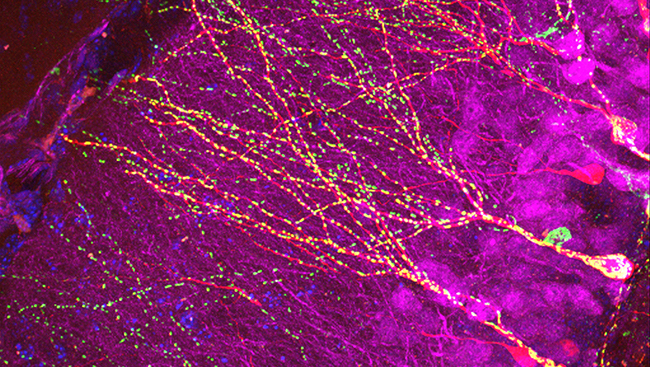
Material below summarizes the article Acetylcholine Acts Through Nicotinic Receptors to Enhance the Firing Rate of a Subset of Hypocretin Neurons in the Mouse Hypothalamus Through Distinct Presynaptic and Postsynaptic Mechanisms, published on February 28, 2015, in eNeuro and authored by Wenliang Zhou, Zio-Bing Gao, and Marina R. Picciotto.
The primary component of tobacco driving addiction is nicotine. Nicotine exerts its effects through a class of membrane proteins throughout the brain and body called nicotinic acetylcholine receptors (nAChRs). These receptors are normally activated by the neurotransmitter acetylcholine, but are hijacked by the nicotine in tobacco. nAChRs are found widely throughout the brain. Nicotine and acetylcholine can activate nAChRs and increase the activity of neurons expressing these receptors. This provides a molecular basis for nicotine to exert multiple biological effects, and ultimately can lead to nicotine dependence. Hypocretin, or orexin, neurons are a small group of neurons with many important functions, including controlling circadian rhythms regulating appetite, and feeding behavior; contributing to arousal, motivation, and emotions; and modulating drug addiction. Many of these behaviors are also modulated by nicotine exposure.
Access to the full article is available to SfN members.
Neuronline is a benefit of SfN membership. Renew your membership now to make sure you don’t lose access.
About the Contributors