
KCC2 on Axotomized Motoneurons Is Regulated Differently Than in Systems Previously Described
Jan 23, 2020
Material below summarizes the article Removal of the Potassium Chloride Co-Transporter From the Somatodendritic Membrane of Axotomized Motoneurons Is Independent of BDNF/TrkB Signaling but Is Controlled by Neuromuscular Innervation, published on September 20, 2019, in eNeuro and authored by Erica Tracey Akhter, Ronald W. Griffith, Arthur W. English, and Francisco J. Alvarez.
Highlights
- Potassium chloride-cotransporter 2 (KCC2) mRNA and protein are downregulated within days of peripheral axotomy of spinal motoneurons.
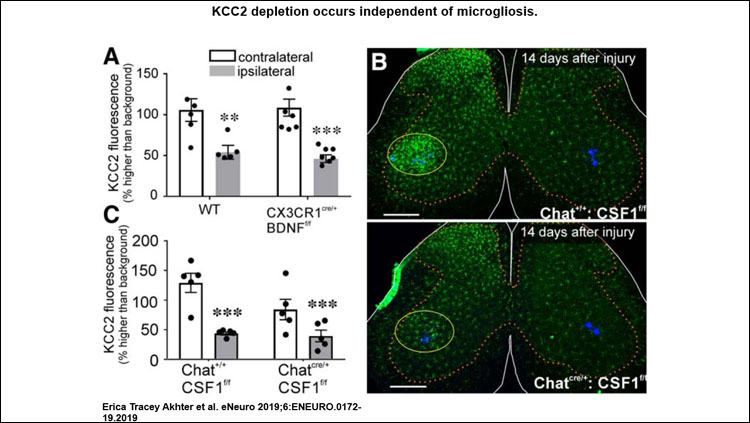
- KCC2 downregulation on axotomized motoneurons is not dependent on microgliosis or BDNF/TrkB signaling by difference to pathways reported previously in other disease and pathology associated with KCC2 dysregulation.
- Extensive KCC2 depletion is tied to the regenerative state and recovers after motor axons reinnervate muscle, suggesting that GABA/glycinergic synapse action in the absence of KCC2 might contribute to axon regeneration.
Access to the full article is available to SfN members.
Neuronline is a benefit of SfN membership. Renew your membership now to make sure you don’t lose access.
About the Contributors

Erica Tracey Akhter is an instructor at Georgia State University. She obtained her PhD from Emory University, where she worked on the topic of this article and looked for novel mechanisms driving motor axon regeneration.


0 of 5 articles left
Login
or
Become a Member
to unlock content