
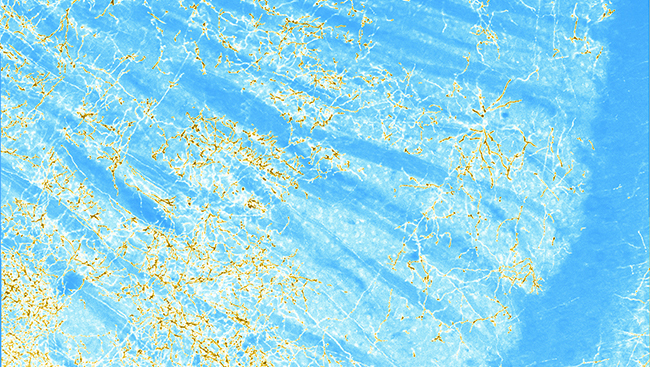
Material below summarizes the article A Primary Cortical Input to Hippocampus Expresses a Pathway-Specific and Endocannabinoid-Dependent Form of Long-Term Potentiation, published on July 25, 2016, in eNeuro and authored by Weisheng Wang, Brian H. Trieu, Linda C. Palmer, Yousheng Jia, Danielle T. Pham, Kwang-Mook Jung, Carley A. Karsten, Collin B. Merrill, Ken Mackie, Christine M. Gall, Daniele Piomelli, and Gary Lynch.
The hippocampus is a structure about the length of your little finger, nestled deep inside the cerebral cortex, that plays a vital role in the formation of new memories. This includes episodic memory, which is a record of a series of events placed into a narrative containing information about what you saw, the locations of the items, and the sequence in which they occurred.
People routinely perform this complex type of encoding and then use the stored episodes to recall what happened at a particular place or time. When asked about a possible encounter while walking through a building, you’ll likely replay an episode to find the answer, such as, “I came through the door, walked across the lobby, and then spotted an unusual chair next to the elevator.
Given that episodic memory is fundamental to everyday behavior, it is not surprising that brain scientists around the world are trying to understand how the hippocampus builds it.
Access to the full article is available to SfN members.
Neuronline is a benefit of SfN membership. Renew your membership now to make sure you don’t lose access.
About the Contributor