Building and Sustaining a Local Neuroscience Chapter: The SfN DCMA Chapter’s Story
- Featured in:
- SfN Chapter Resources
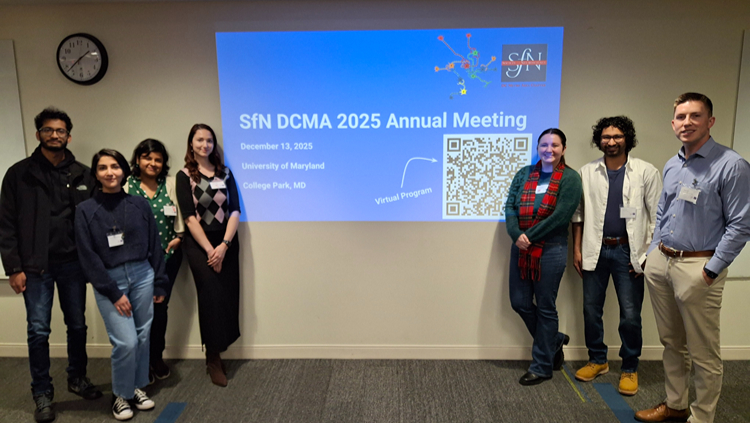
In addition to many resources that SfN directly provides its members, it has several active local chapters within the United States and around the world. Chapters provide networking opportunities for members locally, while helping to foster regional neuroscience communities. One of the many ways SfN supports chapters is through awards, and the D.C. Metro Area chapter (SfN DCMA) was one of the recipients of the 2025 SfN award for science education and outreach. We are grateful that SfN recognized our efforts to build and sustain the neuroscience community within the US national capital region. Given this, we wanted to share with the larger SfN community some of our goals and strategies in fostering our neuroscientific community as well as our focus on outreach activities.
Beginnings and growth
SfN DCMA was founded in 2012 to “advance the understanding of the brain by fostering communication and collaboration between local neuroscientists, policy makers, and members of the community.”
Since then, the chapter has grown to more than 580 members across several institutions in and around Washington, D.C. While growth in the chapter has been steady, sustaining connections has been a challenge. The diversity of our members’ careers and life stages, though an amazing feature of the chapter, has made organizing events that cater to everyone’s needs difficult. This was particularly true during the COVID-19 pandemic in which nearly two years of events were held exclusively online.
Despite these challenges, our chapter has thrived by curating specialized events that serve our members. This specialization is not just in terms of content, but also format and location. We have hosted meetings both in person and online, met at restaurants, museums, and schools in D.C., Virginia, and Maryland, and offered events with individual experts from across neuroscience careers, and even one-on-one professional development and networking. These efforts were only made possible thanks to the dedication of dozens of board members and committee co-chairs who have volunteered to serve the chapter over the past 13 years.
Our chapter’s focus areas
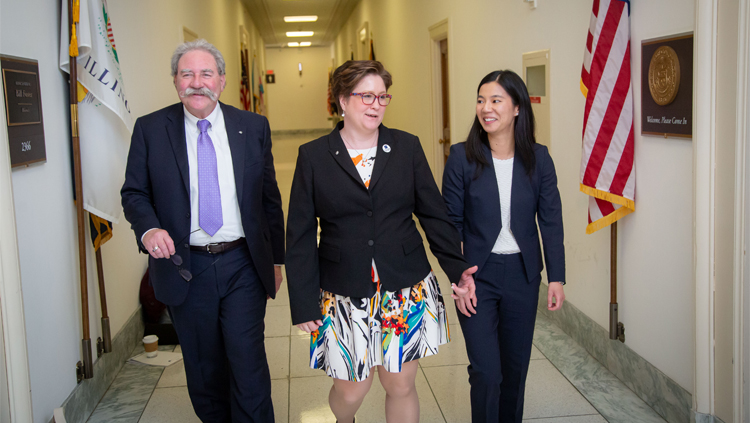
Providing opportunities for growth and professional development to our members has been a priority for our chapter. We regularly provide diverse programming for members, with speakers from traditional neuroscience career paths like academia and industry, as well as those with more niche expertise like science communication. This allows our members, particularly our undergraduate and graduate trainees, to explore career options early in their development as scientists. Our location in the nation’s capital also allows for a unique focus on NeuroPolicy, and we curate events that provide our members with invaluable advocacy tools, such as how to prepare for a meeting on the hill and how to pitch your science to policymakers. These NeuroPolicy events have included policy advisors and fellows at Pfizer, MIT Washington, and even Congress. We are proud to provide meaningful science policy programming, as advocating for scientific research and funding has become increasingly important!
We also enable our members to build meaningful mentor-mentee relationships through our mentorship program. We designed our mentoring program to create and support an accessible and flexible mentorship network for trainees. Our members are eligible to serve as mentors or mentees depending on their career stage, and our professional development co-chairs facilitate mentor-mentee pairs based on shared career interests and compatibility as assessed from their application to the program. Each pair negotiates a unique mentorship agreement which allows them to define their own goals, meeting frequency, and duration. Currently, the mentorship program includes nine mentor-mentee pairs, with mentors representing diverse roles across academia, government, clinical research, industry, and science communication. By intentionally bringing together neuroscientists from a range of career paths, the program broadens career awareness, normalizes alternate career paths, and fosters supportive mentoring relationships within the local neuroscience community. This initiative reflects the role that local SfN chapters can play in building inclusive mentorship networks that empower the next generation of neuroscientists.
Another focus of our chapter has been to engage with lay audiences with the goal of making neuroscience more accessible. Our events have included participating in annual Brain Awareness Week local events, speaking at the Loudoun County Public Schools' annual STEM competition, collaborating with Fairfax County Public Schools at one of their largest outreach events at Thomas Jefferson High School for Science and Technology and a “Neuroscience of Wellness” event. Our chapter prioritizes developing engaging and educational activities where we get people from a range of different backgrounds and age groups more involved with neuroscience at younger ages. With an eye towards this goal, we have been working to expand our outreach portfolio and have spent some of our 2025 award money on designing novel outreach programs and acquiring supplies for them. Another avenue for outreach is our newsletter. We send out chapter newsletters to build community by sharing our members’ achievements, recent and upcoming events, and soliciting members’ preferences to inform chapter program development.
The benefits of being involved in the chapter
Participating in the chapter has enhanced our lives in various ways, but not limited to:
- Networking Opportunities: The chapter has facilitated communication between individuals across academic and non-academic backgrounds working in a range of different specialties. This has helped many of us grow as scientists, reflect on our own career goals, and helps us map out optimal career options in the region.
- Outreach Service: Helping to foster the local neuroscience community has been a rewarding effort for us. We have provided a platform for scientists to share their exciting research with peers, and through our outreach, with lay audiences.
- Meaningful Collaborations: Serving on the board has helped us build productive partnerships between academics and private organizations. In addition, when members share their research at our events, they gain valuable feedback from diverse perspectives. This facilitates collaborations to enhance research planning and execution.
- Professional Development: Serving with the chapter has strengthened our administrative and strategic skills such as fostering our leadership, organizational and collaborative teamwork expertise.
- Fostering Inclusivity and Diversity: Our chapter serves as a reminder that neuroscience is diverse and has a place for everyone. Learning about each member’s unique neuroscience work has enriched and exposed us to multidisciplinary methods and outcomes that we may not have otherwise encountered. Within our board, executive board member responsibilities and skillsets vary greatly (e.g., secretary, social media, professional development, treasurer), reaffirming that diversity and teamwork are fundamental attributes of modern neuroscience.
Looking to the future
The reason we have been able to keep the chapter flourishing and growing over the years has been the commitment of our board members, the buy-in from our members, and the support from SfN. We have always adapted to the needs of our members, and in challenging times (such as the pandemic or funding uncertainties) provided resources, community, and continuity. Our current focus is therefore to continue providing advocacy, science communication, professional development and outreach programming to our members, as well as to build collaborations within and between chapters.
We are also interested in participating in the chapters workshops and availing other resources that SfN provides to us to continue providing optimal resources and programming. In the spirit of resource sharing, we are also very happy to share details and resources from our programs and would love to learn from what other chapters are doing to build and foster communities around the world. If you are interested in collaborating with us, simply drop us an email at sfn.dcma@gmail.com. We look forward to working with you!
About the Contributors