SfN Chapters Spotlight: How the Ottawa Chapter Turned Creativity Into Community Impact
- Featured in:
- SfN Chapter Resources
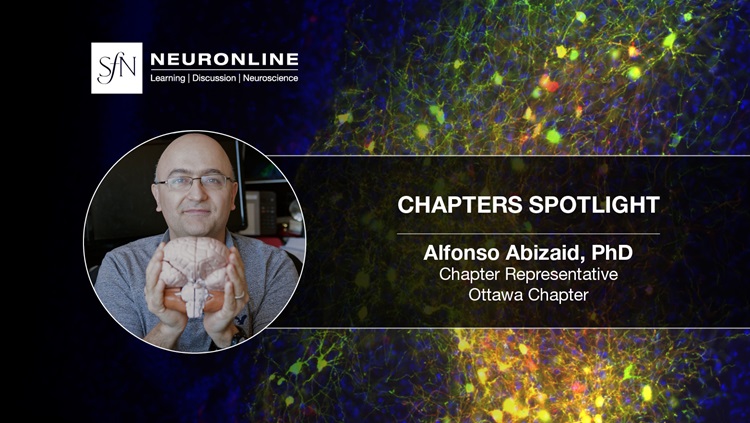
In this spotlight on SfN Chapters, learn more about SfN’s Ottawa chapter and its creative, self-sustaining model for fundraising and community impact in this feature with chapter representative Alfonso Abizaid, PhD. Explore more about SfN’s local chapters here.
Seventeen years ago, the Society for Neuroscience Ottawa Chapter began with a pair of clear, focused ambitions: to bring neuroscience into the community and to bring the world’s leading scientists to Ottawa. What started as a modest, locally supported effort has since grown into a dynamic, self-sustaining model for fundraising and community engagement—one built on persistence, partnerships, and a willingness to think creatively.
“We started with very basic goals,” Alfonso Abizaid, PhD, professor of neuroscience at Carleton University, and the Ottawa Chapter’s representative, explained, “to develop a Brain Awareness Week campaign in the Ottawa region and to bring world-class neuroscientists to present ground-breaking work to our community.”
Early funding was humble but impactful. A $1,000 contribution from Carleton University’s Department of Neuroscience helped launch their first Brain Awareness Week campaign, supporting educational props, volunteer materials, and travel costs. That initial investment laid the groundwork for what would become a thriving program. Over time, partnerships deepened, including a longstanding collaboration with Carleton to sustain a colloquium series that continues today.
The chapter also expanded its reach by securing funding for an annual keynote lecture—backed by a network of local institutional partners. These efforts have enabled Ottawa to host renowned scientists such as Jeff Mogill, PhD, John Cryan, PhD, Robert Sapolsky, PhD, Tracy Bale, PhD, and Eric Nestler, PhD, MD. As Abizaid put it, “The key to our success is that we have created partnerships where we contribute with work and determination and creativity.”
That same spirit of creativity is evident in the chapter’s flagship fundraising initiatives. Among them, the Brain and Mental Health Art Show stands out as both a community favorite and a financial success. “It’s a show that has been running for over 15 years,” Abizaid noted, “and one that generates over $10,000 in funds that are donated to local charities on an annual basis.” What began with institutional support has evolved into a self-sustaining event that not only covers its own costs but consistently raises significant funds for the community.
The chapter has also built an exceptional Brain Bee program, producing two Canadian champions in the past five years—students who went on to place first and second at the international level. This success stems from strategic collaborations, including partnerships with McMaster University’s Canadian Institutes of Health Research-funded Brain Bee training program, and support from The Natural Sciences and Engineering Research Council of Canada funding.
Meanwhile, their Brain Awareness Campaign continues to expand its reach, bringing neuroscience directly into classrooms and public spaces. By aligning presentations with school curricula and incorporating hands-on tools like Backyard Brains kits—funded through an NSERC science promotion grant—the chapter ensures its programming is both engaging and educationally relevant.
Despite these achievements, fundraising has not been without its challenges. “Fundraising is always difficult,” Abizaid said. “Our approach is to knock on every door to secure funding for our activities.” The chapter has learned to navigate obstacles such as limited interest by designing events that are engaging, interactive, and rewarding for participants. This approach not only boosts attendance but also builds momentum and visibility.
“Our enthusiasm has produced events that are high profile,” Abizaid said, “and that translates into income from partners and community funders.” A key strategy has been transitioning events toward self-sustainability—charging modest fees that cover operational costs while still generating funds for charitable causes. Strong marketing efforts, both online and through community channels, further amplify their reach.
Central to Ottawa’s model is its inclusive approach to engagement. The chapter actively involves partners and stakeholders by inviting them into the process and demonstrating the tangible impact of their contributions. “We apply for every source of funding that we can to run a very successful program,” Abizaid explained. “We do this by inviting partners to be part of our events or at least allow us to send them outcome progress reports so that the evidence of success is clear to them.”
This transparency, combined with a robust social media presence and promotion through institutional partners such as Carleton University, the Royal Ottawa Hospital, and the University of Ottawa Brain and Mind Institute, helps maintain strong and lasting relationships.
For chapters looking to strengthen their own fundraising efforts, Abizaid offered simple but powerful advice: “Don’t be afraid to canvas for support! People are interested in neuroscience and the impact of our work on health. The worst that can happen is that potential funders say no.”
It’s a philosophy that has guided the Ottawa Chapter from its earliest days and one that continues to fuel its growth, impact, and success today.