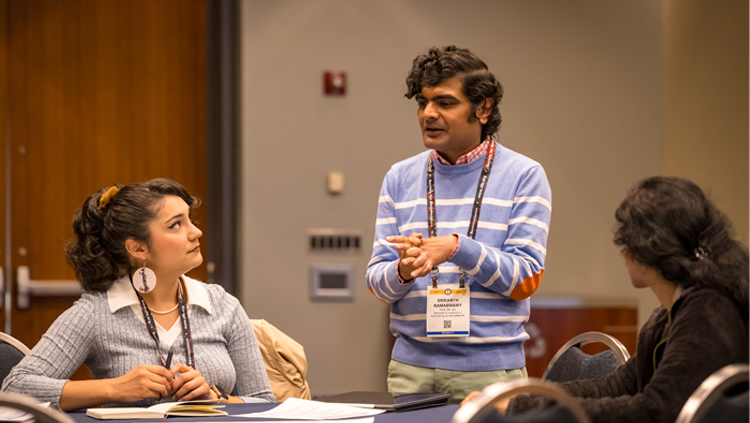
Srikanth Ramaswamy, PhD, breaks down the emerging field of NeuroAI, including early advances, promises, and challenges, and resources for early career scientists to start learning and contributing to the growing field. For more about Ramaswamy and his journey into NeuroAI, watch this interview on Neuronline.
Artificial intelligence (AI) has achieved remarkable feats in recent years, from diagnosing diseases to generating human-like text. Yet, AI systems consume vast amounts of energy, often hallucinate, struggle to adapt to new situations, and fail in unpredictable ways. What if the next breakthrough comes from understanding how our brains actually work? This gap between artificial and natural intelligence is precisely what drives NeuroAI, an emerging field bridging neuroscience and AI that is transforming both disciplines.
What Is NeuroAI?
NeuroAI explores the relationship between neuroscience and AI in both directions. Neuroscience utilizes AI tools to analyze neural data and understand brain function. At the same time, AI systems implement principles from neuroscience to design better artificial agents. This symbiosis benefits both fields: neuroscience gains powerful computational tools, while AI gains insights from millions of years of evolutionary brain optimization.
The motivation is practical as well as scientific. Our aging global population faces increasing rates of neurodegenerative diseases. Understanding brain circuits could lead to better diagnostics and treatments. Meanwhile, AI systems need to become more robust, interpretable, and energy efficient for real-world deployment, particularly at the edge, where power and computational resources are limited.
Beyond Simple Neural Networks
As I discussed recently in Quanta Magazine, current AI is nothing like a brain, and that is actually okay. Deep learning networks, while inspired by neurons, operate very differently from biological circuits. They lack the diversity, adaptability, and efficiency that characterize real brains. The human brain runs on roughly 20 watts of power while performing computations that would require megawatts in conventional AI systems.
My own research focuses on one specific aspect of this puzzle: neuromodulation. The brain uses chemical messengers like dopamine, serotonin, acetylcholine, noradrenaline and histamine to dynamically regulate neural circuits. These neuromodulators control everything from attention and arousal to learning and memory consolidation. They operate across multiple spatial and temporal scales, allowing the brain to reconfigure itself based on behavioral context.
What makes neuromodulation interesting for AI? It provides a biological solution to problems that plague artificial systems: catastrophic forgetting when learning new tasks, inability to transfer knowledge across domains, and lack of context-appropriate behavior. Together with colleagues at Newcastle, Interdisciplinary Transformation University in Linz, and University of Sydney, we are working to incorporate these neuromodulatory principles into artificial neural networks.
The Promise and the Challenges
Early work suggests that biologically inspired approaches can improve AI in specific ways. Systems that incorporate cellular diversity, local learning rules, and neuromodulatory signals show better continual learning, improved energy efficiency, and more robust performance. Recent demonstrations on neuromorphic hardware like Intel's Loihi chips show dramatic gains in speed and power consumption compared to conventional processors.
However, we must be honest about the limitations. Simply copying biology does not guarantee better AI. Evolution optimizes brains for survival and reproduction, not for playing chess or recognizing images. Many biological mechanisms are constrained by developmental history and metabolic costs that do not apply to artificial systems. The challenge is to identify which principles transfer productively and which do not.
Moreover, our understanding of brain function remains incomplete. We still debate fundamental questions about how neural circuits encode information, how learning occurs at the synaptic level, and how neuromodulators coordinate network dynamics. Building AI based on incomplete neuroscience risks amplifying our misconceptions.
Getting Started in NeuroAI
For students interested in this field, the path requires building competence in both domains. If your background is neuroscience, learn programming (Python is essential), mathematics (linear algebra, calculus, probability, and statistics), machine learning fundamentals, and computational modeling. If you come from computer science or engineering, study systems neuroscience, neural circuits, and biological constraints.
More importantly, engage with both communities. Attend NeuroAI workshops at conferences like SfN’s annual meeting, NeurIPS, and COSYNE. Consider participating in structured learning opportunities like Neuromatch Academy's NeuroAI summer school, which offers hands-on tutorials and projects bridging neuroscience and AI. Join collaborative projects and contribute to open science initiatives. The field benefits from people who can translate concepts across disciplinary boundaries.
For deeper exploration into NeuroAI perspectives, I recommend exploring interviews and discussions from experts in the field. The Brain Inspired podcast offers an excellent NeuroAI course featuring researchers like Blake Richards, and episodes with leaders like Tony Zador discussing how neuroscience principles can improve AI. You can also learn more about my own journey into NeuroAI on Neuronline.
Start with focused problems rather than attempting to model entire brain systems. Work on specific mechanisms like attention, working memory, or sensory processing. Use existing tools and datasets before building new ones. Collaborate widely, since no single person can master all the necessary expertise.
A Growing Field
NeuroAI represents a maturing dialogue between neuroscience and AI. It is not about claiming that AI must copy biology, nor that neuroscience should only serve AI development. Rather, it recognizes that both fields address complementary aspects of intelligence and can inform each other productively.
The next decade will likely see increasing integration between these disciplines, driven by advances in neural recording technologies, neuromorphic hardware, and computational methods. For early-career researchers, this creates opportunities to contribute to fundamental questions about intelligence itself, whether biological or artificial.
About the Contributor