On Leading Undergraduates to Discovery Through Mentorship
- Featured in:
- Best Practices for Mentoring Relationships
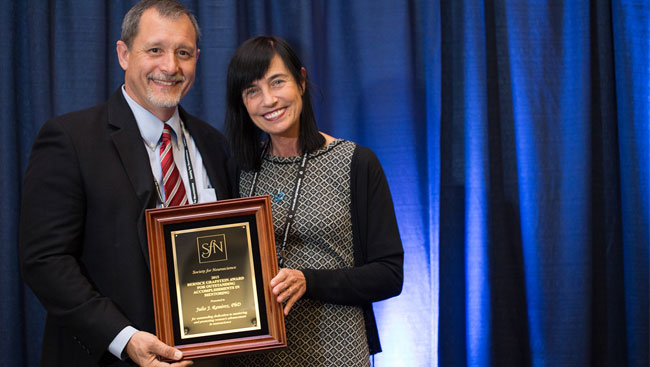
Mentoring advances the field of neuroscience by ensuring that trainees begin their careers with the necessary skills, scientific understanding, and other support to achieve success. Julio Ramirez, professor and chair of the psychology department at Davidson College, is leading efforts to improve mentoring for undergraduates studying neuroscience. He received the Bernice Grafstein Award for Outstanding Accomplishments in Mentoring in 2015 for his contributions. Here, Ramirez discusses his mentoring approach.
When you first became a mentor, what concerns or challenges did you have, and how did you work through them?
In the late 1970s and early 1980s, undergraduate students were not widely involved in original research projects across the life sciences. Funding sources to support undergraduate research were very limited, and undergraduate research was a foreign concept at many institutions. Laboratories at predominantly undergraduate institutions (PUIs) were not well outfitted with research-level equipment and technology. Many PUIs did not have curricular mechanisms that would enable undergraduates to get involved in research or reward mechanisms for supporting faculty efforts to involve students in original research.
Fortunately, several events occurred during that period that dramatically improved the outlook for undergraduate research at PUIs across the country. First, the Council on Undergraduate Research was established in 1978 and began advocating for original undergraduate research at PUIs. In the mid-1980s, both the NSF and the NIH implemented research and/or education grant programs for faculty and students at PUIs.
Many of my efforts during those years focused on contributing to the national efforts to create an infrastructure that would support undergraduate research at PUIs. In 1991, colleagues and I founded Faculty for Undergraduate Neuroscience to provide the neuroscience community with a voice representing the interests of faculty invested in using research to mentor their undergraduate students.
Access to the full article is available to SfN members.
Neuronline is a benefit of SfN membership. Renew your membership now to make sure you don’t lose access.
Speaker