Access a searchable transcript of this video by clicking the magnifying glass icon in the player.
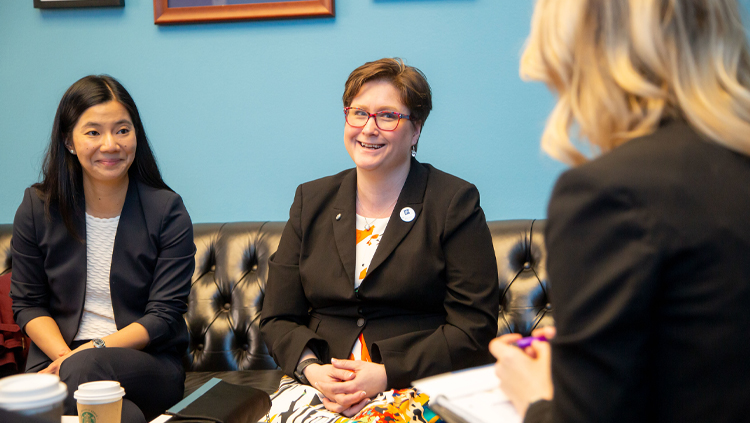
The August Congressional recess offers a valuable window for constituents to connect with federal policymakers in their home districts and states. This webinar will equip SfN members with practical strategies to effectively engage with elected officials and their staff during this period, such as hosting in-district meetings, lab tours, and more. Participants will learn how to craft compelling messages, build relationships with congressional offices, and identifytimely advocacy opportunities in their community. This session will also highlight SfN tools and resources currently available to support your advocacy efforts beyond the August recess and become an effective #NeuroAdvocate. This webinar will be led by the SfN Advocacy Team and their legislative advisors at CRD Associates LLC.
Speakers
Meghan Riley, CRD Associates
Meghan is an experienced government affairs professional with nearly two decades of work in the federal legislative and appropriations processes grassroots and patient advocacy. She plans and executes strategies that advance the federal legislative goals of organizations focused on public health, biomedical research, laboratory issues, and other health fields. Prior to joining CRD Associates, Meg was Vice President of Federal Government Affairs at the American Diabetes Association, leading ADA’s efforts on Capitol Hill to advance policies for people with and at risk for diabetes. Meg helped lead successful advocacy campaigns to establish the National Diabetes Prevention Program and later the Medicare Diabetes Prevention Program, the first community-based disease prevention program to be made eligible for Medicare reimbursement.
Nina Boyle, CRD Associates
Nina Boyle is a dedicated health policy professional with experience in women and children’s health care programs at the federal and state levels. Prior to joining CRD Associates, she interned at the Association of Maternal & Child Health Programs (AMCHP) on the Governmental Affairs team, where she worked on garnering support for the Title V Maternal and Child Health (MCH) Services Block Grant through the appropriations process and state-based differences in Title V. Nina also previously served as a congressional intern for Rep. Mike Quigley (D-IL). At CRD Associates, she has worked with clients engaged in biomedical and scientific research, patient advocacy, and regulatory issues. Nina’s advocacy and research of health policy have fostered her deep interest and care for how health policy functions for the most vulnerable.
Adam Katz, SfN
Adam M. Katz is the director of Advocacy and Training at the Society for Neuroscience, where he oversees organizational legislative and advocacy efforts, scientific training and professional development programs, and community-building programs. He previously held positions at the American Society for Microbiology, Research!America, the University of California at Irvine, and the National Institute of Mental Health. Katz's primary research interests lie in neural plasticity. He received his undergraduate degree in brain and cognitive science from the University of Rochester and his master’s in policy and advocacy from Georgetown University.
Becky Whitney, SfN
Becky Whitney is an Advocacy Associate I at the Society for Neuroscience, where she supports federal and grassroots advocacy initiatives aimed at advancing neuroscience research through SfN's year-long advocacy initiatives, contributions to advocacy communications, and support of the Early Career Policy Ambassadors program. Becky brings experience from previous roles as an intern Capitol Hill and at the Rape, Abuse & Incest National Network (RAINN). She holds a bachelor’s degree in political science and international studies, as well as a Master of Public Administration, from American University.
Julia Oladipo, SfN
Julia Oladipo is the Advocacy and Training Assistant at the Society for Neuroscience, where she supports organizational legislative and advocacy efforts, scientific training and professional development programs, and community-building programs. She previously held positions at the Science and Technology Policy Institute and the OASIS Initiative. She received her undergraduate degree in neuroscience from Yale University.
Who can attend this webinar? This webinar will be complimentary.
Will this webinar be available on demand? Yes, this webinar will be available on demand one week from the live broadcast.
Will a certificate of attendance be offered for this event? No, SfN does not provide certificates of attendance for webinars.
How do I access the conference on the live day? After registering, you will receive a confirmation email with the event link and the option to download calendar reminders.
What are the technology requirements for attending? This webinar will be hosted on Zoom Webinar. Instructions for joining and participating in a webinar can be found here.
Can I ask the presenters questions? Yes! You can submit any questions before the webinar through the registration form. During the webinar, you can submit questions through the Q&A box.
I have other questions not answered here. Email neuronline@sfn.org with any other questions.
Review SfN’s Code of Conduct, rules for virtual events in the Digital Learning Community Guidelines, and communications policies regarding dissemination of unpublished scientific data, listed below. SfN asks that conference attendees respect the sensitivity of information and data being presented that are not yet available to the public by following these guidelines:
- Do not capture or publicly share details of any unpublished data presented.
- If you are unsure whether data is unpublished, check with the presenter.
- Respect presenters' wishes if they indicate that the information presented is not to be shared.