



Filter
-
(133)
-
(733)
-
(4)
-
(1)
-
(47830)
-
(91)
-
(25)
-
(14)
-
(433)
-
(7)
-
(181)
-
(8)
-
(33)
-
(17)
-
(7)
-
(9)
-
(9)
-
(5)
-
(21)
-
(8)
-
(12)
-
(9)
-
(3)
-
(10)
-
(10)
-
(56)
-
(45)
-
(12)
-
(3)
-
(7)
-
(6)
-
(5)
-
(8)
-
(7)
-
(11)
-
(58)
-
(13)
-
(30)
-
(8)
-
(5)
-
(10)
-
(5)
-
(14)
-
(4)
691 - 700
of 52751 results
-
 Journal ArticleReaching movements, while seemingly simple, involve complex motor control mechanisms that select specific trajectories from infinite possibilities. Despite the inherent variability in volitional movements, both humans and monkeys frequently exhibit stereotyped trajectories. The literature has offered numerous explanations for invariant trajectory shapes, including a common planning space in hand-space or joint-space, as well as factors like kinetic energy (KE) minimization and sensory feedback. However, since most studies have relied on single-session data, crucial insights into the motor principles guiding trajectory selection and their evolution through extended practice remain underexplored. This study fills this gap by investigating how specific trajectories are selected and evolve with practice across multiple sessions, using data from two rhesus monkeys (one male, one female) performing a reaching task in a biomechanically constrained 2D setup. Our behavioral study challenges the idea of a common pla...Sep 22, 2025
 -
 Article Professional DevelopmentIt's important to communicate with lay audiences about animal research, but what's an effective approach? Mar Sanchez, a member of SfN's Committee on Animal Research, advises being transparent and proactive to confront the pervasiveness of misleading messages from animal rights groups. Here, she offers advice on facilitating conversations, engaging institutions and activists, protecting yourself against attacks, and more.May 13, 2021
 -
 Video Career PathsYour next position doesn’t have to lock you into a career path. “There’s people transitioning all the time,” says Kip Ludwig, who’s steered his own career through academia, industry, federal agencies, and back into research. In this video, Ludwig draws on his experience hopping sectors to share encouragement and practical advice for transitioning into a different area of the field.May 12, 2021
 -
 Webinar TrainingMaking people feel welcome within a neuroscience department or program contributes to its collective strength and success. To effectively cultivate a more inclusive environment, grassroots efforts, incentive structures, and institutional leaders need to work together toward a common goal. In this discussion panel, institute and program leaders share challenges they have experienced, and the solutions used to achieve a more inclusive environment for neuroscientists and their work to prosper. Attendees are encouraged to bring their questions and experiences to share with the panelists. This discussion between institutional program heads is organized by SfN’s Neuroscience Training Committee. This webinar will be available to watch on-demand after the live broadcast.May 11, 2021
 -
 Webinar Scientific ResearchThis webinar is exclusive for SfN members. Please log in for access. Watch this interactive session as Paula Salamone and Agustín Ibañez discuss their recent JNeurosci paper, “Interoception Primes Emotional Processing: Multimodal Evidence from Neurodegeneration.” After the talk, JNeurosci Editor-in-Chief Marina Picciotto moderates a conversation. This webinar is also available as a podcast, as a part of Neuro Current: An SfN Journals Podcast series. All Neuro Current podcasts are also available on Spotify and Apple Podcasts. Below is the significance statement of Interoception Primes Emotional Processing: Multimodal Evidence from Neurodegeneration, published on April 7, 2021, in JNeurosci and authored by Paula C. Salamone, Agustina Legaz, Lucas Sedeño, Sebastián Moguilner, Matías Fraile-Vazquez, Cecilia Gonzalez Campo, Sol Fittipaldi, Adrián Yoris, Magdalena Miranda, Agustina Birba, Agostina Galiani, Sofía Abrevaya, Alejandra Neely, Miguel Martorell Caro, Florencia Alifano, Roque Villagra, Florencia Anunziata, Maira Okada de Oliveira, Ricardo M. Pautassi, Andrea Slachevsky, Cecilia Serrano, Adolfo M. García, and Agustín Ibañez. Salamone, Legaz, et al. examined whether and how emotions are primed by interoceptive states combining multimodal measures in healthy controls and neurodegenerative models. In controls, negative emotion recognition and ongoing heart-evoked potential modulations were increased after interoception. These patterns were selectively disrupted in patients with atrophy across key interoceptive-emotional regions (e.g., the insula and the cingulate in frontotemporal dementia, frontostriatal networks in Parkinson’s disease), whereas persons with Alzheimer’s disease presented generalized emotional processing abnormalities with preserved interoceptive mechanisms. The integration of both domains was associated to the volume and connectivity (salience network) of canonical interoceptive-emotional hubs, critically involving the insula and the anterior cingulate. This study reveals multimodal markers of interoceptive-emotional priming, laying the groundwork for new agendas in cognitive neuroscience and behavioral neurology.May 6, 2021
 -
Journal ArticleThe integration of olfactory and spatial information is critical for guiding animal behavior. The lateral entorhinal cortex (LEC) is reciprocally interconnected with cortical areas for olfaction and the hippocampus and thus ideally positioned to encode odor-place associations. Here, we used mini-endoscopes to record neural activity in the mouse piriform cortex (PCx) and LEC. We show that in head-fixed mice, odor identity could be decoded from LEC ensembles, but less accurately than from PCx. In male mice freely navigating a linear track, LEC ensemble activity at the odor ports was dominated by spatial information. Spatial position along the linear track could be decoded from LEC and PCx activity, however, PCx but not LEC exhibited strong behavior-driven modulation of positional information. Together, our data reveal that information about odor cues and spatial context is differentially encoded along the PCx-LEC axis. Significance statement For most animals, the sense of smell is essential for successfully...Sep 19, 2025
-
Journal ArticleDespite various histological, electrophysiological, and imaging studies, the topographic organization of saccade-related activity in the posterior parietal cortex (PPC) has been notoriously difficult to characterize. In part, this is because areas of interest in PPC are often embedded deep in sulci in macaques and humans. Understanding the extent of topographic organization in PPC can provide insights into the computation contributions of PPC. The lissencephalic cortex of the common marmoset offers a unique opportunity to investigate fine-scale topographic organization in PPC. Recordings were obtained from the PPC of two male marmosets performing a visually-guided center-out saccade task with 8 or 36 peripheral targets using multi-channel electrode arrays with 100 μm spacing. By plotting the pattern of saccade direction tuning preferences across all penetrations and cortical depths, uncovered topographic organizational features within PPC were uncovered. Like other primates, multiunits in marmoset PPC tend...Sep 19, 2025
-
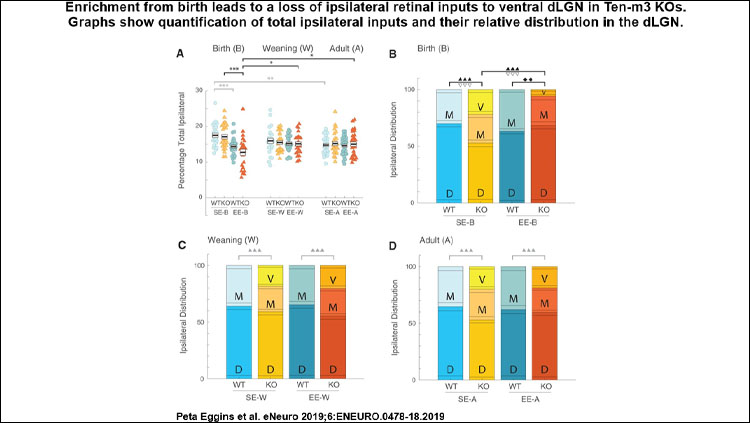 Article Scientific ResearchThis material summarizes the article Environmental Enrichment Partially Repairs Subcortical Mapping Errors in Ten-m3 Knock-Out Mice during an Early Critical Period, published on November 25, 2019, in eNeuro and authored by Peta Eggins, James Blok, Justin Petersen, Larissa Savvas, Lara Rogerson-Wood, Hannan Mansuri, Atomu Sawatari, and Catherine A. Leamey.Apr 29, 2021
 -
 Article Professional DevelopmentIn addition to subject-matter expertise, skills such as leadership, management, and team building are crucial for navigating increasingly complex jobs and research collaboration opportunities in neuroscience.Apr 28, 2021
 -
 Video Annual Meeting AdvocacyCommunicating the relationship between basic and translational research to nonscientists can be difficult. In this recording of the Public Advocacy Forum at Neuroscience 2019, learn how basic research is used by pharmaceutical companies and how to talk about these partnerships. You’ll also learn how to explain why advocating for research funding is an absolute necessity and the importance of collaborating to advance understanding and improve research outcomes.Apr 22, 2021




