



Filter
-
(133)
-
(733)
-
(4)
-
(1)
-
(47833)
-
(91)
-
(25)
-
(14)
-
(433)
-
(7)
-
(182)
-
(8)
-
(33)
-
(17)
-
(7)
-
(9)
-
(9)
-
(5)
-
(21)
-
(8)
-
(12)
-
(9)
-
(3)
-
(10)
-
(10)
-
(56)
-
(45)
-
(12)
-
(3)
-
(7)
-
(6)
-
(5)
-
(8)
-
(7)
-
(11)
-
(58)
-
(13)
-
(30)
-
(8)
-
(5)
-
(10)
-
(5)
-
(15)
-
(4)
1361 - 1370
of 52756 results
-
 Journal ArticleMotor skill learning enables organisms to interact effectively with their environment, relying on neural mechanisms that integrate sensory feedback with motor output. While sensory feedback, such as auditory cues linked to motor actions, enhances motor performance in humans, its mechanism of action is poorly understood. Developing a reliable animal model of augmented motor skill learning is crucial to begin dissects the biological systems that underpin this enhancement. We hypothesized that continuous auditory feedback during a motor task would promote complex motor skill acquisition in mice. We developed a closed-loop system using DeepLabCut for real-time markerless tracking of mouse forepaw movements with high processing speed and low latency. By encoding forepaw movements into auditory tones of different frequencies, mice received continuous auditory feedback during a reaching task requiring vertical displacement of the left forepaw to a target. Adult mice were trained over four days with either auditor...Feb 25, 2025
 -
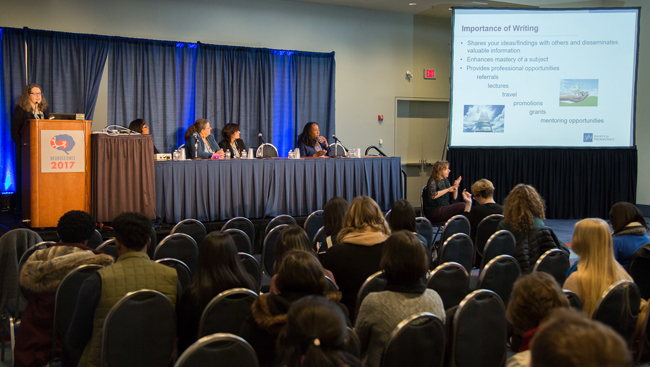 Video Annual Meeting Professional DevelopmentIn this Neuroscience 2017 event, Women in World Neuroscience (WWN), an independent mentoring and networking organization that provides opportunities for neuroscientists across the world, highlights the potential of developing strategic collaborations, identifies funding sources, and provides strategies for establishing successful research networks.Apr 10, 2018
 -
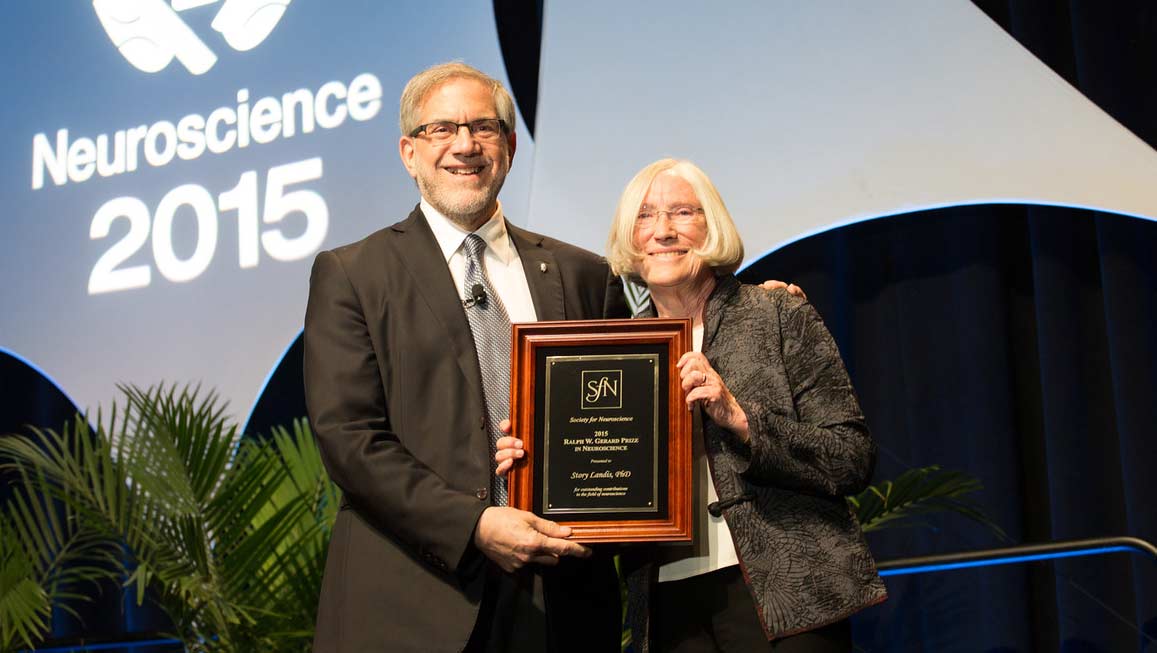 Article Professional DevelopmentStory Landis, former director of the National Institute of Neurological Disease and Stroke (NINDS), has had an impact on neuroscience through her research on developmental neurotransmitter phenotype switching and leadership in academia and at NIH. Landis has championed critical science and public policy issues, diversity, and mentorship throughout her career. For her contributions to advancing the field, Landis received the Ralph W. Gerard Prize in Neuroscience in 2015. Here she reflects on the highlights of leading initiatives and critical conversations about funding, mentoring, and more.Apr 10, 2018
 -
Journal ArticleWhile ketamine, an NMDA receptor antagonist, is effective in treating major depression, studies have not addressed the safety of repeated ketamine infusions in depressed patients with comorbid Alcohol Use Disorder (AUD). In this study, we aimed to determine whether a history of chronic social isolation and alcohol exposure alter the reinforcing properties of ketamine in male and female rats. Rats were pair-housed or socially isolated for 12 weeks and underwent intermittent access to 20% alcohol. Subsequently, rats underwent intravenous ketamine self-administration under a fixed ratio 1 schedule, followed by extinction training and one session of cue-induced reinstatement. Dendritic spine morphology was examined in the nucleus accumbens, an important area implicated in reward and motivation. Our results show that females self-administered more ketamine than males, a history of alcohol increased ketamine intake in females, and a history of isolation or alcohol independently increased ketamine intake in males...Feb 24, 2025
-
Journal ArticleVestibular research is essential for understanding and treating disorders such as vertigo and Meniere’s disease. The vestibulo-ocular reflex (VOR) is a key method for assessing vestibular function and an essential tool for diagnosing vertigo. Traditionally, the VOR comprises angular VOR (aVOR) and translational VOR (tVOR), which originate from the vestibular semicircular canals (SCCs) and otolith organs, respectively. VOR consists of both fast-phase and slow-phase eye movements, which functionally interact to contribute to gaze control. However, to calculate the gain and phase parameters of the VOR, it is common practice to exclude fast-phase information superimposed on slow-phase eye movements. As a result, the information contained in the fast phase has not been fully utilized. OVAR is primarily used to evaluate otolith function, as there is no SCC input during its steady state. It is widely accepted that fast-phase nystagmus (FPN) during OVAR is generated by periodic otolith inputs via the central vesti...Feb 24, 2025
-
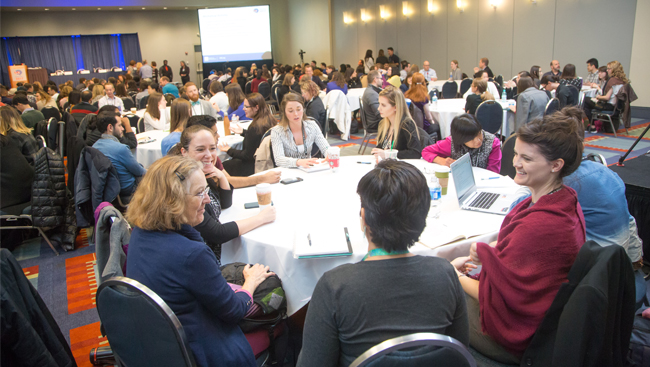 Annual Meeting Video Professional DevelopmentAs the field of neuroscience evolves, NSF is focusing its training and research support towards team-based interdisciplinary strategies to understand how healthy brains and neural circuits function. This Neuroscience 2017 event is designed to inform educational and research leaders at all career stages about national and international funding opportunities that emphasize interdisciplinary neuroscience training and research.Apr 5, 2018
 -
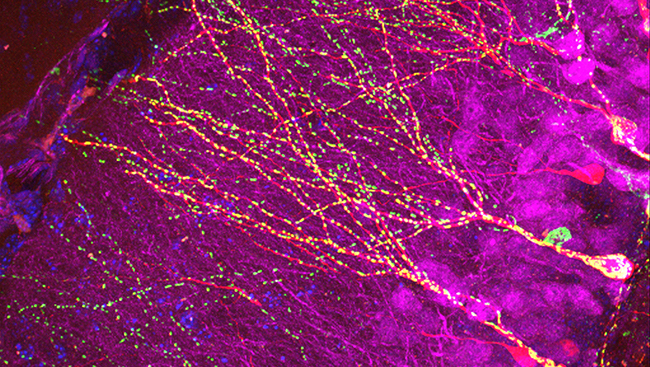 Article Scientific ResearchMaterial below summarizes the article, Problems and Progress Regarding Sex Bias and Omission in Neuroscience Research, published on November 3, 2017, in eNeuro and authored by Tyler R. Will, Stephanie B. Proaño, Anly M. Thomas, Lindsey M. Kunz, Kelly C. Thompson, Laura A. Ginnari, Clay H. Jones, Sarah-Catherine Lucas, Elizabeth M. Reavis, David M. Dorris, and John Meitzen. This study highlights the complex status of sex omission and bias in neuroscience research and provides useful information for decisions regarding policy enactment and enforcement, scientific culture, and individual action. Historically, many neuroscience research articles either neglected to report laboratory animal sex (termed sex omission), or favored one sex over another (termed sex bias, in this case male over female). Documentation of this pattern in neuroscience and other disciplines has prompted intense debate and study, including new scientific findings and regulatory policies. Relevant and high-quality analysis of sex omission and bias in the neuroscience research literature is a crucial component for informed discussion and decision making. Before our study, the last published review of sex bias and omission in the neuroscience literature did not analyze articles published after 2011. Furthermore, how sex omission and bias varies with animal species and scientific journals has been largely unexplored.Apr 5, 2018
 -
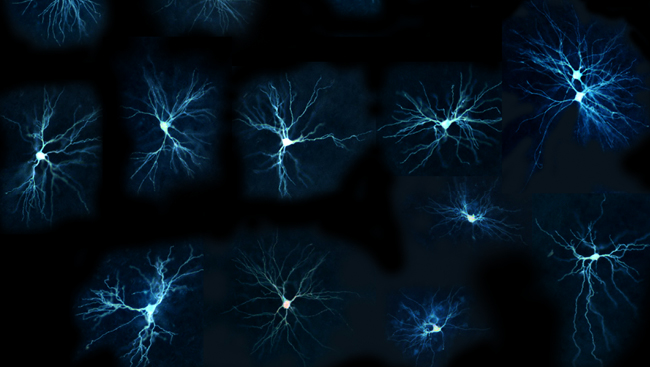 Article Scientific ResearchDespite dopamine being one of the most actively studied neurotransmitters in the brain, there is surprisingly little consensus on what specifically this molecule contributes to behavior in normal animals.Apr 3, 2018
 -
 Article Professional DevelopmentBeing a researcher is exciting and incredibly fulfilling. It can also be challenging, especially as funding, jobs in academia, and tenure are harder to secure. One of the ways to build a successful career despite these challenges is to be proactive and intentional about publishing. That’s because publishing research and disseminating the results of your hard work are just as important as doing the actual experiments. What you publish, how often you publish, and where you publish are essential considerations.Apr 1, 2018
 -
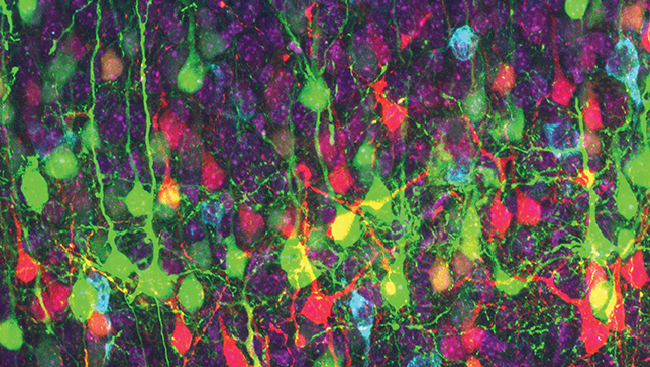 Article Scientific ResearchMaterial below summarizes the article, White Matter Structure in Older Adults Moderates the Benefit of Sleep Spindles on Motor Memory Consolidation, published online October 30, 2017 in The Journal of Neuroscience and authored by Bryce A. Mander, Alyssa H. Zhu, John R. Lindquist, Sylvia Villeneuve, Vikram Rao, Brandon Lu, Jared M. Saletin, Sonia Ancoli-Israel, William J. Jagust, and Matthew P. Walker. Best described by the classic adage “practice makes perfect,” procedural memory encapsulates the ability to acquire new skills through repeated training. This training alters how our brains and bodies process information and perform specific behaviors, so when we carry out the same actions in the future, it will be “like riding a bike.” Many studies show older adults are less able to learn new motor skills. Why this is so remains unclear, but recent findings suggest how well an older individual sleeps may matter. Established literature has demonstrated sleep critically supports the consolidation of motor skills and this sleep benefit appears to be absent in older adults. The loss of this sleep benefit parallels a decline in sleep quality, with sleep being less rich in the brain oscillations known to support motor memory. One such oscillation, called the sleep spindle, is generated in a specific nucleus in the thalamus that governs how sensory and motor information are relayed between the brain and the body. Through their expression, sleep spindles selectively modify connections within brain circuits, ultimately cementing learned skills into the brain to support adaptive behavior in the future.Mar 29, 2018




