



Filter
-
(133)
-
(733)
-
(4)
-
(1)
-
(47833)
-
(91)
-
(25)
-
(14)
-
(433)
-
(7)
-
(182)
-
(8)
-
(33)
-
(17)
-
(7)
-
(9)
-
(9)
-
(5)
-
(21)
-
(8)
-
(12)
-
(9)
-
(3)
-
(10)
-
(10)
-
(56)
-
(45)
-
(12)
-
(3)
-
(7)
-
(6)
-
(5)
-
(8)
-
(7)
-
(11)
-
(58)
-
(13)
-
(30)
-
(8)
-
(5)
-
(10)
-
(5)
-
(15)
-
(4)
1041 - 1050
of 52756 results
-
 Journal ArticleSavings refers to the gain in performance upon relearning. In sensorimotor adaptation, savings is tested by having participants adapt to perturbed feedback and, following a washout block during which the system resets to baseline, presenting the same perturbation again. While savings has been observed with these tasks, we have shown that the contribution from implicit adaptation, a process that uses errors to recalibrate the sensorimotor map, is attenuated upon relearning ( [Avraham et al., 2021][1]). Here, we test the hypothesis that this attenuation is due to interference arising from the different relationship between the movement and the feedback during washout. Removing the perturbation at the start of the washout block typically results in a salient error signal in the opposite direction to that observed during learning. We first replicated the finding that implicit adaptation is attenuated following a washout period that introduces salient opposite errors. When we eliminated feedback during washout,...Jun 1, 2025
 -
 Journal ArticleThe rodent brain contains 70,000,000+ neurons interconnected via complex axonal circuits with varying architectures. Neural pathologies are often associated with anatomical changes in these axonal projections and synaptic connections. Notably, axonal density variations of local and long-range projections increase or decrease as a function of the strengthening or weakening, respectively, of the information flow between brain regions. Traditionally, histological quantification of axonal inputs relied on assessing the fluorescence intensity in the brain region of interest. Despite yielding valuable insights, this conventional method is notably susceptible to background fluorescence, postacquisition adjustments, and inter-researcher variability. Additionally, it fails to account for nonuniform innervation across brain regions, thus overlooking critical data such as innervation percentages and axonal distribution patterns. In response to these challenges, we introduce AxoDen, an open-source semiautomated platfo...Jun 1, 2025
 -
 Journal Articleα-Synuclein is a synaptic protein that accumulates primarily in synucleinopathies and secondarily in certain lysosomal storage disorders. However, its physiological roles in health and disease are not fully understood. In part, this has been hampered by the inability to visualize α-synuclein and its cellular localization, due to the lack of specific antibodies and faithful reporters. Here, we used CRISPR/Cas9-based genome editing to generate human-induced pluripotent stem cell (iPSC) lines in which the α-synuclein ( SNCA ) gene has been tagged with the short HA peptide either at the N-terminus or C-terminus or with the fluorescent protein mCherry at the C-terminus of the protein. These diverse strategies revealed the C-terminus HA-tag as the best option. C-Terminus HA-tagged α-synuclein had unchanged protein expression and did not generate degradation by-products. Importantly, we show that following differentiation to neurons, the C-terminus HA-tagged iPSC line had unaffected electrophysiological propertie...Jun 1, 2025
 -
 Journal ArticleUnderstanding the ability to self-evaluate decisions is an active area of research. This research has primarily focused on the neural correlates of self-evaluation during visual tasks and whether neural correlates before or after the primary decision contribute to self-reported confidence. This focus has been useful, yet the reliance on subjective confidence reports may confound our understanding of key everyday features of metacognitive self-evaluation: that decisions must be rapidly evaluated without explicit feedback and unfold in a multisensory world. These considerations led us to hypothesize that an automatic domain-general metacognitive signal may be shared between sensory modalities, which we tested in the present study with multivariate decoding of electroencephalographic (EEG) data. Participants ( N = 21, 12 female) first performed a visual task with no request for self-evaluations of performance, prior to an auditory task that included rating decision confidence on each trial. A multivariate cl...Jun 1, 2025
 -
 Journal ArticleGlymphatic transport in rodents has primarily been studied using cisterna magna cannulation (CMC), a minimally invasive method for cerebrospinal fluid (CSF) tracers infusion. However, CMC is suboptimal due to the lack of bony structures to stabilize the cannula, leading to potential movement artifacts. Here, we present an alternative approach involving chronic cannulation of the lateral ventricles of mice for CSF tracer delivery. A direct comparison demonstrated that intraventricular cannulation (IVC) reproduces CMC results in vivo, including perivascular labeling of the middle cerebral artery, which was further confirmed by ex vivo analysis. IVC enables tracer infusion in awake mice, facilitating glymphatic transport studies in conjunction with behavioral assessments that were previously unattainable. Additionally, IVC supports repeated infusions in awake animals, offering the potential to reduce the number of experimental animals required. This study establishes IVC as a robust alternative for studying g...Jun 1, 2025
 -
 Journal ArticleThe genetic role and specific effects of primary familial cerebral calcification (PFBC) are still unclear. We aim to analyze bibliometric features in studies related to PFBC, investigate variant detection rates in patients with brain calcifications, and examine the phenotypic characteristics of PFBC patients. A comprehensive search of studies on the genetic effects of PFBC up until December 31, 2024, was conducted across Web of Science, PubMed, Embase, and Scopus. A random-effects meta-analysis combined variant detection rates for genes SLC20A2 , PDGFRB , PDGFB , XPR1 , MYORG , JAM2 , CMPK2 , and NAA60 . Data on total calcification scores (TCS), age of onset, and the prevalence of various phenotypes in PFBC patients were also aggregated. Publication bias was assessed using Egger's linear regression, and a leave-one-out sensitivity analysis was performed. Of 1,267 records, 224 were included in the bibliometric analysis. Keywords “primary familial brain calcification” and “ SLC20A2 ” were most prominent. Eig...Jun 1, 2025
 -
 Journal ArticleRegardless of discipline, quantitative literacy is a critical component of any scientist's skill set. A recent push from the NINDS has focused on enhancing and maintaining this expertise in trainees to enhance scientific fluency and to combat the reproducibility crisis. T32-funded programs often include off-campus retreats, providing opportunities to integrate a quantitative literacy component, or thematic focus. Here we will discuss the lessons and considerations learned from organizing a retreat focused on quantitative aspects of diagnostics for spinal cord injury. Survey results regarding retreat events and workshops reveal elements that were perceived to be successful by attendees. Events developed with active learning that focused on collaborative problem-solving and cross-discipline quantitative measures were well received by trainees. On the other hand, lectures and panel discussions were found to be less effective in boosting long-lasting improvements in quantitative literacy. Taken as a whole, the...Jun 1, 2025
 -
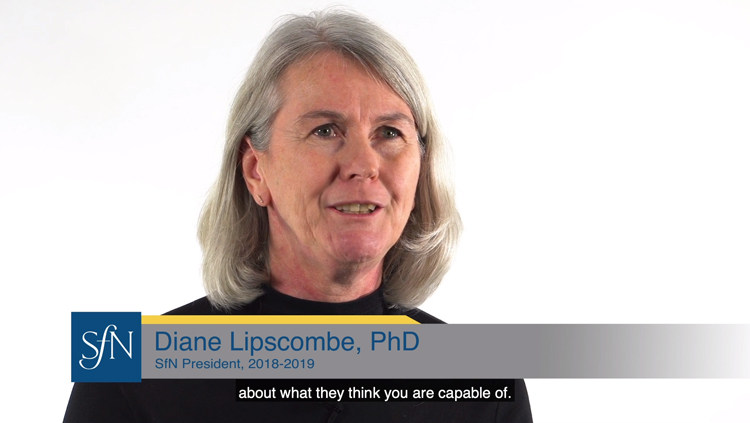 Video DiversityIn this video, SfN past presidents share their advice for rising female neuroscientists. SfN President Diane Lipscombe offers three guiding principles for women early in their careers: First, “Believe in yourself. Don't listen to other people's views about what they think you are capable of. You know what you're capable of.” Second, “Find those people who are going to support you. Search them out. Build a peer group of people around you, people who are going to listen to you, who are going to believe in you and who are going to help.” Third, “Work hard. There's huge satisfaction in working incredibly hard and then seeing the things that you've achieved as a scientist.” This video is one of three in the SfN Presidents on Gender Diversity in Neuroscience interview series, part of an ongoing effort to increase all forms of diversity in neuroscience. Watch the other videos in this series, on the importance of gender parity and building a scientific culture that supports women.Oct 4, 2019
 -
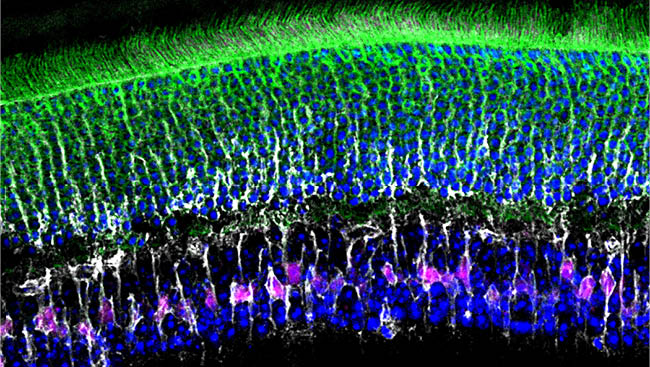 Article Scientific ResearchThe mammalian hippocampus is required for spatial memory. Teleosts have spatial memory, and it is stored in DL. What mechanisms do DL use to store such memories? Does the DL network store spatial memories in a manner consistent with theories derived from work on the mammalian hippocampus?Oct 4, 2019
 -
 Video DiversityWhat can neuroscientists do to promote greater representation of women in the field, across the career spectrum? In this video, SfN past presidents examine how individuals, institutions, and the scientific community at large can catalyze cultural change that allows all scientists to contribute fully. “As a society, we can come together and recognize that there are common issues that are preventing young women, in particular, from achieving their goals and following their passion. As a society, I think we have a great opportunity to look and see where those common features are that a single institution might not,” says SfN President Diane Lipscombe. This video is one of three in the SfN Presidents on Gender Diversity in Neuroscience interview series, part of an ongoing effort to increase all forms of diversity in neuroscience. Watch the other videos in this series, on the importance of gender parity and advice for the next generation of women.Oct 4, 2019




