



Filter
-
(133)
-
(733)
-
(4)
-
(1)
-
(47830)
-
(91)
-
(25)
-
(14)
-
(433)
-
(7)
-
(181)
-
(8)
-
(33)
-
(17)
-
(7)
-
(9)
-
(9)
-
(5)
-
(21)
-
(8)
-
(12)
-
(9)
-
(3)
-
(10)
-
(10)
-
(56)
-
(45)
-
(12)
-
(3)
-
(7)
-
(6)
-
(5)
-
(8)
-
(7)
-
(11)
-
(58)
-
(13)
-
(30)
-
(8)
-
(5)
-
(10)
-
(5)
-
(14)
-
(4)
951 - 960
of 52751 results
-
 Journal ArticleAccurate perception of the direction of gravity relies on the integration of multisensory information, particularly from the visual and vestibular systems, within the brain. Although a recent study of patients with cerebellar degeneration suggested a cerebellar role in visuo-vestibular interaction in the perception of gravitational direction, direct evidence remains limited. To address this gap, we conducted two experiments with 42 healthy participants to evaluate the impact of repetitive 1 Hz transcranial magnetic stimulation (rTMS) over the posterior cerebellar vermis on visual dependency, quantified by the subjective visual vertical bias induced by rotating optokinetic stimulation (OKS). Electric field simulations in high-resolution generic head models were used to ensure focal stimulation of the cerebellum at the group level. The results demonstrated that the rTMS applied to the vermis significantly attenuated the OKS-induced shift in visual vertical (SVV) bias. This effect was not observed when stimul...Jul 1, 2025
 -
 Journal ArticleThe development of Schwann cells, which myelinate axons in the peripheral nervous system, is critically dependent on MEK/ERK signaling. While Ets-domain transcription factors ( Etv1 , Etv4 , Etv5 ) are downstream effectors of this pathway, only Etv1 has been specifically linked to Schwann cell development. Here, we examined the functions of Etv5 , which is expressed in Schwann cell precursors, neural crest cells and satellite glia, at embryonic stages and at low levels in mature Schwann cells. In hypomorphic Etv5tm1Kmm homozygous mutant mice, no overt defects in Schwann cell differentiation were observed at embryonic stages. To study the function of Etv5 in juvenile (postnatal days 21–30) and mature adult (6 month) mice, we generated Etv5 conditional knock-outs (cKOs) using a Sox10-Cre driver. In juvenile male Etv5 -cKO mice, Schwann cell numbers increased normally after a peripheral nerve crush injury, a response that was attenuated by 6 months. Transmission electron microscopy of the naive sciatic nerve ...Jul 1, 2025
 -
 Journal ArticleThe prepositus hypoglossi nucleus (PHN), involved in horizontal gaze control, contributes to this function via cooperation with the vestibulocerebellum (VC). Furthermore, some PHN neurons have been observed to project to cerebellar regions outside the VC. We previously reported a neuronal population in the ventral caudal PHN that projects to lobules III–V of the anterior vermis or to the cerebellar hemispheric crus. Because the properties of these neurons have not been clarified, this study aimed to determine their localization, projections, and electrophysiological and morphological characteristics in male rats. Tracing experiments revealed that these neurons were clustered within the ventral caudal PHN, approximately between the bregma −12.72 and −12.00 mm, and did not project to the uvula/nodulus (UN), which is part of the VC. Whole-cell recordings and morphological experiments revealed that these PHN neurons exhibited high input capacitance, low input resistance, low-frequency firing, prominent voltage...Jul 1, 2025
 -
 Journal ArticleIt has long been hypothesized that the nervous system uses the direction of gravity to align the various sensory systems when interacting with the external world. In line with this hypothesis, systematic drift in hand-path orientation was recently observed during targeted arm motions performed with eyes closed in weightlessness or, on Earth, for longitudinal movements in a supine posture. No such drift was observed in upright posture on Earth. But the precise conditions under which participants exhibit such drift, and the factors that influence the magnitude of the drift, are not yet known. The objective of our study was to investigate if the upright posture, by virtue of being at a biomechanical singularity induced by the force of gravity, represents a unique condition in which drift in hand-path orientation is prevented. Human participants (male and female) performed sequences of repeated point-to-point arm movements between two visual targets aligned with the longitudinal body axis, first with eyes open...Jul 1, 2025
 -
 Journal ArticleAnimal behavior is crucial for understanding both normal brain function and dysfunction. To facilitate behavior analysis of mice within their home environments, we developed DeepEthoProfile, an open-source software powered by a deep convolutional neural network for efficient behavior classification. DeepEthoProfile requires no spatial cues for either training or processing and is designed to perform reliably under real laboratory conditions, tolerating variations in lighting and cage bedding. For data collection, we introduce EthoProfiler, a mobile cage rack system capable of simultaneously recording up to 10 singly housed mice. We used 36 h of manually annotated video data sampled in 5 min clips from a 48 h video database of 10 mice. This published dataset provides a reference that can facilitate further research. DeepEthoProfile achieved an overall classification accuracy of over 83%, comparable with human-level accuracy. The model also performed on par with other state-of-the-art solutions on another pu...Jul 1, 2025
 -
 Article Professional DevelopmentImagine you are the parent of two children. Your oldest, a boy, was diagnosed with autism last year and just celebrated his fourth birthday. Your youngest, a girl, is six months old. You’ve heard that autism runs in families; you know this means that your daughter is at higher risk than most children. But you’ve also heard that boys tend to get autism at a higher rate than girls. Your daughter, like her brother, is a poor sleeper, and sometimes you wonder whether she is more interested in looking at the ceiling fan than at you…but other times she smiles at you or her brother and seems very engaged. You find yourself making comparisons between your two children frequently, and wondering…will she have autism too? A friend tells you that just last year, researchers were able to scan the brains of babies when they were six to twelve months old and predict, for the first time, who would develop autism by age two. Your friend then poses the inevitable question: would you want this test for your daughter?Mar 25, 2020
 -
 Journal ArticleOur ability to shift from one emotion to the next allows us to adapt our behaviors to a constantly changing and often uncertain environment. Although previous studies have identified cortical and subcortical regions involved in affective responding, none have shown how these regions track and represent transitions between different emotional states nor how such responses are modulated based on the recent emotional context. To study this, we commissioned new musical pieces designed to systematically move participants (N = 39, 20 males and 19 females) through different emotional states during fMRI and to manipulate the emotional context in which different participants heard a musical motif. Using a combination of data-driven (Hidden Markov modeling) and hypothesis-driven methods, we confirmed that spatiotemporal patterns of activation along the temporal-parietal axis reflect transitions between music-evoked emotions. We found that the spatial and temporal signatures of these neural response patterns, as well...Jun 30, 2025
 -
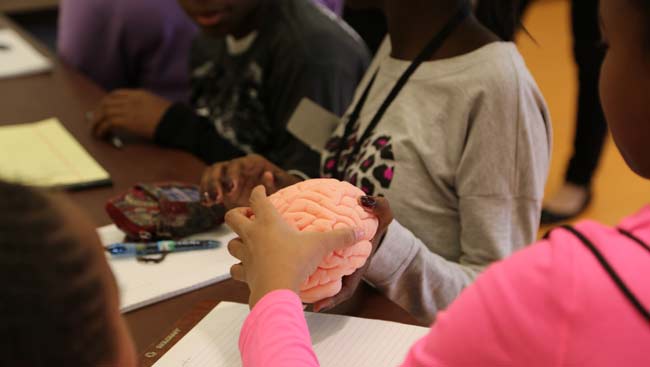 Article OutreachHaung (Ho) Yu is part of the Greater New York City Chapter of SfN (braiNY), which brings together like-minded neuroscience organizations to better neuroscience education and outreach. Over the years, braiNY have seen steady growth and increased reach. Here are three things the chapter does to impact their audiences.Mar 19, 2020
 -
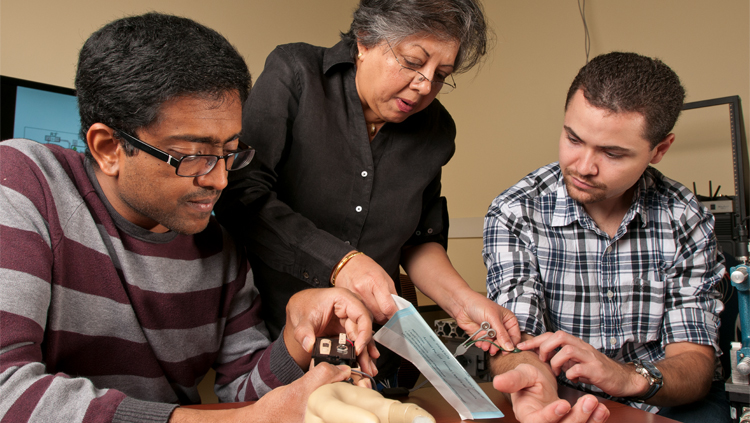 Article Career PathsThis resource was featured in the NeuroJobs Career Center. Visit today to search the world’s largest source of neuroscience opportunities. As director of the Adaptive Neural Systems Laboratory and the owner of more than a half dozen patents, Ranu Jung designs neural engineering projects that drive the process of transforming basic discoveries into clinical applications. In this interview she explains how collaborative projects can at once advance the understanding of the brain and the development of medical devices. She also talks about what sparks questions for her, the advantages of adaptability, and where to find support. This article is part of Neuronline's interview series "Entrepreneurial Women Combining Neuroscience, Engineering, and Tech," which highlights the career paths and scientific accomplishments of female leaders and role models who are creatively bridging disciplines to improve lives.Mar 16, 2020
 -
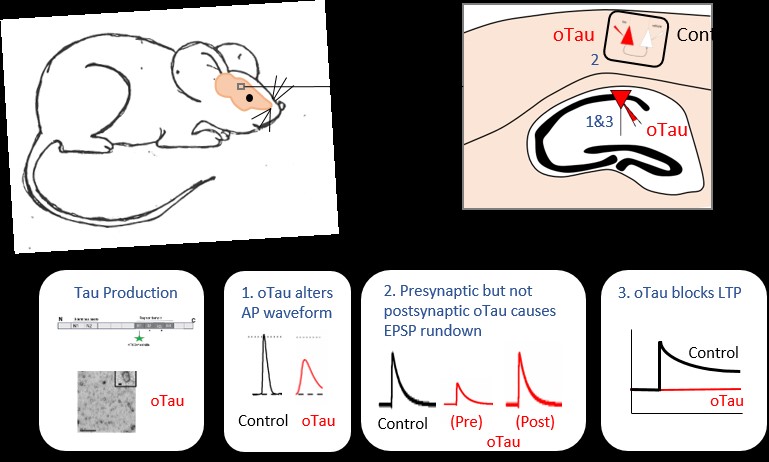 Article Scientific ResearchMaterial below summarizes the article Introduction of Tau Oligomers into Cortical Neurons Alters Action Potential Dynamics and Disrupts Synaptic Transmission and Plasticity, published on September 25, 2019, in eNeuro and authored by Emily Hill, Thomas K. Karikari, Kevin G. Moffat, Magnus J. E. Richardson, and Mark J. Wall. Highlights Introduction of nanomolar concentrations of tau oligomers into cortical neurons causes significant changes in action potential kinetics in a 40-minute timeframe. Introduction of tau oligomers into the presynaptic cell of synaptically connected pairs impairs basal synaptic transmission and enhances short-term depression. Introduction of tau oligomers into the postsynaptic cell of synaptically connected pairs has no effect on basal synaptic transmission but markedly impairs synaptic plasticity (long-term potentiation).Mar 12, 2020




