



Filter
-
(133)
-
(733)
-
(4)
-
(1)
-
(47833)
-
(91)
-
(25)
-
(14)
-
(433)
-
(7)
-
(182)
-
(8)
-
(33)
-
(17)
-
(7)
-
(9)
-
(9)
-
(5)
-
(21)
-
(8)
-
(12)
-
(9)
-
(3)
-
(10)
-
(10)
-
(56)
-
(45)
-
(12)
-
(3)
-
(7)
-
(6)
-
(5)
-
(8)
-
(7)
-
(11)
-
(58)
-
(13)
-
(30)
-
(8)
-
(5)
-
(10)
-
(5)
-
(15)
-
(4)
1341 - 1350
of 52756 results
-
 Journal ArticleDelayed motor development is an early clinical sign of fetal alcohol spectrum disorders. However, changes at the neural circuit level that underlie early motor differences are underexplored. The striatum, the principal input nucleus of the basal ganglia, plays an important role in motor learning in adult animals, and the maturation of the striatal circuit has been associated with the development of early motor behaviors. Here, we briefly exposed pregnant C57BL/6 dams to ethanol (5% w/w) in a liquid diet on embryonic days 13.5–16.5 and assessed the mouse progeny using a series of nine brief motor behavior tasks on postnatal days 2–14. Live brain slices were then obtained from behaviorally tested mice for whole-cell voltage- and current-clamp electrophysiology to assess GABAergic/glutamatergic synaptic activity and passive/active properties in two populations of striatal neurons: GABAergic interneurons and spiny striatal projection neurons. Electrophysiologically recorded spiny striatal projection neurons we...Mar 1, 2025
 -
 Journal ArticleThe annual Society for Neuroscience (SfN) meeting is a bonanza of scientific achievement: famous keynote speakers, beautiful scientific results, and award ceremonies. This focus is exciting and invigorating but glosses over the many failures, mistakes, and rejections that typically lead to scientific success. Our goal has been to create a space within the annual SfN meeting for open conversation about scientific failure and, by doing so, increase transparency, resilience, and mental well-being within our community. In this article, we share the materials that we have used at SfN during the past 4 years (2021–2024) to promote discussions of scientific failure, including formal storytelling, individual and interactive games, and confessionals. For each activity, we provide the rationale and practical guidance regarding logistics and usage. We hope this will aid scientists interested in adapting the activities for their own communities or local events. We end with a call for scientific institutions to commit ...Mar 1, 2025
 -
 Journal ArticleIn the article “Comprehensive Characterization of a Subfamily of Ca2+-Binding Proteins in Mouse and Human Retinal Neurons at Single-Cell Resolution” by Jun-Bin Liu, He-Lan Yuan, Gong Zhang, and Jiang-Bin Ke …Mar 1, 2025
 -
Journal ArticleNeurons adapt to chronic activity changes by modifying synaptic properties, including neurotransmitter release. However, whether neuropeptide release via dense core vesicles (DCVs)—a distinct regulated secretory pathway—undergoes similar adaptation remains unclear. Here, we demonstrate that 24 h action potential blockade leads to significant DCV accumulation in primary mouse cortical neurons of both sexes. Reactivation with action potential trains induced enhanced Ca2+ influx and 700% more DCV exocytosis compared with control neurons. Notably, total DCV cargo protein levels were unchanged, while mRNA levels of corresponding genes were reduced. Blocking neurotransmitter release with Tetanus toxin induced DCV accumulation, similar to that induced by network silencing with TTX. Hence, chronic network silencing triggers increased DCV accumulation due to reduced exocytosis during silencing. These accumulated DCVs can be released upon reactivation resulting in a massive potentiation of DCV exocytosis, possibly c...Mar 1, 2025
-
 Journal ArticleNeuroligins (NLGNs) are a family of postsynaptic adhesion molecules that bind to their presynaptic partners, neurexins, facilitating the formation and maintenance of synapses. In humans, there are five genes encoding NLGNs ( NLGN1-3 , NLGN4X , and NLGN4Y ), with NLGN1-3 having highly conserved counterparts in rodents, allowing these genes to be studied with high confidence of translational validity in mouse models. Human NLGN4X and 4Y were often assumed to serve similar functions because they share a 97% sequence homology, whereas mouse NLGN4-like is quite divergent. Many NLGN-mediated synaptic effects are modulated through post-translation modifications, which exert temporal and spatial control. In this report, we characterize a conserved phosphorylation site, serine 712, on NLGN4X and 4Y. Despite serine 712 being located in a highly conserved region between NLGN4X and 4Y, we observed kinase specificity. PKA exclusively phosphorylates NLGN4X S712, whereas Cdk5 phosphorylates S712 on both NLGN4X and 4Y. NL...Mar 1, 2025
 -
 Journal ArticleCentral sensitization plays a critical role in bladder pain syndrome/interstitial cystitis (BPS/IC). Electroacupuncture (EA) nerve stimulation therapy has been broadly acknowledged as an effective means of alleviating chronic pathological pain. However, it remains to be explored whether EA is effective in mitigating pain-sensitive symptoms of BPS/IC and the mechanisms involved. This study aims to investigate the analgesic effect and mechanism of EA therapy. We employed several techniques: mechanical pain threshold tests to assess pain sensitivity, urodynamic studies to evaluate bladder function, western blotting for protein analysis, immunofluorescence for visualizing, and transcriptomics. A rat cystitis model was established through a systemic intraperitoneal injection with cyclophosphamide (CYP). EA therapy was executed by stimulating the deep part of the hypochondriac point. EA treatment was observed to effectively reduce mechanical allodynia, enhance urinary function, suppress the activation of microgl...Mar 1, 2025
 -
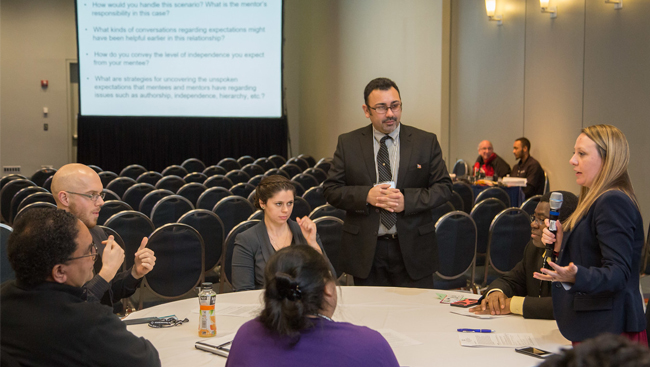 Annual Meeting Video Professional DevelopmentThis Neuroscience 2017 event, based on the Entering Mentoring series, is designed for mentors of diverse trainees. Through an evidence-based approach, you will learn effective strategies to gain an understanding of best practices in mentoring. This event is led by master facilitators from the NIH National Research Mentoring Network (NRMN), whose mission is to provide all trainees across the biomedical sciences with evidence-based mentorship and professional development programming.May 8, 2018
 -
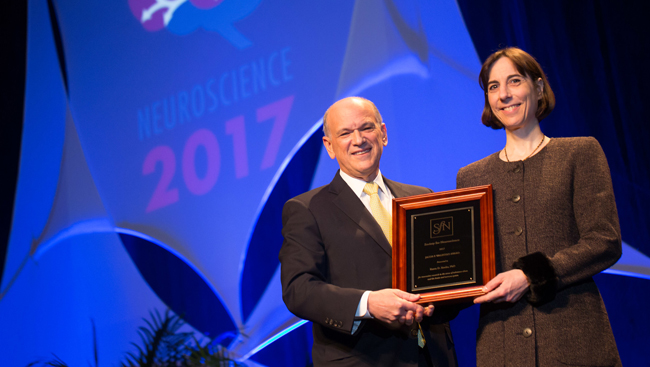 Annual Meeting Article Scientific ResearchKaren Ersche’s work focuses on the neurochemical processes underlying addictive behavior and how to translate these findings into therapies. Her findings have contributed to new behavioral and pharmacological approaches. For this work, she was awarded the Jacob P. Waletzky Award in 2017. What led you to study drug addiction, particularly cocaine addiction? My enthusiasm for drug addiction research is rooted in the potential it has to make a difference in people’s lives. Scientific advances have fundamentally changed the understanding of addiction from a deficit of character to a brain disorder, and I strongly believe it will also provide the pathway for developing more effective treatments. My research aims to tackle the problems surrounding cocaine addiction, which is a fairly common disorder in the United Kingdom with few effective treatments.May 7, 2018
 -
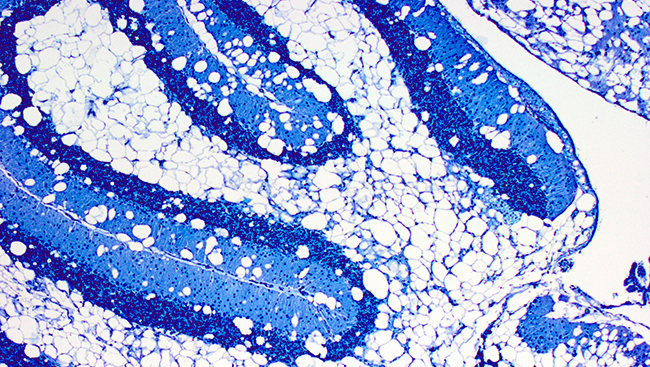 Video Scientific ResearchThis is a playlist of 19 videos from the 2016 FENS-Hertie Winter School. Since the groundbreaking description of patient H.M. in the 1950's, our understanding of human memory and the mechanisms underlying memory functions has increased dramatically in the last decades. Through extensive interactions with leaders in the field, the 2016 FENS-Hertie Winter School provided a comprehensive overview of both the basic and the latest knowledge about memory functions and their underlying mechanisms in humans.May 4, 2018
 -
 Annual Meeting Article Professional DevelopmentEmery Brown, professor of anesthesia at Harvard Medical School, discusses his career trajectory as a physician-scientist and his work-life balance. He delivered this talk during SfN’s Meet-the-Expert Series at Neuroscience 2017. The text below has been condensed and lightly edited and offer highlights from his talk. Listen to the audio recording above for the full remarks. Transitioning From Romance Languages to Circadian Rhythms I started out as an undergraduate at Harvard, majoring in romance languages. I knew I was going to go to medical school. I figured I would work for the World Health Organization, traveling around the world and stamping out diseases. However, in my sophomore year, my roommates concentrated in economics, and they talked like they understood the world. I then switched into economics, and in my junior year, I switched my major to applied mathematics. I also did an undergraduate thesis, and I wrote about studying outcomes from high-risk surgery. It was funded by the anesthesiology department at Massachusetts General Hospital. I didn't solve an earth-shattering problem, but it taught me how to formulate a problem, research it, and write it up.May 2, 2018




