



Filter
-
(133)
-
(733)
-
(4)
-
(1)
-
(47833)
-
(91)
-
(25)
-
(14)
-
(433)
-
(7)
-
(182)
-
(8)
-
(33)
-
(17)
-
(7)
-
(9)
-
(9)
-
(5)
-
(21)
-
(8)
-
(12)
-
(9)
-
(3)
-
(10)
-
(10)
-
(56)
-
(45)
-
(12)
-
(3)
-
(7)
-
(6)
-
(5)
-
(8)
-
(7)
-
(11)
-
(58)
-
(13)
-
(30)
-
(8)
-
(5)
-
(10)
-
(5)
-
(15)
-
(4)
1271 - 1280
of 52756 results
-
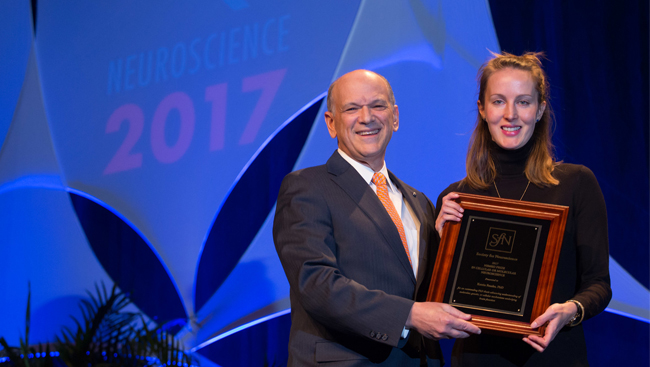 Article Annual Meeting Scientific ResearchKatrin Franke’s research seeks to understand how the retinal network disassembles complex visual input. Previous research on this topic conducted by the field often focused on individual types of retinal cells, but Franke sought to record complete populations of neurons to capture the full functional diversity of parallel retinal channels. Through her approach, her findings have increased the understanding of how the mammalian retina processes visual information. For her outstanding work, she was awarded the Nemko Prize in Cellular or Molecular Neuroscience in 2017. What led to your interest in visual processing? Information processing in the visual system first attracted my interest as a master’s student at Tübingen University in a lecture series about the retina as a model system in neuroscience. I found it extremely fascinating that retinal cells perform computations to “decide” what’s important enough to be sent to the brain, determining what we see. I decided to do a PhD in this field because I wanted to better understand how the retina decomposes the incoming visual stream into its relevant components that can then be interpreted by the brain. In the last few years, I developed a strong interest in visual ecology, which aims to understand how different animal species use their visual systems to meet their ecological needs. I think investigating visual processing and comparing findings from different species is exciting and essential to discover universal and general principles of vision.Jul 31, 2018
 -
 Journal ArticleDelayed motor development is an early clinical sign of Fetal Alcohol Spectrum Disorders (FASD). However, changes at the neural circuit level that underlie early motor differences are underexplored. The striatum, the principal input nucleus of the basal ganglia, plays an important role in motor learning in adult animals, and the maturation of the striatal circuit has been associated with the development of early motor behaviors. Here, we briefly exposed pregnant C57BL/6 dams to ethanol (5% w/w) in a liquid diet on embryonic days (E)13.5-16.5, and assessed the mouse progeny using a series of 9 brief motor behavior tasks on postnatal days (P)2-14. Live brain slices were then obtained from behaviorally-tested mice for whole cell-voltage and current clamp electrophysiology to assess GABAergic/glutamatergic synaptic activity, and passive/active properties in two populations of striatal neurons: GABAergic interneurons and spiny striatal projection neurons. Electrophysiologically-recorded spiny striatal projection...Mar 14, 2025
 -
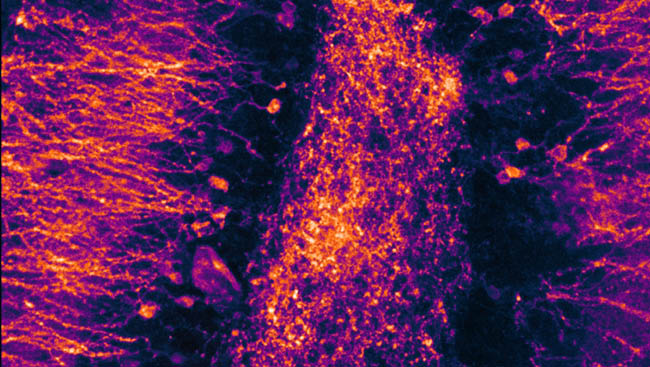 Article Scientific ResearchMaterial below summarizes the article, Neural Entrainment to the Beat: the “Missing Pulse” Phenomenon, published on May 30, 2017, in JNeurosci and authored by Idan Tal, Edward W. Large, Eshed Rabinovitch, Yi Wei, Charles E. Schroeder, David Poeppel, and Elana Zion Golumbic.Jul 24, 2018
 -
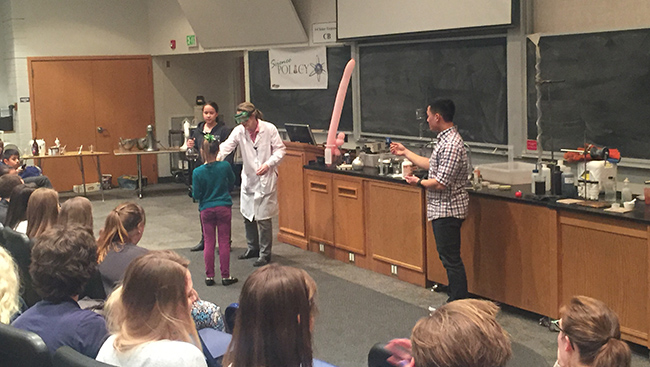 Article AdvocacyBefore becoming an SfN Early Career Policy Ambassador (ECPA), I had no experience with science policy advocacy. This is probably why I was surprised when in 2016, while attending SfN’s Capitol Hill Day, I discovered how difficult it would be to persuade my Utah representatives to support pro-science policies.Jul 18, 2018
 -
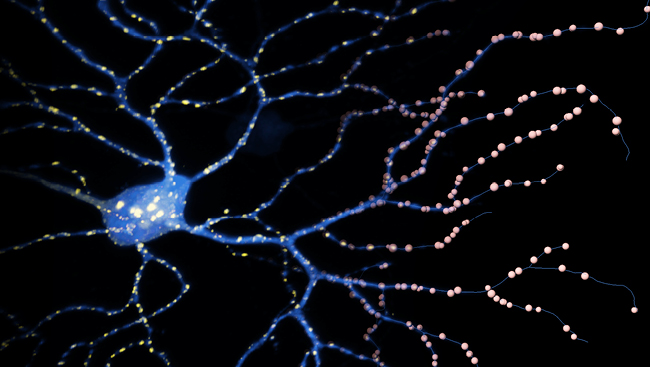 Article Annual Meeting Scientific ResearchMaterial below is adapted from the SfN Short Course, The Glymphatic System by Nadia Aalling, MSc, Anne Sofie Finmann Munk, BSc, Iben Lundgaard, PhD, and Maiken Nedergaard, MD, DMSc. Short Courses are day-long scientific trainings on emerging neuroscience topics and research techniques held just prior to SfN’s annual meeting. The glymphatic system is a network of vessels that clear waste from the central nervous system (CNS), mostly during sleep. Recent evidence suggests that the glymphatic system may be disrupted in and contribute to some diseases of the brain. Cerebrospinal fluid (CSF) flows alongside the arteries and is forced into the spaces next to the smaller blood vessels that enter the brain. There, it interchanges with interstitial fluid — the fluid surrounding the brain’s cells — often through a channel expressed by astrocytes, glial cells whose feet surround the space around the brain’s capillaries, forming the glymphatic vasculature. Glymphatic transport uses energy from arteries pulsing and from the pressure created as CSF is made, as well as from as yet unknown forces. This interchange results in the collection of waste products, such as metabolites and proteins, and their transfer to CSF, which carries them out of the brain to sites where CSF drains.Jul 17, 2018
 -
 Video Scientific ResearchThis Neurobiology of Disease Workshop, held at Neuroscience 2017, embraces the breadth of "gene therapy," including viral vectors, oligonucleotides, and cell therapies used in promising preclinical studies and clinical trials for a variety of neurological disorders long thought to be incurable. These new methods involve DNA engineering, gene replacement using virus vectors and the patient's own genetically modified cells, oligonucleotides that can "revive" beneficial gene functions or suppress toxic ones, and viruses and cells armed to tackle brain tumors.Jul 12, 2018
 -
 Webinar Scientific ResearchAdvances in gene therapy have propelled the field into the clinical realm, and new medical treatment options are beginning to offer help in neurological diseases long thought to be incurable.Jul 12, 2018
 -
 Video Annual Meeting Professional DevelopmentUnderstanding current NIH policy and priorities is advantageous to grant applicants. Much has changed at NIH, including an emphasis on rigor and transparency influencing scores in review, new policies on clinical trial, evolving scientific priorities at NIH institutes; and new funding opportunities. Hear from senior representatives at the Center for Scientific Review, National Institute of Neurological Disorders and Stroke, National Institute on Aging, National Institute on Drug Abuse, and National Institute of Mental Health about the implications of these changes for neuroscience grant applications.Jul 11, 2018
 -
 Article Professional DevelopmentAccording to Donna Korol, an associate professor at Syracuse University, there isn’t a standard practice for finding and securing a postdoc. But there are considerations to keep in mind to help you decide what type of postdoc is right for you and how to be a competitive candidate. To help you navigate this process, Korol answered commonly asked questions. Click on each question to reveal her perspectives. Do you have additional questions or insights? Leave them in the comments.Jul 10, 2018
 -
Journal ArticleZebrafish have gained prominence as a model organism in neuroscience over the past several decades, generating key insight into the development and functioning of the vertebrate brain. However, techniques for whole brain mapping in adult stage zebrafish are lacking. Here, we describe a pipeline built using open-source tools for whole-brain activity mapping in adult zebrafish. Our pipeline combines advances in histology, microscopy, and machine learning to capture cfos activity across the entirety of the brain. Following tissue clearing, whole brain images are captured using light-sheet microscopy and registered to the recently created adult zebrafish brain atlas (AZBA) for automated segmentation. By way of example, we used our pipeline to measure brain activity after zebrafish were subject to the novel tank test, one of the most widely used behaviors in adult zebrafish. Cfos levels peaked 15 minutes following behavior and several regions, including those containing serotoninergic and dopaminergic neurons, ...Mar 11, 2025




