



Filter
-
(133)
-
(733)
-
(4)
-
(1)
-
(47833)
-
(91)
-
(25)
-
(14)
-
(433)
-
(7)
-
(181)
-
(8)
-
(33)
-
(17)
-
(7)
-
(9)
-
(9)
-
(5)
-
(21)
-
(8)
-
(12)
-
(9)
-
(3)
-
(10)
-
(10)
-
(56)
-
(45)
-
(12)
-
(3)
-
(7)
-
(6)
-
(5)
-
(8)
-
(7)
-
(11)
-
(58)
-
(13)
-
(30)
-
(8)
-
(5)
-
(10)
-
(5)
-
(14)
-
(4)
1161 - 1170
of 52754 results
-
 Journal ArticleChildhood epilepsy is a common and devastating condition, for which many children still do not have adequate treatment. Some children with drug-resistant epilepsy require surgical excision of epileptogenic brain tissue for seizure control, affording the opportunity to study this tissue ex vivo to interrogate human epileptic neurons for potentially hyperexcitable perturbations in intrinsic electrophysiological properties. In this study, we characterized the diversity of layer L2/3 (L2/3) pyramidal neurons (PNs) in ex vivo brain slices from pediatric patients with epilepsy. We found a remarkable diversity in the firing properties of epileptic L2/3 PNs: five distinct sub-populations were identified. Additionally, we investigated whether the etiology of epilepsy influenced the intrinsic neuronal properties of L2/3 PNs when comparing tissue from patients with epilepsy due to malformations of cortical development (MCDs), other forms of epilepsy (OEs), or with deep-seated tumors. When comparing epileptic with con...Apr 17, 2025
 -
Journal ArticleThe primary motor cortex (M1) is strongly engaged by movement planning and execution. However, the role of M1 activity in voluntary grasping is still not completely understood. Here we analyze recordings of M1 neurons during the execution of a delayed reach-to-grasp task, where monkeys had to actively grasp an object with either a side or a precision grip, and then pull it with a low or high amount of force. Single cell and neural populations analyses showed that grip type was robustly and specifically encoded by a large population of neurons, while force level was weakly and transiently encoded within mixed-selective neurons that also encoded grip type. Notably, the grip type was stably decoded from motor cortical populations during the preparation and execution epochs of the task. Our results are consistent with the idea that planning and performing specific grasping movements are high-level skills that strongly engage M1 neurons, while the execution of pulling force might be prominently encoded at lower...Apr 17, 2025
-
Journal ArticleThe re-emergence of task-related activation patterns during awake rest has been reported to play a role in memory consolidation and perceptual learning. This study aimed to test whether such reactivation occurs in the primary sensorimotor cortex following a visuomotor task. During functional magnetic resonance imaging (fMRI) scanning, 42 healthy participants (13 women and 29 men) learned visuomotor tracking, while a rotational perturbation was introduced between the cursor position and joystick angle. This visuomotor task block was interleaved with a control block, during which participants passively viewed a replay of their previously performed cursor movements. Half of the participants used their right hand, whereas the other half used their left hand to control the joystick. Resting-state scans were acquired before and after the visuomotor task sessions. A multivariate pattern classifier was trained to classify task and control blocks and was then tested on resting-state scans collected before and after...Apr 17, 2025
-
Journal ArticleThe explore/exploit tradeoff is a fundamental property of choice selection during reward-guided decision making, where the “same” choice can reflect either of these internal cognitive states. An unanswered question is whether the execution of a decision provides an underexplored measure of internal cognitive states. Touchscreens are increasingly used across species for cognitive testing, and afford the ability to measure the precise location of choice touch responses. We examined how male and female mice in a restless bandit decision making task interacted with a touchscreen to determine if the explore/exploit tradeoff, prior reward, and/or sex differences change the variability in the kinetics of touchscreen choices. During exploit states, successive touch responses are closer together than those made in an explore state, suggesting exploit states reflect periods of increased motor stereotypy. Although exploit decisions might be expected to be rewarded more frequently than explore decisions, we find that ...Apr 17, 2025
-
 Article Professional DevelopmentThere are five major components of an NIH training grant, which are almost equally weighted in the review process — that includes the sponsor statement. It’s important to know that the sponsor statement has to be as strong as the rest of the application. Even an outstanding training grant applicant can get hung up because of a moderate concern with this section. Write an effective sponsor statement by addressing the following areas. 1. Follow Instructions It’s never a good idea to make reviewers work to find information they need to complete their critiques. Fortunately, online instructions from NIH for this section clearly state the information and format you must provide.Feb 5, 2019
 -
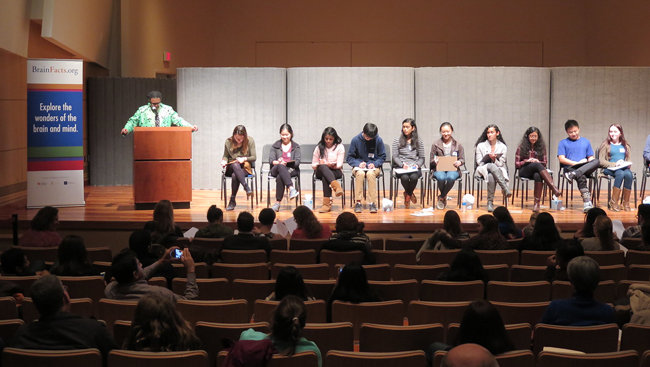 Article OutreachBrain bees are grassroots, Q&A competitions for secondary school students to encourage them to learn more about the brain and pursue careers in biomedical research. Leading a brain bee is an impactful way for neuroscientists to get involved in outreach and work with schools and students to expand their interest in neuroscience. The International Brain Bee organization oversees all national brain bees. Each national brain bee then oversees the local bees in their area. Anyone is eligible to sponsor a competition. Register your competition so your winner is eligible for national and international brain bees. After registering, follow these recommended steps to ensure your bee is successful. Remember, each local bee can have a unique setup and methods, so these are merely suggestions. Work with your national coordinator to determine if there are any specific requirements for bees in your area.Jan 31, 2019
 -
 Video Annual Meeting AdvocacyAdvocacy comprises more than in-person conversations with lawmakers. It requires connecting with a variety of audiences and tailoring your messages to what they care about most. In this recording of the Public Advocacy Forum at Neuroscience 2018, advocates from across the field share how they build their present advocacy activities on past ones, find ways to advocate throughout the day, and communicate how their research improves lives. You’ll learn how different audiences think about science, as well as how to tap into preexisting support for research among nonscientists and use key advocacy tools to demonstrate the impact of science funding over time — the story scientists are best suited to tell.Jan 30, 2019
 -
 Podcast Scientific Research“Our ultimate goal is to understand how the brain controls behavior," says Anne Churchland, an associate professor at Cold Spring Harbor Laboratory. “We want to measure neural activity from as many neurons as possible,” she says, and “know as much about those neurons as we can.” In this Meet-the-Expert, she reflects on her career path, beginning as an undergrad through where she is today. She also shares some of the approaches and techniques her lab uses to illuminate the neural circuits underlying decision-making, such as two-photon and widefield imaging, and modeling to interpret neural data and make discoveries. Her lab examines behavior in humans and rodents and measures neural activity in rodents. She also explains how the work of her lab is made more powerful through the International Brain Laboratory, a team she helped launch comprising 21 experimental and theoretical neuroscientists working in London, New York, and Lisbon.Jan 29, 2019
 -
 Article Scientific ResearchMaterial below summarizes the article, Refractoriness Accounts for Variable Spike Burst Responses in Somatosensory Cortex, published on August 14, 2017, in eNeuro and authored by Bartosz Teleńczuk, Richard Kempter, Gabriel Curio, and Alain Destexhe. In the cortical area responsible for the processing of touch, the primary somatosensory cortex (S1) neurons can respond to touch stimuli with a very high precision. This is measured by repeating the same stimulus many times and recording neurons in S1 using a micro-electrode. This was shown in macaque monkeys. Electrically stimulating the median nerve (which relays the touch information from the hand) at the wrist leads to the firing of high-frequency bursts of action potentials in the primary somatosensory cortex. Remarkably, this pattern of firing is repeatable with sub-millisecond precision.Jan 24, 2019
 -
 Article Professional DevelopmentDuring Fall 2011, I moved from Puerto Rico, where I was born and raised, to New York City, for grad school. It was the first time I lived so far from my family and the world I knew. My undergraduate experience at the University of Puerto Rico was relatively homogenous. However, that quickly changed when I started graduate school, as I was often the only underrepresented minority in the room. All of these changes hit at once, and I struggled to manage the stress of graduate school and the feeling of being an imposter. As I look back on that time, here’s what helped me connect with my peers and find success academically. 1. Focus on what unites you with your peers, not what separates you.Jan 23, 2019




