



Filter
-
(133)
-
(733)
-
(4)
-
(1)
-
(47833)
-
(91)
-
(25)
-
(14)
-
(433)
-
(7)
-
(182)
-
(8)
-
(33)
-
(17)
-
(7)
-
(9)
-
(9)
-
(5)
-
(21)
-
(8)
-
(12)
-
(9)
-
(3)
-
(10)
-
(10)
-
(56)
-
(45)
-
(12)
-
(3)
-
(7)
-
(6)
-
(5)
-
(8)
-
(7)
-
(11)
-
(58)
-
(13)
-
(30)
-
(8)
-
(5)
-
(10)
-
(5)
-
(15)
-
(4)
931 - 940
of 52756 results
-
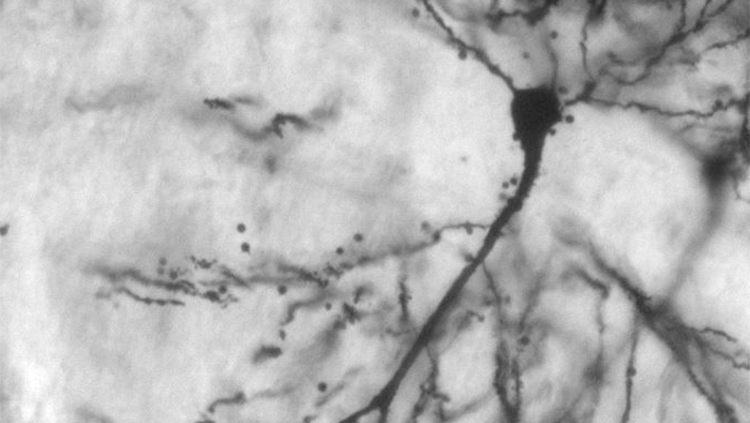 Article Career PathsVivian Mushahwar designs rehabilitation interventions for people with spinal cord injuries. Director of a state-of-the-art center for researchers from engineering, medicine, rehabilitation, computer science, and neuroscience, she's working to alleviate the effects of spinal cord injury through innovation and entrepreneurship. In this interview she walks through her career path in detail, shares how mentors have guided her, and offers advice for trainees on discovering your passion, choosing a faculty position, and navigating challenges as a woman in science. This article is part of Neuronline's interview series "Entrepreneurial Women Combining Neuroscience, Engineering, and Tech," which highlights the career paths and scientific accomplishments of female leaders and role models who are creatively bridging disciplines to improve lives.Mar 30, 2020
 -
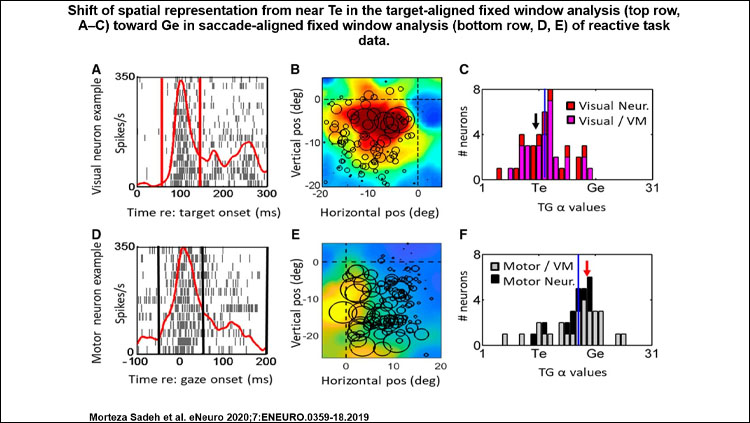 Article Scientific ResearchMaterial below summarizes the article Timing Determines Tuning: A Rapid Spatial Transformation in Superior Colliculus Neurons during Reactive Gaze Shifts, published on December 2, 2019, in eNeuro and authored by Morteza Sadeh, Amirsaman Sajad, Hongying Wang, Xiaogang Yan, and John Douglas Crawford. Highlights During gaze shifts of the eyes and head, the superior colliculus rapidly transforms a visual signal related to target direction into a motor command for gaze direction. This visuomotor transition involves a relay of signals between cells with visual, visuomotor, and motor responses, each contributing to the overall transformation. The difference between the visual input and motor output seems to arise from internal noise, correlating to behavioral errors that may reflect the health of the system.Mar 26, 2020
 -
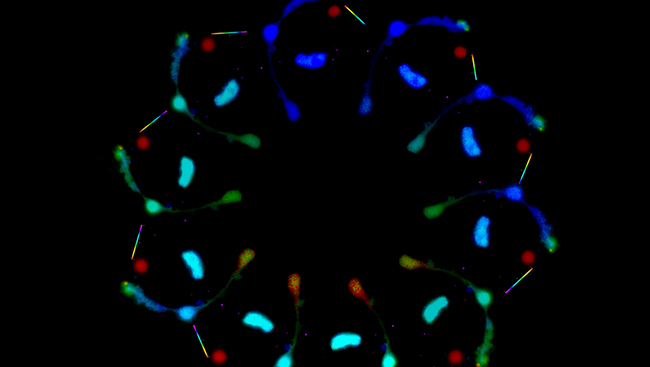 Article Professional DevelopmentImagine you are the parent of two children. Your oldest, a boy, was diagnosed with autism last year and just celebrated his fourth birthday. Your youngest, a girl, is six months old. You’ve heard that autism runs in families; you know this means that your daughter is at higher risk than most children. But you’ve also heard that boys tend to get autism at a higher rate than girls. Your daughter, like her brother, is a poor sleeper, and sometimes you wonder whether she is more interested in looking at the ceiling fan than at you…but other times she smiles at you or her brother and seems very engaged. You find yourself making comparisons between your two children frequently, and wondering…will she have autism too? A friend tells you that just last year, researchers were able to scan the brains of babies when they were six to twelve months old and predict, for the first time, who would develop autism by age two. Your friend then poses the inevitable question: would you want this test for your daughter?Mar 25, 2020
 -
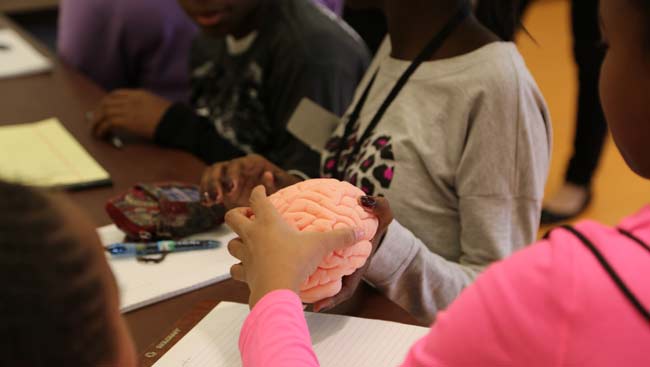 Article OutreachHaung (Ho) Yu is part of the Greater New York City Chapter of SfN (braiNY), which brings together like-minded neuroscience organizations to better neuroscience education and outreach. Over the years, braiNY have seen steady growth and increased reach. Here are three things the chapter does to impact their audiences.Mar 19, 2020
 -
 Journal ArticleAdvances in in vivo Ca2+ imaging using miniature microscopes have enabled researchers to study single-neuron activity in freely-moving animals. Tools such as MiniAN and CalmAn have been developed to convert Ca 2+ v isual signals to n umerical data, collectively referred to as CalV2N. However, substantial challenges remain in analyzing the large datasets generated by CalV2N, particularly in integrating data streams, evaluating CalV2N output quality, and reliably and efficiently identifying Ca2+ transients. In this study, we introduce CalTrig, an open-source graphical user interface (GUI) tool designed to address these challenges at the post-CalV2N stage of data processing collected from C57BL/6J mice. CalTrig integrates multiple data streams, including Ca2+ imaging, neuronal footprints, Ca2+ traces, and behavioral tracking, and offers capabilities for evaluating the quality of CalV2N outputs. It enables synchronized visualization and efficient Ca2+ transient identification. We evaluated four machine learnin...Jul 2, 2025
 -
Journal ArticleDespite the vivid experience of homogeneous vision, our visual system is inherently endowed with highly inhomogeneous structures. Although the temporal characteristics of visual responses vary with eccentricity, the connection between this variation, the speed of visual processing, and its underlying neurophysiological mechanisms remains a topic of debate. Here, we performed simultaneous recordings of high-precision gaze positions and EEG activity to investigate how foveal and perifoveal stimulation impact reaction times (RTs) and visual evoked potentials (VEPs). Volunteers discriminated the position and orientation of a U-shaped figure with the aperture facing either upward or downward. Stimuli were presented briefly (50 ms) either in the foveola (0.33◦) or perifovea (6.5◦), to the right or left of the fixation point. Stimulus size in the perifovea condition was adjusted according to the cortical magnification factor (stimulus size: 0.2◦ and 0.75◦ for the foveola and perifovea condition, respectively). Wh...Jul 2, 2025
-
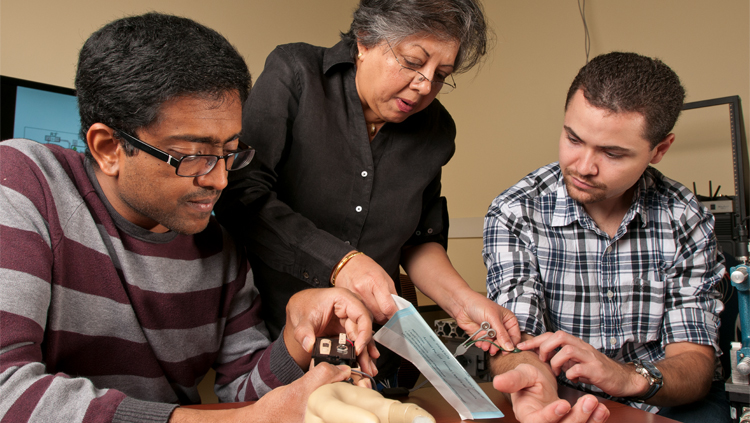 Article Career PathsThis resource was featured in the NeuroJobs Career Center. Visit today to search the world’s largest source of neuroscience opportunities. As director of the Adaptive Neural Systems Laboratory and the owner of more than a half dozen patents, Ranu Jung designs neural engineering projects that drive the process of transforming basic discoveries into clinical applications. In this interview she explains how collaborative projects can at once advance the understanding of the brain and the development of medical devices. She also talks about what sparks questions for her, the advantages of adaptability, and where to find support. This article is part of Neuronline's interview series "Entrepreneurial Women Combining Neuroscience, Engineering, and Tech," which highlights the career paths and scientific accomplishments of female leaders and role models who are creatively bridging disciplines to improve lives.Mar 16, 2020
 -
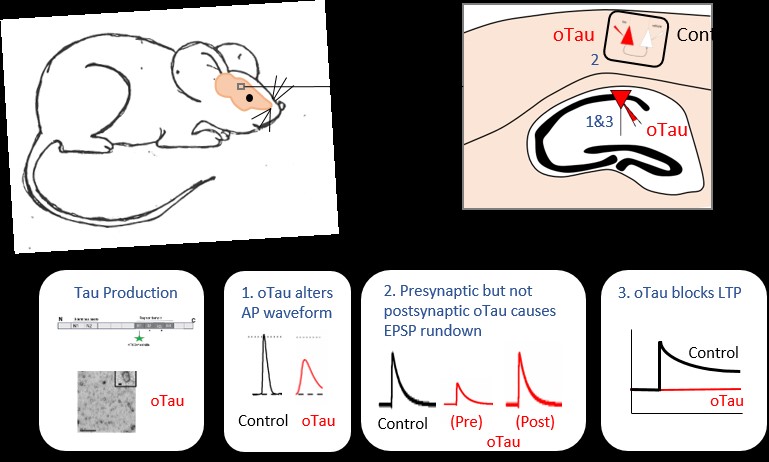 Article Scientific ResearchMaterial below summarizes the article Introduction of Tau Oligomers into Cortical Neurons Alters Action Potential Dynamics and Disrupts Synaptic Transmission and Plasticity, published on September 25, 2019, in eNeuro and authored by Emily Hill, Thomas K. Karikari, Kevin G. Moffat, Magnus J. E. Richardson, and Mark J. Wall. Highlights Introduction of nanomolar concentrations of tau oligomers into cortical neurons causes significant changes in action potential kinetics in a 40-minute timeframe. Introduction of tau oligomers into the presynaptic cell of synaptically connected pairs impairs basal synaptic transmission and enhances short-term depression. Introduction of tau oligomers into the postsynaptic cell of synaptically connected pairs has no effect on basal synaptic transmission but markedly impairs synaptic plasticity (long-term potentiation).Mar 12, 2020
 -
 Journal ArticleAdvances in in vivo Ca2+ imaging using miniature microscopes have enabled researchers to study single-neuron activity in freely moving animals. Tools such as Minian and CalmAn have been developed to convert Ca2+ visual signals to numerical data, collectively referred to as CalV2N. However, substantial challenges remain in analyzing the large datasets generated by CalV2N, particularly in integrating data streams, evaluating CalV2N output quality, and reliably and efficiently identifying Ca2+ transients. In this study, we introduce CalTrig, an open-source graphical user interface (GUI) tool designed to address these challenges at the post-CalV2N stage of data processing collected from C57BL/6J mice. CalTrig integrates multiple data streams, including Ca2+ imaging, neuronal footprints, Ca2+ traces, and behavioral tracking, and offers capabilities for evaluating the quality of CalV2N outputs. It enables synchronized visualization and efficient Ca2+ transient identification. We evaluated four machine learning m...Jul 1, 2025
 -
Journal ArticleHippocampal synaptic activity is tightly regulated to ensure appropriate synaptic function and plasticity, which are important for critical cognitive processes such as learning and memory. Altered hippocampal synaptic function can lead to cognitive and behavioral deficits observed in neurodegenerative diseases such as Alzheimer's disease (AD), necessitating a deeper fundamental understanding of hippocampal synaptic control mechanisms. Glycerophosphodiester phosphodiesterase 2 (GDE2 or GDPD5) is a surface transmembrane enzyme that cleaves the glycosylphosphatidylinositol anchor that tethers some proteins to the membrane. Mice lacking GDE2 ( Gde2 KO) display behavioral deficits in learning and memory that are hippocampal-dependent. However, roles of GDE2 in mouse hippocampal function are not known. Here, we show that GDE2 is expressed in pre- and postsynaptic compartments along apical dendrites in hippocampal CA1 cells. Gde2 KO CA1 cells showed increased dendritic length and complexity and increased numbers ...Jul 1, 2025




