



Filter
-
(133)
-
(733)
-
(4)
-
(1)
-
(47833)
-
(91)
-
(25)
-
(14)
-
(433)
-
(7)
-
(182)
-
(8)
-
(33)
-
(17)
-
(7)
-
(9)
-
(9)
-
(5)
-
(21)
-
(8)
-
(12)
-
(9)
-
(3)
-
(10)
-
(10)
-
(56)
-
(45)
-
(12)
-
(3)
-
(7)
-
(6)
-
(5)
-
(8)
-
(7)
-
(11)
-
(58)
-
(13)
-
(30)
-
(8)
-
(5)
-
(10)
-
(5)
-
(15)
-
(4)
901 - 910
of 52756 results
-
 Podcast OutreachIn this episode of History of SfN: 50th Anniversary, Nick Spitzer, inaugural editor-in-chief of BrainFacts.org, shares how BrainFacts.org came to be, his experience on SfN’s Public Education and Communication Committee, and the importance of scientific outreach.Jun 2, 2020
 -
 Journal ArticleThe anterior cingulate cortex (ACC) plays a pivotal role in processing pain and emotion, communicating with both cortical and subcortical regions involved in these functions. The claustrum (CLA), a subcortical region with extensive connectivity to the ACC, also plays a critical role in pain perception and consciousness. Both ACC and CLA express Kappa (KOR), Mu (MOR), and Delta (DOR) opioid receptors, yet whether and how opioid receptors modulate this circuit is poorly understood. This study investigates the effects of opioid receptor activation on glutamatergic signaling in CLA-ACC circuitry using spatial transcriptomics, brain slice electrophysiology, optogenetics, and pharmacological approaches in mice of both sexes. Our results demonstrated that excitatory synaptic transmission generated by the CLA onto layer 5 pyramidal cells (L5 PYR) in the ACC are reduced by KOR, MOR, and DOR agonists. However, only KOR agonists reduce monosynaptic transmission from the CLA onto L5 ACC PYR cells, highlighting the uni...Jul 16, 2025
 -
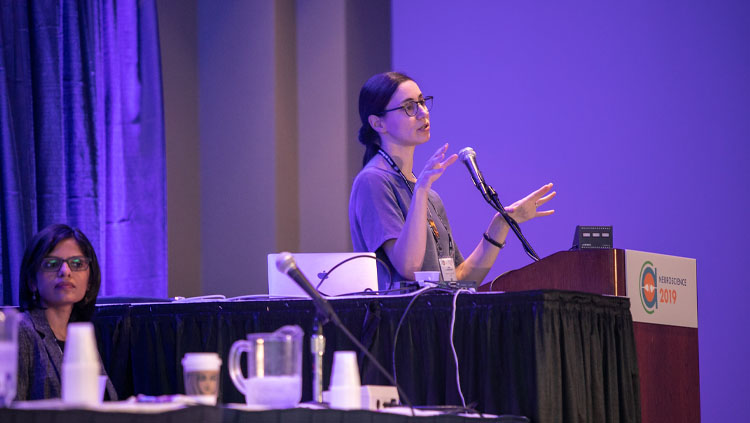 Annual Meeting Video Scientific ResearchMany new tools have been created to address barriers to reproducibility, but how do you know which ones to use? This workshop breaks down workflows and tools to help you improve the reproducibility of your work, organizing workflows and tools into four themes: organization, documentation, automation of analysis, and dissemination. You’ll come away with ideas to implement in your lab as well as ideas for enhancing reproducibility more broadly.May 28, 2020
 -
 Article Professional DevelopmentNo two careers are identical. Yet, all neuroscientists will likely share certain commonalities: the first sparks of scientific curiosity, difficult challenges, resilience to press on, accomplishments large and small, hard-earned wisdom, and support from professional and personal communities. In this series, Notable Careers: Reflections on Science, Leadership, and Community, five neuroscientists reflect on their life’s work and share their hope for the future of the field. Here, Osvaldo Uchitel, whose last position was senior researcher at the University of Buenos Aires, focuses on what it was like to conduct high quality science and rebuild a community of neuroscientists in Argentina despite a volatile political climate and scarce funding and scientific support. What inspired you to get involved in neuroscience? I was born and educated in Argentina. In my first year of college, I went to a lecture given by Edward De Robertis, a neuroscientist who led the team that discovered synaptic vesicles. He showed us an electron microscope picture that captured my attention. From that moment, I wanted to learn more about cells and how they work. At first, I was more interested in research than clinical work. But then I started working on how nerves and muscles interact, bringing me closer to neuroscience and neurology.May 26, 2020
 -
Journal ArticleThe prepositus hypoglossi nucleus (PHN), involved in horizontal gaze control, contributes to this function via cooperation with the vestibulocerebellum (VC). Furthermore, some PHN neurons have also been observed to project to cerebellar regions outside the VC. We previously reported a neuronal population in the ventral caudal PHN that projects to lobules III–V of the anterior vermis or to the cerebellar hemispheric crus. Because the properties of these neurons have not been clarified, this study aimed to determine their localization, projections, and electrophysiological and morphological characteristics in male rats. Tracing experiments revealed that these neurons were clustered within the ventral caudal PHN, approximately between bregma -12.72 mm and -12.00 mm, and did not project to the uvula/nodulus (UN), which is part of the VC. Whole-cell recordings and morphological experiments revealed that these PHN neurons exhibited high input capacitance, low input resistance, low-frequency firing, prominent vol...Jul 15, 2025
-
Journal ArticleRecognition of conspecific individuals in mammals is an important skill, thought to be mediated by a distributed array of neural networks, including those processing olfactory cues. Recent data from our groups have shown that social memory can be supported by olfactory cues alone, and that interactions with an individual lead to increased neural representations of that individual in the anterior olfactory nucleus, an olfactory network strongly modulated by the neuropeptide oxytocin. We here show, using a computational model, how enhanced representations in the AON can easily arise during the encoding phase, how they can be modulated by OXT and how a dynamic memory signature in the form of enhanced oscillations in the beta range arises from the architecture of the neural networks involved. These findings have implications for our understanding how social memories are formed and retrieved and generate further hypotheses that can be tested experimentally. Significance statement Memory for con-specifics is of...Jul 15, 2025
-
 Webinar Scientific ResearchJoin experts Robert Calin-Jageman and Katherine Button as they discuss their work in estimation statistics and statistical power. Watch their short videos introducing this work, then join them along with moderator Christophe Bernard on Thursday, June 4 from 12:30 – 1:30 pm EDT to ask questions about how these statistical practices apply to your own work. This Ask an Expert event is part of SfN’s Foundations of Rigorous Neuroscience Research (FRN) program, which aims to increase awareness of the sociological and cultural factors that influence rigorous research practices.May 21, 2020
 -
Journal ArticleEarly childhood is a critical period showing experience-dependent changes in brain structure and function. The complex link between the structural connectivity (SC) and functional connectivity (FC) of the brain is of particular interest. However, its relationship with both age and attention in early childhood is not well understood. In this study, children between the ages of 4 and 7, and at a one-year follow-up visit, underwent neuroimaging (diffusion-weighted and passive-viewing functional magnetic resonance imaging) and assessments for selective, sustained, and executive attention. We examined regional graph metrics and SC-FC coupling of the structural and functional networks. Partial least squares (PLS) was used to investigate longitudinal brain measure changes and cross-sectional associations with age and attention. We observed longitudinal changes in functional graph metrics and age-related decreases in SC modularity. Region-wise graph analyses revealed variable brain-behaviour relationships across t...Jul 14, 2025
-
 Video AdvocacyIn this series of videos from Improving Openness in Animal Research in Portugal, an event that coincided with the establishment of the Portuguese Transparency Agreement, learn why it’s important for scientists to be proactive in giving the public information on the use of animals in research. By hearing perspectives from a variety of speakers, each of whose work is connected to animal research in some way, you’ll better understand what the public want to know, what information is helpful to share, and how to communicate in a way that contributes to collective understanding of the importance of the responsible use of animals in research.May 15, 2020
 -
 Video AdvocacyAlthough in-person meetings are preferable, virtual one-on-one or small group conversations are important when building and maintaining relationships with your elected officials and their offices. These virtual meetings are much like ones carried out in-person and can be effective in helping your issue stand out. Whether by telephone or videoconference, the following tips will help you schedule and prepare for a successful virtual appointment.May 14, 2020




