



Filter
-
(133)
-
(733)
-
(4)
-
(1)
-
(47833)
-
(91)
-
(25)
-
(14)
-
(433)
-
(7)
-
(181)
-
(8)
-
(33)
-
(17)
-
(7)
-
(9)
-
(9)
-
(5)
-
(21)
-
(8)
-
(12)
-
(9)
-
(3)
-
(10)
-
(10)
-
(56)
-
(45)
-
(12)
-
(3)
-
(7)
-
(6)
-
(5)
-
(8)
-
(7)
-
(11)
-
(58)
-
(13)
-
(30)
-
(8)
-
(5)
-
(10)
-
(5)
-
(14)
-
(4)
801 - 810
of 52754 results
-
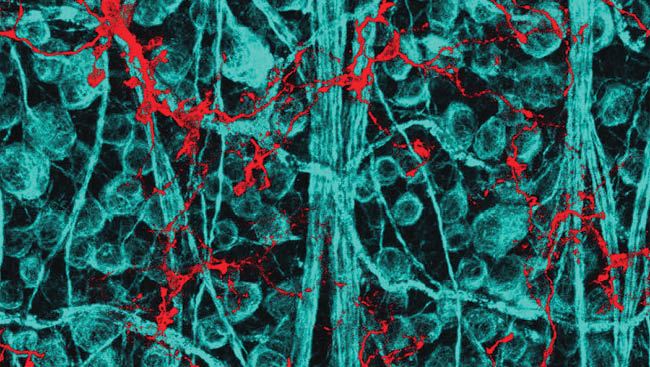 Article Scientific ResearchMaterial below summarizes the article, Metabotropic Glutamate Receptor 2/3 (mGluR2/3) Activation Suppresses TRPV1 Sensitization in Mouse, but not Human, Sensory Neurons, published on March 5, 2018, in eNeuro and authored by Tayler D. Sheahan, Manouela V. Valtcheva, Lisa A. McIlvried, Melanie Y. Pullen, David A.A. Baranger, and Robert W. Gereau. Chronic pain is a widespread, debilitating condition in need of effective treatments. Unfortunately, current drugs for pain relief, such as opioids, often have unwanted side effects, including addiction and abuse, which are mediated by off-target drug activity within the central nervous system. Therefore, scientists and clinicians have been particularly interested in identifying new targets for pain relief within the peripheral nervous system. Despite extensive efforts of researchers to develop novel treatments for pain relief, promising drugs identified in rodent models rarely provide effective pain relief in clinical trials with chronic pain patients. One explanation for these failures is there are likely important, yet often overlooked, differences in the physiological effects caused by drugs in humans compared to model organisms such as mice. In response to this criticism, our lab has established an approach to collect and use peripheral sensory neurons from human organ donors to better understand human sensory neuron physiology and how it compares to that of rodents. Previous rodent studies have suggested metabotropic glutamate receptors two and three (mGluR2/3) expressed on sensory neurons are promising targets for pain relief. In a recent publication, we determined mGluR2/3 are also expressed on human sensory neurons.Nov 12, 2020
 -
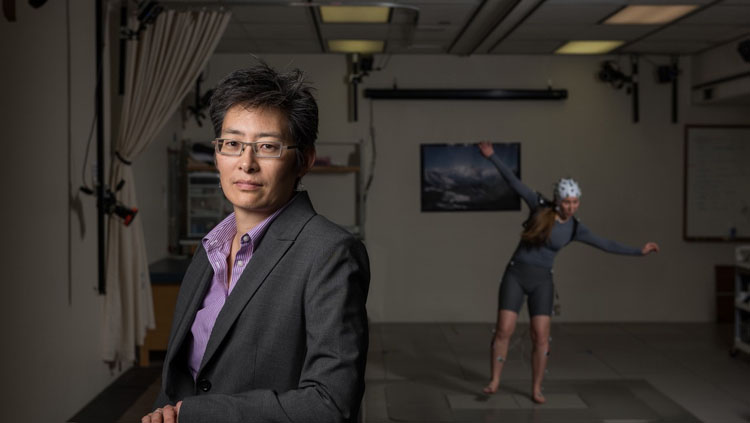 Article Career PathsThis resource was featured in the NeuroJobs Career Center. Visit today to search the world’s largest source of neuroscience opportunities. Lena Ting is in the liminal space between computation and neurophysiology, illumining how the brain works with the nervous and musculoskeletal systems to move the body. In this interview she explains how her diverse training experiences allow her to make waves in a new discipline, as director of the Neuromechanics Lab at Emory University, and to bring together researchers from different scientific backgrounds to study movement disorders. She also offers advice for embracing nonlinear thinking and charting your own path. This article is part of Neuronline's interview series "Entrepreneurial Women Combining Neuroscience, Engineering, and Tech," which highlights the career paths and scientific accomplishments of female leaders and role models who are creatively bridging disciplines to improve lives.Nov 9, 2020
 -
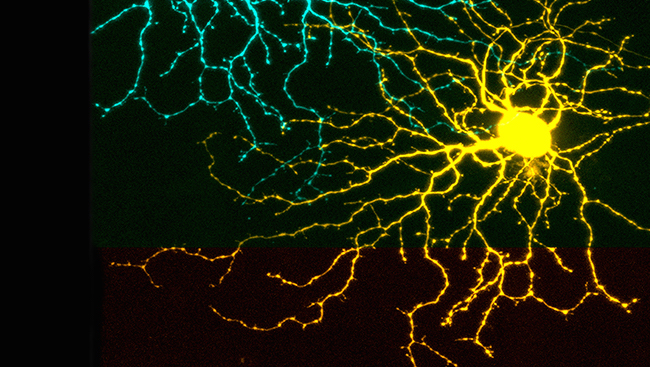 Article Scientific ResearchMaterial below summarizes the article, Facilitated Event-Related Power Modulations during Transcranial Alternating Current Stimulation (tACS) Revealed by Concurrent tACS-MEG, published on June 25, 2018, in eNeuro and authored by Florian H. Kasten, Burkhard Maess, and Christoph S. Herrmann Relationships between brain oscillations and human cognition are traditionally performed using imaging modalities, such as magneto- or electroencephalography (M/EEG). For almost a century, these methods were successfully used to identify oscillatory brain activity within different frequency bands and associate them with numerous cognitive functions, as well as several neurological and psychiatric disorders. However, as these methods provide observational data, inference about relationships between brain oscillations and cognition remains mostly correlational.Nov 5, 2020
 -
 Article Professional DevelopmentWhen it comes to growing in your career, building a diverse team of mentors, instead of having just one, can be valuable.Nov 4, 2020
 -
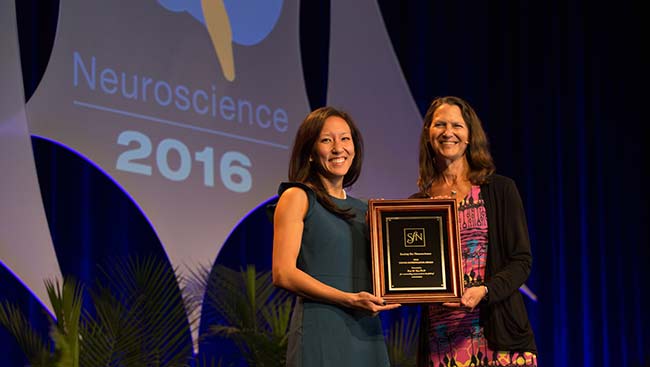 Article Professional DevelopmentKay Tye’s pioneering work with projection-specific optogenetics has built a strong foundation for future insights into healthy and addiction-related behaviors.Oct 29, 2020
 -
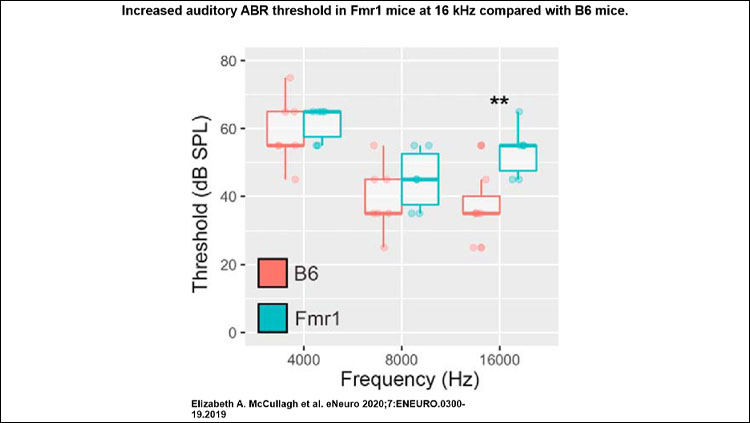 Article Scientific ResearchMaterial below summarizes the article Characterization of Auditory and Binaural Spatial Hearing in a Fragile X Syndrome Mouse Model, published on January 17, 2020, in eNeuro and authored by Elizabeth A. McCullagh, Shani Poleg, Nathaniel T. Greene, Molly M. Huntsman, Daniel J. Tollin, and Achim Klug. Fragile X Syndrome (FXS) mice have decreased inhibition of acoustic startle responses under several auditory conditions including gaps in noise, large changes in sound source positions, and discrimination of target sounds from background noise compared to wildtype control mice. FXS mice took longer to respond to startling sounds in most conditions suggesting additional impairments to pathways underlying when to respond. FXS mouse models exhibit similar hearing impairments to humans with FXS.Oct 28, 2020
 -
 Journal ArticleSleep is a vital physiological phenomenon observed amongst almost all organisms. Although its exact purpose remains elusive, sleep has been linked to memory consolidation. In our present study, we investigated the role of sleep quality on sleep-dependent memory consolidation. Previous studies have shown that tequila , a serine protease, affects long-term memory consolidation in flies. In the present study we identified that the hypomorphic mutation in the tequila gene ( tequila f01792 ) leads to increased day-time sleep fragmentation at a very early age in male flies. Intrigued by this observation, we delved into further understanding the role of tequila in sleep-dependent memory consolidation by manipulating sleep duration using pharmacological methods such as GABA-A agonist. Inducing sleep using GABA-A agonist resulted in improved sleep during the day. This further led to a significant improvement in the long-term memory of these flies when compared to the vehicle-treated flies. In conclusion, day-time d...Aug 15, 2025
 -
 Video Outreach“I really wanted to have constant communication and constant impact with our local community,” explains Edith Brignoni-Pérez, PhD candidate at Georgetown University Medical Center who also served as president and secretary of SfN’s DC Metro Area Chapter. As president, Brignoni-Pérez intentionally branched out further into her community. She achieved success by hosting impactful events, listening to her team, and collaborating with other institutions and organizations. Ultimately, she believes, “A leader will never be successful if they don’t put the knowledge they have about their community in the context of compassion.” Watch this video to hear more insight from Brignoni-Pérez to help you conduct outreach in your own community or lead your local SfN chapter.Oct 27, 2020
 -
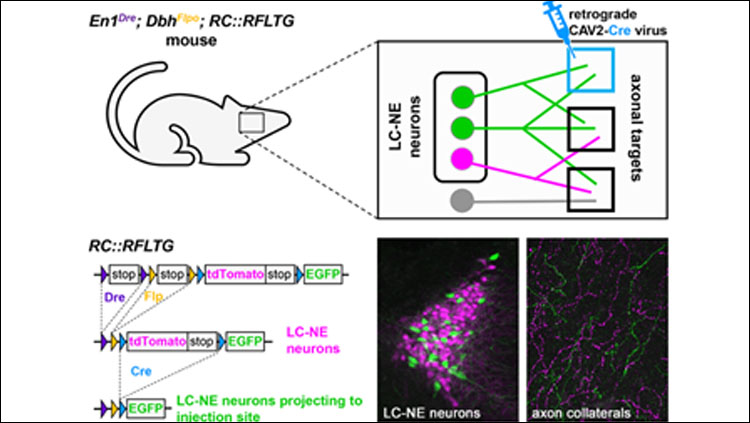 Article Scientific ResearchMaterial below summarizes the article An Intersectional Viral-Genetic Method for Fluorescent Tracing of Axon Collaterals Reveals Details of Noradrenergic Locus Coeruleus Structure, published on April 30, 2020, in eNeuro and authored by Nicholas W. Plummer, Daniel J. Chandler, Jeanne M. Powell, Erica L. Scappini, Barry D. Waterhouse and Patricia Jensen. Highlights TrAC (Tracing Axon Collaterals) is a new viral-genetic method that allows simultaneous visualization of axon collaterals from a genetically defined neuronal population and a projection-based subpopulation. TrAC was used to show that norepinephrine (NE)-containing locus coeruleus (LC) neurons projecting to the medial prefrontal cortex and primary motor cortex differ from each other and from the LC as a whole in their pattern of axon collateralization. Labeled LC-NE neurons have dense axon projections to their primary target in the cerebral cortex, and widespread, albeit sparse, collateral projections to other cortical and subcortical regions.Oct 22, 2020
 -
 Article AdvocacyIt should be clear to us by now that science is done by actual people whose intersectional identities, and the social challenges and trauma that come with them, don’t disappear when they enter the lab. Regardless of where they are, Black scholars and those belonging to other marginalized groups face overt, implicit, and systemic racism on a daily basis. Particularly in the last few years, US-based international researchers have regularly faced xenophobic and anti-immigrant policies from their host nation. This year, international students and postdocs experienced damaging threats to their presence, security, and peace of mind as a result of new anti-immigrant policies targeting their visa programs. Many scientists promptly took to social media to respond to these actions.Oct 20, 2020




