



Filter
-
(133)
-
(733)
-
(4)
-
(1)
-
(47833)
-
(91)
-
(25)
-
(14)
-
(433)
-
(7)
-
(181)
-
(8)
-
(33)
-
(17)
-
(7)
-
(9)
-
(9)
-
(5)
-
(21)
-
(8)
-
(12)
-
(9)
-
(3)
-
(10)
-
(10)
-
(56)
-
(45)
-
(12)
-
(3)
-
(7)
-
(6)
-
(5)
-
(8)
-
(7)
-
(11)
-
(58)
-
(13)
-
(30)
-
(8)
-
(5)
-
(10)
-
(5)
-
(14)
-
(4)
741 - 750
of 52754 results
-
 Article Professional DevelopmentFour years ago, in my second year of graduate school, I wrote about coping with failure as a graduate student. I was frustrated I couldn’t answer scientific questions because I was spending all of my time trying to get basic techniques to work. Since then, I continued to experience disappointment, both in and out of the lab. I’ve recently been reflecting on what I would now tell my younger self, and I’m sharing those thoughts in the hope that they might help someone else. Let yourself grieve. When we experience disappointment, there’s a sharp emotional response. That response has to pass before we can evaluate what happened and decide what to do next. The first few times we’re disappointed, it takes a long time to process and dispel our negative feelings. Eventually, we begin to heal from disappointment faster. We can’t force rational processes onto emotion – emotions happen in their own time, through a system older and deeper than our executive functioning. But we can understand how our own feelings work and create space for them to happen and to minimize the damage they inflict on our lives. That can mean taking an afternoon or day to sulk after a frustrating experiment or “not discussed” grant application. The pain will eventually subside, and then you can think. And each time, with each disappointment, the cycle will get shorter.Jan 28, 2021
 -
 Video Annual Meeting OutreachRecent studies in the field of neuroscience illustrate the importance of creativity across our life spans. Using examples such as ballet lessons before kindergarten, band practice in college, and music therapy following a stroke, among others, this Public Advocacy Forum panel explore how and why the arts influence us so deeply and how we can use creativity to be healthier and more productive throughout our lives.Jan 27, 2021
 -
 Video Webinar AdvocacyAfter watching the video below, join us February 10th at 1:00pm for a live chat on the Neuronline Community and learn about the ways you can incorporate more sustainable practices in your work, and ask your questions on how to help move the field towards an environmentally friendly framework This special interest event from the FENS (Federation of European Neuroscience Societies) 2020 Virtual Forum offered an opportunity to discuss what scientists can do to adopt a more sustainable model for life sciences. The organizers presented the results of a small survey performed among neuroscientists and their research institutes to trigger discussion and start identifying solutions regarding the environmental footprint of the life science community. A panel of academics, activists, and life science industry representatives, among others, shared their viewpoints and experiences implementing concrete actions towards an environmentally friendly life science framework. Learn more and check out the conversations in the video (above or below). Organized by FENS-Kavli Network of Excellence (FKNE).Jan 27, 2021
 -
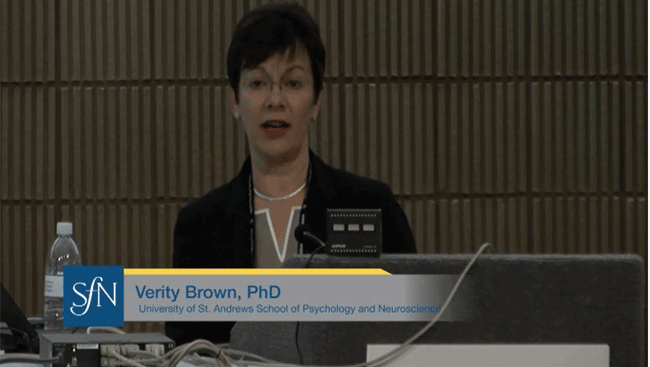 Video Annual Meeting Professional DevelopmentThis playlist walks through the entire process of deciding when to write, how to write, and where to publish your manuscript. Verity Brown, editor-in-chief of Neuroscience & Biobehavioral Reviews, discusses many helpful tips and tricks that these videos can help any neuroscientist learn new things about getting published.Jan 26, 2021
 -
 Journal ArticleUnderstanding the roles of astrocytic calcium signaling in multiple brain regulatory mechanisms including metabolism, blood flow, neuromodulation and neuroinflammation has remained one of the enduring challenges in glial biology. To delineate astrocytic contribution from concurrent neuronal activity, it is vital to establish robust control and manipulate astrocytes using a technique like optogenetics due to its high cellular specificity and temporal resolution. The lack of an experimental paradigm to induce controlled calcium signaling in astrocytes has hindered progress in the field. To address this, in this study, we systematically characterize and identify light stimulation paradigms for inducing regulated, on-demand increases in astrocytic calcium in acute brain slice cortical astrocytes from MlC1-ChR2(C128S)-EYFP mice (of either sex). We identified paradigms 20%, 40% and 60% (of T=100s) to elicit robust calcium responses upon periodic stimulations, while the 95% paradigm exhibited a response only duri...Sep 2, 2025
 -
Journal ArticleThe corticospinal tract (CST) is essential for forelimb-specific fine motor skills. In rodents, it undergoes extensive structural remodeling across development, injury, and disease states, with major implications for motor function. A vast body of literature, spanning numerous injury models, frequently assesses these projections. Despite this, a cohesive imaging modality for rapid, quantitative assessment of the bilateral cervical spinal cord projectome is lacking. To address this, we developed SpinalTRAQ (Spinal cord Tomographic Registration and Automated Quantification), a novel mouse cervical spinal cord volumetric reference atlas and machine learning-based analytical pipeline. Using serial two-photon tomography, SpinalTRAQ enables unbiased, region-specific quantification of fluorescently labeled CST presynaptic terminals. In healthy male mice, the CST exhibits a distinct bilateral synaptic projectome, with the densest innervation in laminae 5 and 7 on the contralateral side and lamina 7 on the ipsilate...Sep 2, 2025
-
 Article Scientific ResearchMaterial below summarizes the article, Vibrational Detection of Odorant Functional Groups by Drosophila Melanogaster, published on October 26, 2017, in eNeuro and authored by Klio Maniati, Katherine-Joanne Haralambous, Luca Turin, and Efthimios M.C. Skoulakis. We are interested in tests that could help decide between the vibrational theory of odor and the lock-and-key theory, a controversial question in the field of olfaction. Is odor character of a molecule determined by its shape or its vibrations? In a shape theory, the smell of an odorant is encoded in the shape of the odorant molecule, which in turn determines the receptors in which it fits. This is a lock-and-key theory: the shapes of both locks and keys matter to the pattern of receptor activation. Picture a thought experiment in which the shapes of the olfactory receptor binding sites are all altered, while leaving wiring identical to the brain. The receptor activation pattern will be different, and therefore odorants will be perceived to have a different smell or odor character.Jan 21, 2021
 -
Journal ArticleDepression and anxiety are often characterized by altered reward-seeking and avoidance, respectively. Yet less is known about the relationship between depressive symptoms and specific avoidance behaviors. To address this gap, we conducted two studies. In Study 1, undergraduates and online workers completed an uninstructed go/no-go avoidance task ( N Total = 465) as a reverse translation of a rodent paradigm. Participants exhibited a wide range of symptom scores on the Beck Depression Inventory-II (BDI-II), ranging from low to severe. In Study 1, cues were used to signal the response type (go/active vs. no-go/inhibitory) required to avoid an aversive sound. Higher depressive scores were associated with poorer acquisition of active avoidance in undergraduates. Overall participants showed lower accuracy for active than inhibitory avoidance. To examine whether the better No-go trial performance reflected a prepotent response to avoid aversive outcomes, in Study 2, undergraduates ( N Total = 330) completed a ve...Sep 1, 2025
-
 Journal ArticleThe corticospinal tract (CST) facilitates skilled, precise movements, which necessitates that subcerebral projection neurons (SCPNs) establish segmentally specific connectivity with brainstem and spinal circuits. Developmental molecular delineation enables prospective identification of corticospinal neurons (CSNs) projecting to thoraco-lumbar spinal segments; however, it remains unclear whether other SCPN subpopulations in developing sensorimotor cortex can be prospectively identified in this manner. Such molecular tools could enable investigations of SCPN circuitry with precision and specificity. During development, Kelch-like 14 ( Klhl14 ) is specifically expressed by a specific SCPN subpopulation, CSNBC-lat, that reside in lateral sensorimotor cortex with axonal projections exclusively to bulbar-cervical targets. In this study, we generated Klhl14-T2A-Cre knock-in mice to investigate SCPN that are Klhl14+ during development into maturity. Using conditional anterograde and retrograde labeling in mice of ...Sep 1, 2025
 -
 Journal ArticlePathological levels of beta amyloid (Aβ) lead to disruption and elimination of synapses in brain as the result of direct neurotoxicity as well as neuroinflammation. The synaptic impact of beta amyloid includes altered morphology and reduced number of dendritic spines at excitatory synapses, evident in the brains of individuals with Alzheimer’s disease. Here, we assessed the ability of an identified neuroprotective peptide, YEVHHQ, derived from the N-terminal domain of Aβ, known as the AβCore, to protect against Aβ-induced alterations in dendritic spines. Our approach involved both 2D and 3D imaging of spine morphology in hippocampal neuron cultures from mice of either sex, with the 3D imaging focusing on the postsynaptic density (PSD), as its morphology is tightly correlated with synaptic strength, and presynaptic terminal morphology and density to assess the impact on both sides of the synapse. We present evidence for uniform prevention by the AβCore of Aβ-induced reductions in spine cross-sectional size ...Sep 1, 2025




