



Filter
-
(133)
-
(733)
-
(4)
-
(1)
-
(47830)
-
(91)
-
(25)
-
(14)
-
(433)
-
(7)
-
(181)
-
(8)
-
(33)
-
(17)
-
(7)
-
(9)
-
(9)
-
(5)
-
(21)
-
(8)
-
(12)
-
(9)
-
(3)
-
(10)
-
(10)
-
(56)
-
(45)
-
(12)
-
(3)
-
(7)
-
(6)
-
(5)
-
(8)
-
(7)
-
(11)
-
(58)
-
(13)
-
(30)
-
(8)
-
(5)
-
(10)
-
(5)
-
(14)
-
(4)
381 - 390
of 52751 results
-
.png) Podcast Scientific ResearchKaitlin Laws and Greg Bashaw discuss their paper, “DrosoPHILA: A Partnership between Scientists and Teachers That Begins in the Lab and Continues into City Schools,” published in Vol. 10, Issue 2 of eNeuro, with BrainFacts editor Kelley Remole.May 23, 2023
Podcast Scientific ResearchKaitlin Laws and Greg Bashaw discuss their paper, “DrosoPHILA: A Partnership between Scientists and Teachers That Begins in the Lab and Continues into City Schools,” published in Vol. 10, Issue 2 of eNeuro, with BrainFacts editor Kelley Remole.May 23, 2023 -
 Journal ArticleForming a long-term memory requires changes in neuronal transcription. What happens, though, as the memory is forgotten? And how does the transcriptional state relate to the maintenance and recall of the long-term memory? To answer these questions we have been systematically tracing the time-course of transcriptional changes evoked by long-term sensitization in the marine mollusk Aplysia californica . Our approach captures transcriptional changes in neurons of known behavioral relevance using a within-subjects design, delineating patterns of transcriptional change that are comprehensive and reproducible. We have previously reported that within 1 day of long-term sensitization training there is a widespread transcriptional response involving robust changes in over 5% of tested transcripts (1,252 of ∼22k; Conte, 2017). Within 1 week, however, memory strength fades and nearly all transcriptional changes relapse to baseline (Perez, 2018). Here we report microarray analysis ( N = 16) of transcriptional changes ...Mar 9, 2026
 -
Journal ArticleThe suprachiasmatic nucleus (SCN) produces diffusible signals sufficient to sustain circadian locomotor rhythms, though the nature of such signals, their targets, and the pathway whereby such signals may travel is unknown. It is possible that the venous portal veins that connect the capillary beds of the SCN to those of the organum vasculosum of the lamina terminalis (OVLT) provide a vascular pathway whereby signals originating in SCN neurons can reach local targets in the OVLT. Given the presence of the blood-brain interface (BBI) within the SCN, it is unclear how diffusible signals originating in SCN neurons might access the capillary vasculature of this nucleus. Estimates of astrocyte coverage of capillary vasculature range widely, from 70-100%, and furthermore such coverage can change dynamically. In the present study, we investigated whether three vasoactive peptidergic processes found in the mouse SCN, namely vasopressin, vasoactive intestinal peptide and gastrin releasing peptide, might breach the B...Mar 9, 2026
-
Journal ArticleRapid advancements in artificial intelligence (AI) have enabled text-to-speech (TTS) systems to produce voices increasingly indistinguishable from humans, posing significant societal risks, particularly through potential misuse in fraud and deception. To address this concern, this study combined behavioral assessments and neural measures using electroencephalography (EEG) to examine whether short-term perceptual training enhances people's ability to distinguish AI-generated from human speech. Thirty participants (of either sex) listened to sentences produced by human speakers and corresponding AI-generated clones, judging each sentence as either human or AI-generated before and after a brief (∼12-minute) training session, during which voices were explicitly labeled as "human" or "AI". Behaviorally, participants showed consistently poor discrimination before and after training, with only minimal improvement. However, neural analyses revealed substantial training-induced changes. Specifically, temporal respo...Mar 9, 2026
-
Journal ArticleA possible mechanism of temporal lobe epilepsy is insufficient inhibition of hippocampal dentate granule cells. Precipitating injuries that kill interneurons in the dentate gyrus might result in fewer inhibitory synapses with granule cells. To test this hypothesis, previous studies evaluated numbers or densities of interneurons, γ-amino butyric acid (GABA)ergic boutons, and inhibitory synapses in tissue from human patients with temporal lobe epilepsy and rodent models. However, those studies have limitations. Some of those limitations can be addressed by a large animal model. Sea lions ( Zalophus californianus ) can develop temporal lobe epilepsy naturally. Like humans, epileptic sea lions exhibit bilateral or unilateral hippocampal sclerosis (neuron loss) with granule cell vulnerability, but sea lions permit optimal tissue preservation and sampling, and good control subjects. To label interneuron cell bodies and GABAergic synaptic boutons, sea lion hippocampal tissue from both sexes was processed with imm...Mar 9, 2026
-
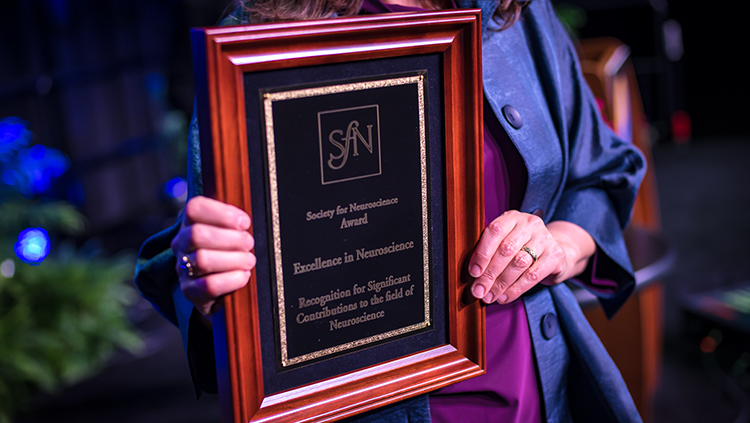 Article Professional DevelopmentIf you’ve never nominated someone for an award, the process can be daunting. At SfN, there are multiple categories meant for different achievement types, and each award’s requirements are different. This can make it confusing when you’re trying figure out if someone is eligible and if you can put together a nomination in time.May 1, 2023
 -
.png) Podcast Scientific ResearchTerry Dean and Vittorio Gallo discuss their paper, “Endogenous Circadian Clock Machinery in Cortical NG2-Glia Regulates Cellular Proliferation,” published in Vol. 9, Issue 5 of eNeuro, with Editor-in-Chief Cristophe Bernard.Apr 25, 2023
Podcast Scientific ResearchTerry Dean and Vittorio Gallo discuss their paper, “Endogenous Circadian Clock Machinery in Cortical NG2-Glia Regulates Cellular Proliferation,” published in Vol. 9, Issue 5 of eNeuro, with Editor-in-Chief Cristophe Bernard.Apr 25, 2023 -
 Journal ArticleRepeated restraint stress (RRS) in rats impairs cognitive flexibility, particularly when faced with additional mild acute stress (AS). We tested the hypothesis that this impairment is associated with altered dopaminergic activity in the dorsal striatum (DS) driven by corticotropin-releasing-factor receptor type 1 (CRFR1) in the substantia nigra pars compacta (SNpc). Sixty-two male rats received RRS or handling for 14 d, before training on a two-action, two-outcome instrumental conditioning task. Initial learning was assessed using an outcome devaluation test. Cognitive flexibility was assessed by reversing the outcome identities and a second outcome devaluation test, with half the rats in each group receiving AS before reversal training. Dopamine and metabolites were quantified in the DS, and CRFR1 mRNA was quantified in the SNpc. In Experiment 2, SNpc CRFR1 was pharmacologically blocked unilaterally before AS and reversal training in 32 male and 32 female rats. Increased dopaminergic activity in the DS an...Mar 1, 2026
 -
Journal ArticleConsumption varies across the stages (metestrus, diestrus, proestrus, estrus) of a rat's estrous cycle, changing in ways that might be expected to reflect, in part, a direct impact of hormones on taste palatability. Evidence regarding this hypothesis has been mixed, however, and critical within-subject experiments comparing consumption of multiple tastes with distinct valences across all estrous phases have been few. Here, we assayed female rats' licking of palatable (saccharin, sucrose, NaCl) and aversive (quinine-HCl, citric acid) tastes in brief-access trials, while tracking their estrous cycles through vaginal cytology. We observed sucrose palatability to be high at metestrus, the same phase at which the palatability of the aversive citric acid was low. These patterns were consistent across tastes of similar palatability, despite vast differences between the substances' receptor mechanisms and central impacts. Together, these results reveal a general (i.e., independent of particular tastant identity) m...Mar 1, 2026
-
 Journal ArticleSocial media (SM) use is typically regarded as a technological tool which might negatively impact physical fitness and cognitive function, especially in critical developmental stages. In this opinion paper, we argue that specific forms of SM content might be beneficial for promoting motor skill acquisition and function. Furthermore, we suggest that SM use might be a promising innovative tool for educational purposes in optimizing skills not only in sports but also in academia. As a prerequisite, future research is needed to clarify the optimal type of content, its use, and how these parameters are affected by age. Therefore, longitudinal studies across the lifespan are necessary for a thorough understanding of the potential beneficial effects of SM use. The use of social media (SM) has rapidly accelerated due to technological progress and the release of the first SM platforms such as Facebook in the early 2000s. During the Covid-19 pandemic, lockdowns and social distancing acted as catalysts, contributing...Mar 1, 2026




