



Filter
-
(133)
-
(733)
-
(4)
-
(1)
-
(47838)
-
(91)
-
(25)
-
(14)
-
(433)
-
(7)
-
(183)
-
(8)
-
(33)
-
(17)
-
(7)
-
(9)
-
(9)
-
(5)
-
(21)
-
(8)
-
(12)
-
(9)
-
(3)
-
(10)
-
(10)
-
(56)
-
(45)
-
(12)
-
(3)
-
(7)
-
(6)
-
(5)
-
(8)
-
(7)
-
(11)
-
(58)
-
(13)
-
(30)
-
(8)
-
(5)
-
(10)
-
(5)
-
(15)
-
(4)
2101 - 2110
of 52763 results
-
 Journal ArticleSocial recognition is an essential part of social function and often promotes specific social behaviors based on prior experience. Social and defensive behaviors in particular often emerge with prior experiences of familiarity or novelty/stress, respectively. This is also commonly seen in rodents towards same-strain and inter-strain conspecifics. Medial amygdala (MeA) activity guides social choice based on age and sex recognition and is sensitive to social experiences. However, little is known about whether the MeA exhibits differential responses based on strain or how this is impacted by experience. Social stress impacts posterior MeA (MeAp) function and can shift measures of social engagement. However, it is unclear how stress impacts MeAp activity and contributes to altered social behavior. The primary goal of this study in adult male Sprague Dawley rats was to determine whether prior stress experience with a different strain (Long Evans) rat impacts MeAp responses to same-strain and different-strain co...Sep 11, 2024
 -
Journal ArticleConscious reportability of visual input is associated with a bimodal neural response in primary visual cortex (V1): an early-latency response coupled to stimulus features and a late-latency response coupled to stimulus report or detection. This late wave of activity, central to major theories of consciousness, is thought to be driven by prefrontal cortex (PFC), responsible for “igniting” it. Here we analyzed two electrophysiological studies in mice performing different stimulus detection tasks, and characterize neural activity profiles in three key cortical regions: V1, posterior parietal cortex (PPC) and PFC. We then developed a minimal network model, constrained by known connectivity between these regions, reproducing the spatio-temporal propagation of visual- and report-related activity. Remarkably, while PFC was indeed necessary to generate report-related activity in V1, this occurred only through the mediation of PPC. PPC, and not PFC, had the final veto in enabling the report-related late wave of V1 ...Sep 11, 2024
-
Journal ArticleSome visual neurons in the dragonfly ( Hemicordulia tau ) optic lobe respond to small, moving targets, likely underlying their fast pursuit of prey and conspecifics. In response to repetitive targets presented at short intervals, the spiking activity of these ‘small target motion detector’ (STMD) neurons diminishes over time. Previous experiments limited this adaptation by including inter-trial rest periods of varying durations. However, the characteristics of this effect have never been quantified. Here, using extracellular recording techniques lasting for several hours, we quantified both the spatial and temporal properties of STMD adaptation. We found that the time course of adaptation was variable across STMD units. In any one STMD, a repeated series led to more rapid adaptation, a minor accumulative effect more akin to habituation. Following an adapting stimulus, responses recovered quickly, though the rate of recovery decreased nonlinearly over time. We found that the region of adaptation is highly ...Sep 10, 2024
-
Journal ArticleA goal of connectomics is to reveal the links between neural circuits and behavior. Larvae of the primitive chordate Ciona are well-suited to make contributions in this area. In addition to having a described connectome, Ciona larvae have a range of readily-quantified behaviors. Moreover, the small number of neurons in the larval CNS (∼180) holds the promise of a comprehensive characterization of individual neurons. We present single-neuron predictions for glutamate receptor (GlutR) expression based on in situ hybridization. Included are both ionotropic receptors (AMPA, NMDA, and Kainate), and metabotropic receptors. The predicted glutamate receptor expression dataset is discussed in the context of known circuits driving behaviors such as phototaxis, mechanosensation, and looming shadow response. The predicted expression of AMPA and NMDA receptors may help to resolve issues regarding the co-production of GABA and glutamate by a subset of photoreceptors. The targets of these photoreceptors in the midbrain a...Sep 10, 2024
-
Journal ArticleSpike-and-wave discharges (SWDs) and sleep spindles are characteristic electroencephalographic (EEG) hallmarks of absence seizures and non-rapid eye movement (NREM) sleep, respectively. They are commonly generated by the cortico-thalamo-cortical (CTC) network including the thalamic reticular nucleus (TRN). It has been reported that SWD development is accompanied by a decrease in sleep spindle density in absence seizure patients and animal models. However, whether the decrease in sleep spindle density precedes, coincides with, or follows, the SWD development remains unknown. To clarify this, we exploited Pvalb -tetracycline transactivator (tTA)::tetO-ArchT (PV-ArchT) double-transgenic mouse, which can induce an absence seizure phenotype in a time-controllable manner by expressing ArchT in PV neurons of the TRN. In these mice, EEG recordings demonstrated that a decrease in sleep spindle density occurred 1 week before the onset of typical SWDs, with the expression of ArchT. To confirm such temporal relationsh...Sep 10, 2024
-
 Article Career PathsNo matter the task, you take an energetic, creative approach. No matter how busy you are, you’re willing to help others because you value their success.Apr 3, 2015
 -
 Video Annual Meeting Professional DevelopmentHow can training programs better prepare students for different career options? By bridging the disconnect between mentors as traditional role models for academic careers and the reality that students are taking other routes in science. Find out how to adjust your training programs in these videos with Alan Sved.Apr 3, 2015
 -
 Video Annual Meeting Professional DevelopmentFeel in-control when applying for an NIH grant mechanism. Know how the peer review process works and what you can expect. In these videos, René Etcheberrigaray lays it all out for you.Apr 3, 2015
 -
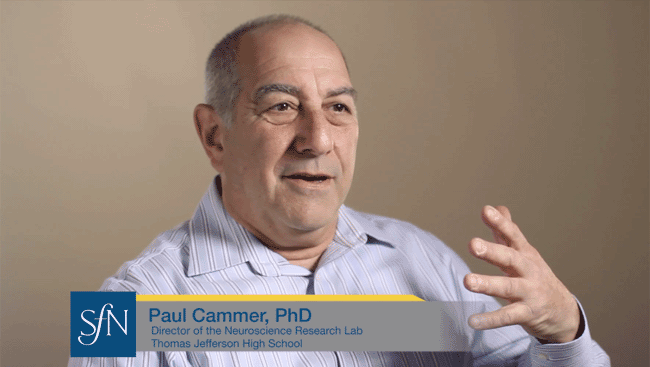 Video Career PathsLearn how rewarding teaching in secondary education can be. Paul Cammer discusses his decision to move into high school teaching from research, and how much others in the field can get out of making a similar move.Apr 3, 2015
 -
 Article DiversityThink about a time when you didn’t receive the recognition you felt you deserved, or when you hadn’t been heard on a particular issue. How productive were you? Did you still feel connected to your team, or did you withdraw?Apr 3, 2015




