



Filter
-
(133)
-
(733)
-
(4)
-
(1)
-
(47833)
-
(91)
-
(25)
-
(14)
-
(433)
-
(7)
-
(182)
-
(8)
-
(33)
-
(17)
-
(7)
-
(9)
-
(9)
-
(5)
-
(21)
-
(8)
-
(12)
-
(9)
-
(3)
-
(10)
-
(10)
-
(56)
-
(45)
-
(12)
-
(3)
-
(7)
-
(6)
-
(5)
-
(8)
-
(7)
-
(11)
-
(58)
-
(13)
-
(30)
-
(8)
-
(5)
-
(10)
-
(5)
-
(15)
-
(4)
1301 - 1310
of 52756 results
-
 Annual Meeting Video OutreachNeuroscience research regularly intersects with concepts of human nature, identity, free will, and other philosophical and religious topics. This Neuroscience 2017 Social Issues Roundtable explores paradigms for constructive engagement with diverse and religious audiences. Panelists examine tensions and domains of confluence between scientific and faith perspectives, the underlying values and assumptions in scientific research, and the role of cross-cultural dialogue on science education, practice and policy.May 22, 2018
 -
 Journal ArticleImpulsivity is often considered a risk factor for drug addiction; however, not all evidence supports this view. In the present study, we used a food reward delay-discounting task (DDT) to categorize rats as low-, middle-, and high-impulsive but failed to find any difference among these groups in the acquisition and maintenance of cocaine self-administration, regardless of electrical foot-shock punishment. Additionally, there were no group differences in locomotor responses to acute cocaine in rats with or without a history of cocaine self-administration. Unexpectedly, chronic cocaine self-administration selectively increased impulsive choice in low-impulsive rats. Resting-state fMRI analysis revealed a positive correlation between impulsivity and cerebral blood volume in the midbrain, thalamus, and auditory cortex. Using these three regions as seeds, we observed a negative correlation between impulsivity and functional connectivity between the midbrain and frontal cortex, as well as between the thalamus an...Mar 3, 2025
 -
Journal ArticleThe external globus pallidus (GPe) is a central part of the basal ganglia indirect pathway implicated in movement and decision-making. As a hub connecting the dorsal striatum and subthalamic nucleus (STN), the GPe guides repetitive and routine behaviors. However, it remains unknown how diverse GPe cells engage in routine formation while learning action sequences in repetitive reward-seeking conditioning. Here, in male mice, we investigated the Ca2+ dynamics of two GPe cell types, astrocytes and parvalbumin-expressing neurons, during routine formation. Our findings show that the dynamics of GPe astrocytes may be involved in action sequence refinement, a characteristic potentially contributing to more efficient reward-seeking behavior. Significance Statement The ability to form and refine action sequences is essential for both survival and efficiency. In this study, we introduced the “routine index”, a measure that captures how consistently animals repeat a specific action sequence to maximize rewards. This...Mar 3, 2025
-
Journal ArticleNeuroligins (NLGNs) are a family of postsynaptic adhesion molecules that bind to their presynaptic partners, neurexins (NRXNs), facilitating the formation and maintenance of synapses. In humans, there are five genes encoding NLGNs ( NLGN1-3, NLGN4X , and NLGN4Y ), with NLGN1-3 having highly conserved counterparts in rodents, allowing these genes to be studied with high confidence of translational validity in mouse models. Human NLGN4X and 4Y were often assumed to serve similar functions because they share a 97% sequence homology, whereas mouse NLGN4-like is quite divergent. Many NLGN-mediated synaptic effects are modulated through post-translation modifications, which exert temporal and spatial control. In this report, we characterize a conserved phosphorylation site, serine 712, on NLGN4X and 4Y. Despite serine 712 being located in a highly conserved region between NLGN4X and 4Y, we observed kinase specificity. PKA exclusively phosphorylates NLGN4X S712, whereas Cdk5 phosphorylates S712 on both NLGN4X and...Mar 3, 2025
-
Journal ArticleEarly psychosis (EP) is a critical period for psychotic disorders during which the brain undergoes rapid and significant functional and structural changes(Shinn et al., 2017). The Human Connectome Project (HCP) is a global effort to map the human brain's connectivity in health and disease. Here we focus on HCP-EP subjects (i.e., those within five years of the initial psychotic episode) to determine macro- and micro-structural alterations in EP (HCP-EP sample, n=179: EP, n=123, Controls, n=56) and their association with clinical outcomes (i.e., symptoms severity) in HCP-EP. We carried out analyses of Deformation-Based-Morphometry (DBM), scalar indices from the Diffusion Tensor Imaging (DTI), and Tract-Based Spatial Statistics (TBSS). Lastly, we conducted correlation analyses focused on the midbrain (DBM and DTI) to examine associations between its structure and clinical symptoms. Our results show that the midbrain displays robust alteration in its structure (DBM and DTI) in the voxel-based analysis. Complim...Mar 3, 2025
-
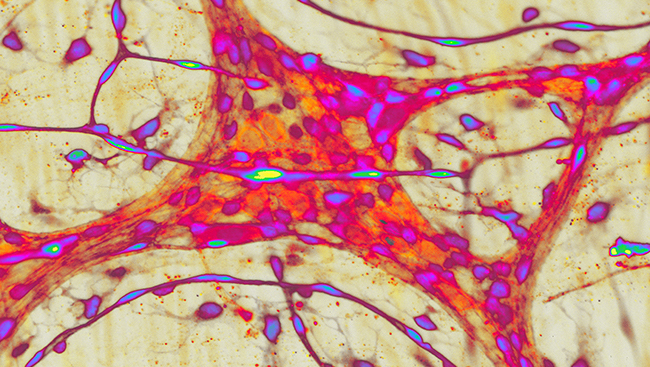 Article Scientific ResearchMaterial below summarizes the article, Working Memory Replay Prioritizes Weakly Attended Events, published on August 14, 2017, in eNeuro and authored by Anna Jafarpour, Will Penny, Gareth Barnes, Robert T. Knight, and Emrah Duzel. Working memory is a system with limited capacity that supports keeping information in mind for a short duration. Two important questions are: One, what are the mechanisms by which information is retained during the gap between encoding and recall (that is, the maintenance period), and two, how is information within working memory prioritized? These are often studied with a cuing procedure in which subjects are prompted to focus on one item. For example, if an event in a sequence of three events is cued, the cued event can be decoded during maintenance. In this study, we investigated how the information about a sequence of multiple events is retained without cueing.May 17, 2018
 -
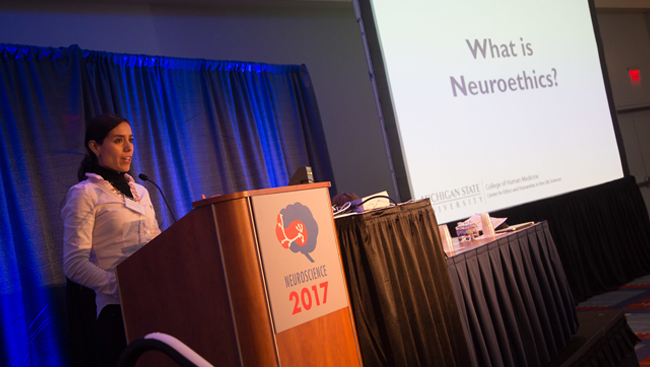 Annual Meeting Video Professional DevelopmentPublic education and engagement are crucial in the process of assessing and applying societal values to the risks and benefits of neuroscience and the ethical dimensions involved. Explore what neuroethics is, why public engagement is key, and develop ideas on how to engage with the public regarding research in this Short Course 3 from Neuroscience 2017.May 16, 2018
 -
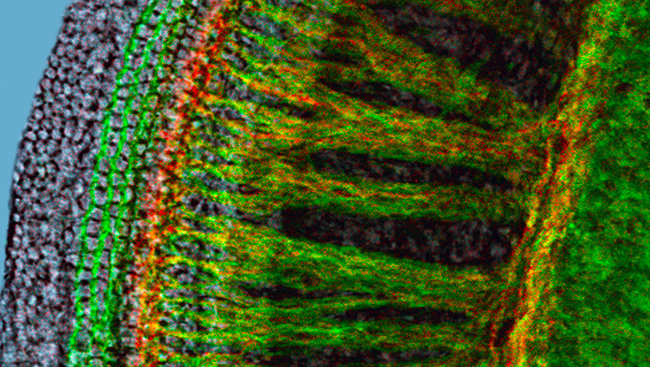 Annual Meeting Article Scientific ResearchMaterial below is adapted from the SfN Short Course, Multiple Sclerosis: From Bench to Bedside and Back Again, by Steven L. Hauser, MD. Short Courses are day-long scientific trainings on emerging neuroscience topics and research techniques held just prior to SfN’s annual meeting. The connection between the type of immune cells called B-cells and multiple sclerosis (MS) was confirmed after unblinding a phase II clinical trial in 2006. The story of the challenges and successes that clinicians and researchers have faced in studying this connection reveals that coupling laboratory and clinical research can improve the efficacy of translational medicine. MS is a disease in which the immune system attacks cells of the brain and spinal cord, yet symptoms observed in rodent models used in the 1970s likely came from problems with the peripheral nerves.May 15, 2018
 -
 Annual Meeting Video Professional DevelopmentThis Neuroscience 2017 event, based on the Entering Mentoring series, is designed for mentors of diverse trainees. Through an evidence-based approach, you will learn effective strategies to gain an understanding of best practices in mentoring. This event is led by master facilitators from the NIH National Research Mentoring Network (NRMN), whose mission is to provide all trainees across the biomedical sciences with evidence-based mentorship and professional development programming.May 8, 2018
 -
 Journal ArticleZebrafish have gained prominence as a model organism in neuroscience over the past several decades, generating key insight into the development and functioning of the vertebrate brain. However, techniques for whole-brain mapping in adult stage zebrafish are lacking. Here, we describe a pipeline built using open-source tools for whole-brain activity mapping in adult zebrafish. Our pipeline combines advances in histology, microscopy, and machine learning to capture c-fos activity across the entirety of the brain. Following tissue clearing, whole-brain images are captured using light-sheet microscopy and registered to the recently created adult zebrafish brain atlas (AZBA) for automated segmentation. By way of example, we used our pipeline to measure brain activity after zebrafish were subject to the novel tank test, one of the most widely used behaviors in adult zebrafish. c-fos levels peaked 15 min following behavior and several regions, including those containing serotoninergic and dopaminergic neurons, we...Mar 1, 2025




