



Filter
-
(133)
-
(735)
-
(4)
-
(1)
-
(47866)
-
(93)
-
(25)
-
(14)
-
(434)
-
(7)
-
(186)
-
(8)
-
(33)
-
(17)
-
(7)
-
(10)
-
(9)
-
(5)
-
(21)
-
(8)
-
(12)
-
(9)
-
(3)
-
(10)
-
(10)
-
(56)
-
(46)
-
(12)
-
(3)
-
(7)
-
(6)
-
(5)
-
(8)
-
(7)
-
(11)
-
(58)
-
(13)
-
(31)
-
(8)
-
(5)
-
(10)
-
(5)
-
(16)
-
(4)
9591 - 9600
of 52807 results
-
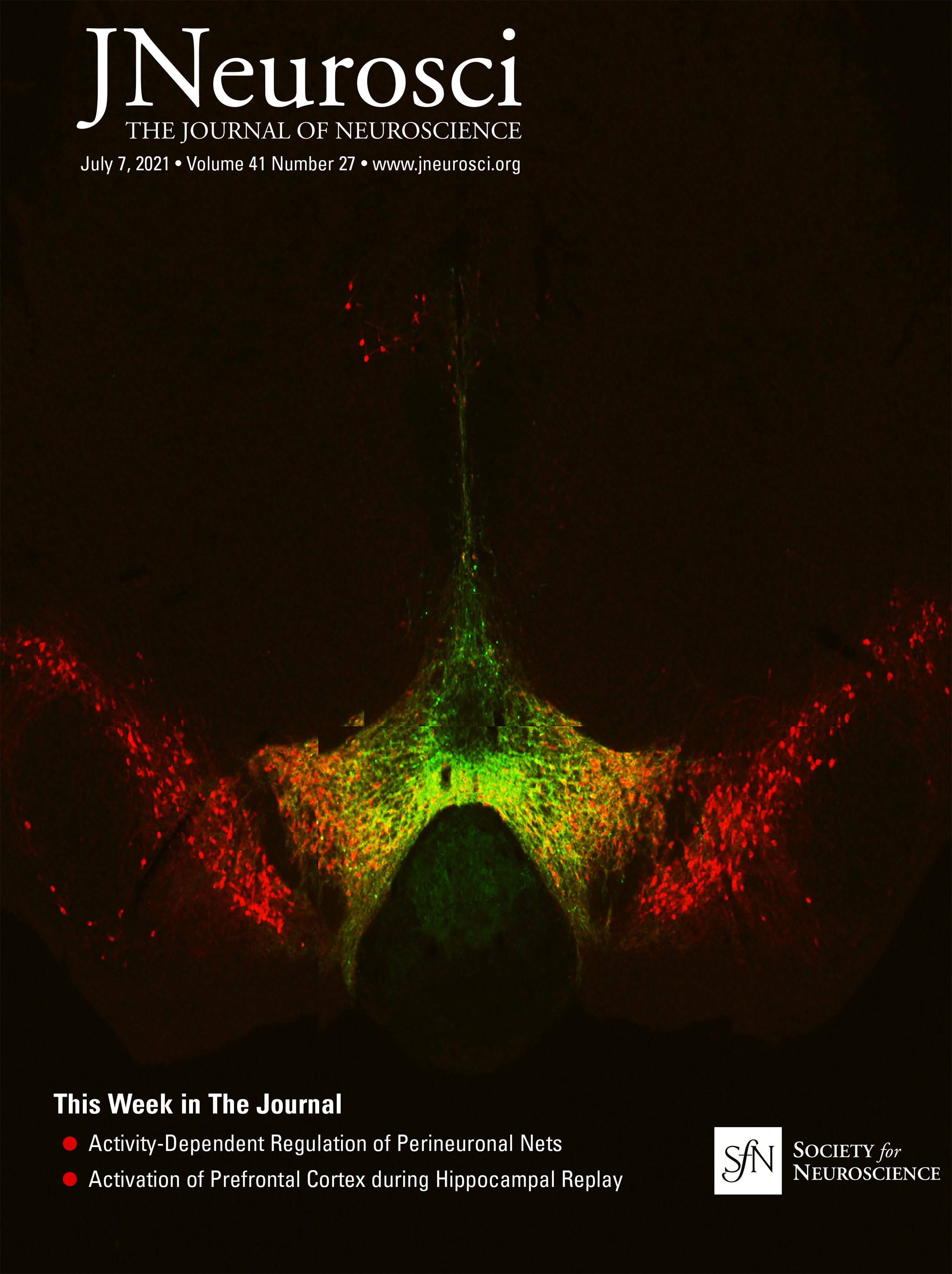 Journal ArticleRepeated cocaine exposure causes dendritic spine loss in the orbitofrontal cortex, which might contribute to poor orbitofrontal cortical function following drug exposure. One challenge, however, has been verifying links between neuronal structural plasticity and behavior, if any. Here we report that cocaine self-administration triggers the loss of dendritic spines on excitatory neurons in the orbitofrontal cortex of male and female mice (as has been reported in rats). To understand functional consequences, we locally ablated neuronal β1-integrins, cell adhesion receptors that adhere cells to the extracellular matrix and thus support dendritic spine stability. Degradation of β1-integrin tone: (1) caused dendritic spine loss, (2) exaggerated cocaine-seeking responses in a cue-induced reinstatement test, and (3) impaired the ability of mice to integrate new learning into familiar routines, a key function of the orbitofrontal cortex. Stimulating Abl-related gene kinase, overexpressing Proline-rich tyrosine kin...Jul 7, 2021
 -
Journal ArticleTransient receptor potential (TRP) channels are broadly required in animals for sensory physiology. To provide insights into regulatory mechanisms, the structures of many TRPs have been solved. This has led to new models, some of which have been tested in vitro . Here, using the classical TRP required for Drosophila visual transduction, we uncovered structural requirements for channel function in photoreceptor cells. Using a combination of molecular genetics, field recordings, protein expression analysis, and molecular modeling, we interrogated roles for the S4–S5 linker and the TRP domain, and revealed mutations in the S4–S5 linker that impair channel opening or closing. We also uncovered differential requirements for the two highly conserved motifs in the TRP domain for activation and protein stability. By performing genetic complementation, we found an intrasubunit interaction between the S4–S5 linker and the S5 segment that contributes to activation. This analysis highlights key structural requirements...Jul 7, 2021
-
Journal ArticleThe dorsal region of the bed nucleus of the stria terminalis (dBNST) receives substantial dopaminergic input which overlaps with norepinephrine input implicated in stress responses. Using ex vivo fast scan cyclic voltammetry in male C57BL6 mouse brain slices, we demonstrate that electrically stimulated dBNST catecholamine signals are of substantially lower magnitude and have slower uptake rates compared with caudate signals. Dopamine terminal autoreceptor activation inhibited roughly half of the catecholamine transient, and noradrenergic autoreceptor activation produced an ∼30% inhibition. Dopamine transporter blockade with either cocaine or GBR12909 significantly augmented catecholamine signal duration. We optogenetically targeted dopamine terminals in the dBNST of transgenic ( TH:Cre ) mice of either sex and, using ex vivo whole-cell electrophysiology, we demonstrate that optically stimulated dopamine release induces slow outward membrane currents and an associated hyperpolarization response in a subset ...Jul 7, 2021
-
Journal ArticleFragile X syndrome (FXS) is the leading monogenetic cause of cognitive impairment and autism spectrum disorder. Area CA1 of the hippocampus receives current information about the external world from the entorhinal cortex via the temporoammonic (TA) pathway. Given its role in learning and memory, it is surprising that little is known about TA long-term potentiation (TA-LTP) in FXS. We found that TA-LTP was impaired in male fmr1 KO mice. Although there were no significant differences in basal synaptic transmission, synaptically evoked dendritic calcium signals were smaller in KO neurons. Using dendritic recording, we found no difference in complex spikes or pharmacologically isolated Ca2+ spikes; however, the threshold for fast, Na+-dependent dendritic spikes was depolarized in fmr1 KO mice. Cell-attached patch-clamp recordings found no difference in Na+ channels between wild-type and fmr1 KO CA1 dendrites. Dendritic spike threshold and TA-LTP were restored by blocking A-type K+ channels with either 150 µm B...Jul 7, 2021
-
Journal ArticleInsect gustatory systems comprise multiple taste organs for detecting chemicals that signal palatable or noxious quality. Although much is known about how taste neurons sense various chemicals, many questions remain about how individual taste neurons in each taste organ control feeding. Here, we use the Drosophila pharynx as a model to investigate how taste information is encoded at the cellular level to regulate consumption of sugars and amino acids. We first generate taste-blind animals and establish a critical role for pharyngeal input in food selection. We then investigate feeding behavior of both male and female flies in which only selected classes of pharyngeal neurons are restored via binary choice feeding preference assays as well as Fly Liquid-Food Interaction Counter assays. We find instances of integration as well as redundancy in how pharyngeal neurons control behavioral responses to sugars and amino acids. Additionally, we find that pharyngeal neurons drive sugar feeding preference based on sw...Jul 7, 2021
-
Journal ArticleNeural circuitry generating locomotor rhythm and pattern is located in the spinal cord. Most spinal cord injuries (SCIs) occur above the level of spinal locomotor neurons; therefore, these circuits are a target for improving motor function after SCI. Despite being relatively intact below the injury, locomotor circuitry undergoes substantial plasticity with the loss of descending control. Information regarding cell type-specific plasticity within locomotor circuits is limited. Shox2 interneurons (INs) have been linked to locomotor rhythm generation and patterning, making them a potential therapeutic target for the restoration of locomotion after SCI. The goal of the present study was to identify SCI-induced plasticity at the level of Shox2 INs in a complete thoracic transection model in adult male and female mice. Whole-cell patch-clamp recordings of Shox2 INs revealed minimal changes in intrinsic excitability properties after SCI. However, afferent stimulation resulted in mixed excitatory and inhibitory in...Jul 7, 2021
-
Journal ArticleSystemic treatment with resiniferatoxin (RTX) induces small-fiber sensory neuropathy by damaging TRPV1-expressing primary sensory neurons and causes distinct thermal sensory impairment and tactile allodynia, which resemble the unique clinical features of postherpetic neuralgia. However, the synaptic plasticity associated with RTX-induced tactile allodynia remains unknown. In this study, we found that RTX-induced neuropathy is associated with α2δ-1 upregulation in the dorsal root ganglion (DRG) and increased physical interaction between α2δ-1 and GluN1 in the spinal cord synaptosomes. RNAscope in situ hybridization showed that RTX treatment significantly increased α2δ-1 expression in DRG neurons labeled with calcitonin gene-related peptide, isolectin B4, NF200, and tyrosine hydroxylase. Electrophysiological recordings revealed that RTX treatment augmented the frequency of miniature excitatory postsynaptic currents (mEPSCs) and the amplitude of evoked EPSCs in spinal dorsal horn neurons, and these effects we...Jul 7, 2021
-
Journal ArticleDiverse functions such as decision-making and memory consolidation may depend on communication between neurons in the hippocampus (HP) and prefrontal cortex (PFC). HP replay is a candidate mechanism to facilitate this communication, however details remain largely unknown because of the technical challenges of recording sufficient numbers of HP neurons for replay while also recording PFC neurons. Here, we implanted male rats with 40-tetrode drives, split between HP and PFC, during learning of a Y-maze spatial memory task. Surprisingly, we found that in contrast to their non-selectivity for maze arm during movement, a portion of PFC neurons were highly selective for HP replay of different arms. Moreover, PFC neurons' selectivity to HP non-local arm representation during running tended to match their replay arm selectivity and was predictive of future choice. Thus, PFC activity that is tuned to HP activity is best explained by non-local HP position representations rather than HP representation of actual posit...Jul 7, 2021
-
 Journal ArticleSome of the most impressive functional specialization in the human brain is found in occipitotemporal cortex (OTC), where several areas exhibit selectivity for a small number of visual categories, such as faces and bodies, and spatially cluster based on stimulus animacy. Previous studies suggest this animacy organization reflects the representation of an intuitive taxonomic hierarchy, distinct from the presence of face- and body-selective areas in OTC. Using human fMRI, we investigated the independent contribution of these two factors – the face-body division and taxonomic hierarchy – in accounting for the animacy organization of OTC, and whether they might also be reflected in the architecture of several deep neural networks that have not been explicitly trained to differentiate taxonomic relations. We found that graded visual selectivity, based on animal resemblance to human faces and bodies, masquerades as an apparent animacy continuum, which suggests that taxonomy is not a separate factor underlying th...Jul 6, 2021
 -
Journal ArticleOver the past decades, a plethora of studies have linked cortical γ oscillations (∼30–100 Hz) to neurocomputational mechanisms. Their functional relevance, however, is still passionately debated. Here, we asked whether endogenous γ oscillations in the human brain can be entrained by a rhythmic photic drive >50 Hz. A noninvasive modulation of endogenous brain rhythms allows conclusions about their causal involvement in neurocognition. To this end, we systematically investigated oscillatory responses to a rapid sinusoidal flicker in the absence and presence of endogenous γ oscillations using magnetoencephalography (MEG) in combination with a high-frequency projector. The photic drive produced a robust response over visual cortex to stimulation frequencies of up to 80 Hz. Strong, endogenous γ oscillations were induced using moving grating stimuli as repeatedly done in previous research. When superimposing the flicker and the gratings, there was no evidence for phase or frequency entrainment of the endogenous ...Jul 6, 2021




