



Filter
-
(133)
-
(733)
-
(4)
-
(1)
-
(47830)
-
(91)
-
(25)
-
(14)
-
(433)
-
(7)
-
(181)
-
(8)
-
(33)
-
(17)
-
(7)
-
(9)
-
(9)
-
(5)
-
(21)
-
(8)
-
(12)
-
(9)
-
(3)
-
(10)
-
(10)
-
(56)
-
(45)
-
(12)
-
(3)
-
(7)
-
(6)
-
(5)
-
(8)
-
(7)
-
(11)
-
(58)
-
(13)
-
(30)
-
(8)
-
(5)
-
(10)
-
(5)
-
(14)
-
(4)
801 - 810
of 52751 results
-
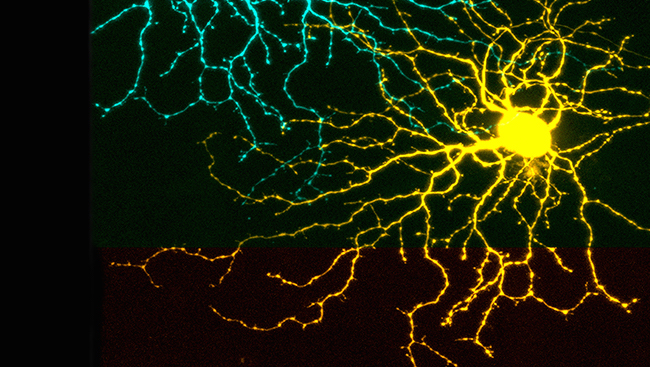 Article Scientific ResearchMaterial below summarizes the article, Facilitated Event-Related Power Modulations during Transcranial Alternating Current Stimulation (tACS) Revealed by Concurrent tACS-MEG, published on June 25, 2018, in eNeuro and authored by Florian H. Kasten, Burkhard Maess, and Christoph S. Herrmann Relationships between brain oscillations and human cognition are traditionally performed using imaging modalities, such as magneto- or electroencephalography (M/EEG). For almost a century, these methods were successfully used to identify oscillatory brain activity within different frequency bands and associate them with numerous cognitive functions, as well as several neurological and psychiatric disorders. However, as these methods provide observational data, inference about relationships between brain oscillations and cognition remains mostly correlational.Nov 5, 2020
 -
 Article Professional DevelopmentWhen it comes to growing in your career, building a diverse team of mentors, instead of having just one, can be valuable.Nov 4, 2020
 -
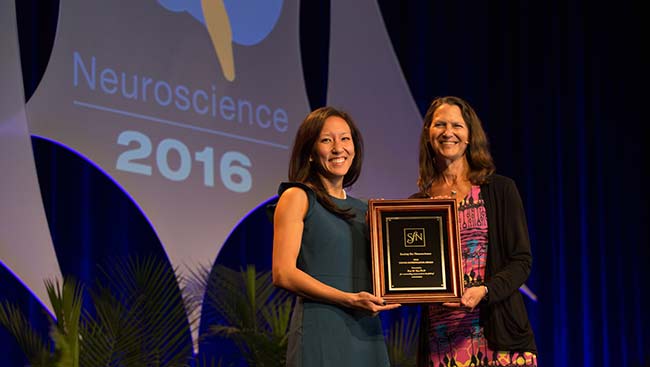 Article Professional DevelopmentKay Tye’s pioneering work with projection-specific optogenetics has built a strong foundation for future insights into healthy and addiction-related behaviors.Oct 29, 2020
 -
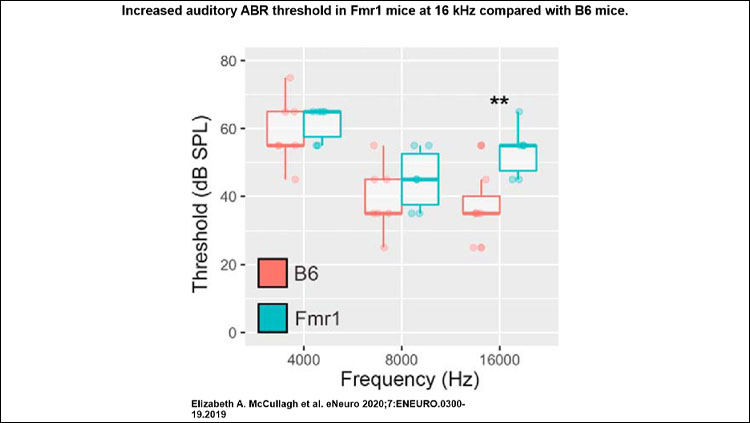 Article Scientific ResearchMaterial below summarizes the article Characterization of Auditory and Binaural Spatial Hearing in a Fragile X Syndrome Mouse Model, published on January 17, 2020, in eNeuro and authored by Elizabeth A. McCullagh, Shani Poleg, Nathaniel T. Greene, Molly M. Huntsman, Daniel J. Tollin, and Achim Klug. Fragile X Syndrome (FXS) mice have decreased inhibition of acoustic startle responses under several auditory conditions including gaps in noise, large changes in sound source positions, and discrimination of target sounds from background noise compared to wildtype control mice. FXS mice took longer to respond to startling sounds in most conditions suggesting additional impairments to pathways underlying when to respond. FXS mouse models exhibit similar hearing impairments to humans with FXS.Oct 28, 2020
 -
 Video Outreach“I really wanted to have constant communication and constant impact with our local community,” explains Edith Brignoni-Pérez, PhD candidate at Georgetown University Medical Center who also served as president and secretary of SfN’s DC Metro Area Chapter. As president, Brignoni-Pérez intentionally branched out further into her community. She achieved success by hosting impactful events, listening to her team, and collaborating with other institutions and organizations. Ultimately, she believes, “A leader will never be successful if they don’t put the knowledge they have about their community in the context of compassion.” Watch this video to hear more insight from Brignoni-Pérez to help you conduct outreach in your own community or lead your local SfN chapter.Oct 27, 2020
 -
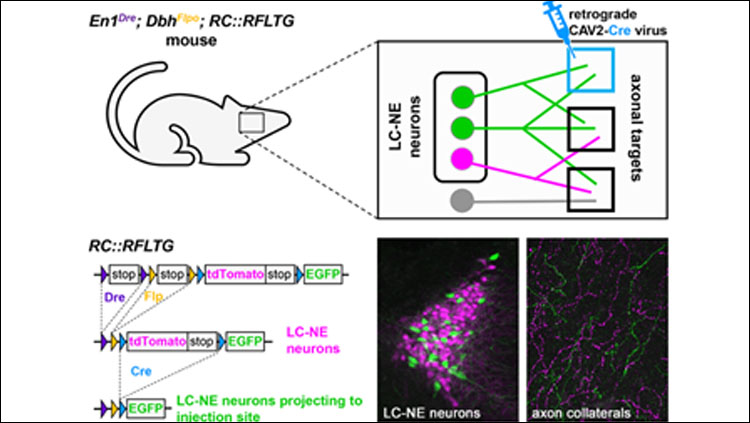 Article Scientific ResearchMaterial below summarizes the article An Intersectional Viral-Genetic Method for Fluorescent Tracing of Axon Collaterals Reveals Details of Noradrenergic Locus Coeruleus Structure, published on April 30, 2020, in eNeuro and authored by Nicholas W. Plummer, Daniel J. Chandler, Jeanne M. Powell, Erica L. Scappini, Barry D. Waterhouse and Patricia Jensen. Highlights TrAC (Tracing Axon Collaterals) is a new viral-genetic method that allows simultaneous visualization of axon collaterals from a genetically defined neuronal population and a projection-based subpopulation. TrAC was used to show that norepinephrine (NE)-containing locus coeruleus (LC) neurons projecting to the medial prefrontal cortex and primary motor cortex differ from each other and from the LC as a whole in their pattern of axon collateralization. Labeled LC-NE neurons have dense axon projections to their primary target in the cerebral cortex, and widespread, albeit sparse, collateral projections to other cortical and subcortical regions.Oct 22, 2020
 -
 Article AdvocacyIt should be clear to us by now that science is done by actual people whose intersectional identities, and the social challenges and trauma that come with them, don’t disappear when they enter the lab. Regardless of where they are, Black scholars and those belonging to other marginalized groups face overt, implicit, and systemic racism on a daily basis. Particularly in the last few years, US-based international researchers have regularly faced xenophobic and anti-immigrant policies from their host nation. This year, international students and postdocs experienced damaging threats to their presence, security, and peace of mind as a result of new anti-immigrant policies targeting their visa programs. Many scientists promptly took to social media to respond to these actions.Oct 20, 2020
 -
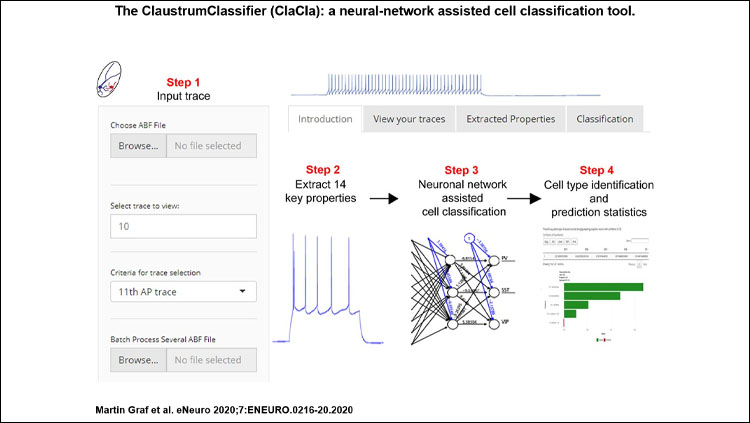 Article Scientific ResearchMaterial below summarizes the article Identification of Mouse Claustral Neuron Types Based on Their Intrinsic Electrical Properties, published on June 11, 2020, in eNeuro and authored by Martin Graf, Aditya Nair, Kelly L.L. Wong, Yanxia Tang and George J. Augustine. Highlights Claustral neurons consist of at least three types of inhibitory interneurons and five types of excitatory projection neurons. Claustral neurons that project to different brain areas differ in their electrical properties. A user-friendly tool allows you to use our classification scheme to identify neurons in your own cell recordings.Oct 15, 2020
 -
 Article Professional DevelopmentThe right postdoc can help you gain key skills for the next step in your career, and it takes an intentional plan to select the right one. To help you identify and secure a postdoc that best fits your goals, SfN has created a toolkit to help you strategically explore career options, develop relevant transferable skills, network with potential mentors, and negotiate the position right for you. Explore the toolkit’s ready-to-use presentation to learn how to: - Explore career options and decide on your next steps. - Build the skills and network you need for career advancement. - Highlight your value on a CV or resume. - Identify and secure a postdoc position. - Plan your postdoc to help you achieve future career advancement. - This toolkit can be shared with an audience or studied independently to learnOct 14, 2020
 -
 Article CommunityBIPOC scientists face unique challenges in their careers, from undervaluing of their work to microaggressions and tokenism at their institutions. In this interview, Pablo Wickham, Marguerite Matthews, and Nii Addy share their advice for Black students and researchers navigating these and other challenges. This interview is a follow-up to SfN’s recent webinar, Black Lives Matter and Neuroscience: Why This Moment Matters. Hear more from Wickham, Matthews, and Addy, by watching the webinar on Neuronline or reading their recent live chat where they answer member questions directly.Oct 13, 2020




