



Filter
-
(133)
-
(735)
-
(4)
-
(1)
-
(47864)
-
(93)
-
(25)
-
(14)
-
(434)
-
(7)
-
(186)
-
(8)
-
(33)
-
(17)
-
(7)
-
(10)
-
(9)
-
(5)
-
(21)
-
(8)
-
(12)
-
(9)
-
(3)
-
(10)
-
(10)
-
(56)
-
(46)
-
(12)
-
(3)
-
(7)
-
(6)
-
(5)
-
(8)
-
(7)
-
(11)
-
(58)
-
(13)
-
(31)
-
(8)
-
(5)
-
(10)
-
(5)
-
(16)
-
(4)
9591 - 9600
of 52805 results
-
 Journal ArticleRepeated cocaine exposure causes dendritic spine loss in the orbitofrontal cortex, which might contribute to poor orbitofrontal cortical function following drug exposure. One challenge, however, has been verifying links between neuronal structural plasticity and behavior, if any. Here we report that cocaine self-administration triggers the loss of dendritic spines on excitatory neurons in the orbitofrontal cortex of male and female mice (as has been reported in rats). To understand functional consequences, we locally ablated neuronal β1-integrins, cell adhesion receptors that adhere cells to the extracellular matrix and thus support dendritic spine stability. Degradation of β1-integrin tone: (1) caused dendritic spine loss, (2) exaggerated cocaine-seeking responses in a cue-induced reinstatement test, and (3) impaired the ability of mice to integrate new learning into familiar routines, a key function of the orbitofrontal cortex. Stimulating Abl-related gene kinase, overexpressing Proline-rich tyrosine kin...Jul 7, 2021
 -
Journal ArticleIdentifying true motivation for Pareto lies, which are mutually beneficial for both the liar and others, can be challenging because different covert motivations can lead to identical overt behavior. In this study, we adopted a brain-fingerprinting approach, combining both univariate and multivariate analyses to estimate individual measures of selfish motivation in Pareto lies by the degree of multivoxel neural representation in the mPFC for Pareto lies conforming with those for selfish versus altruistic lies in human participants of either sex. An increase in selfish motivation for Pareto lies was associated with higher mean-level activity in both ventral and rostral mPFC. The former showed an increased pattern similarity to selfish lies, and the latter showed a decreased pattern similarity to altruistic lies. Higher ventral mPFC pattern similarity predicted faster response time in Pareto lies. Our findings demonstrated that hidden selfish motivation in white lies can be revealed by neural representation i...Jul 7, 2021
-
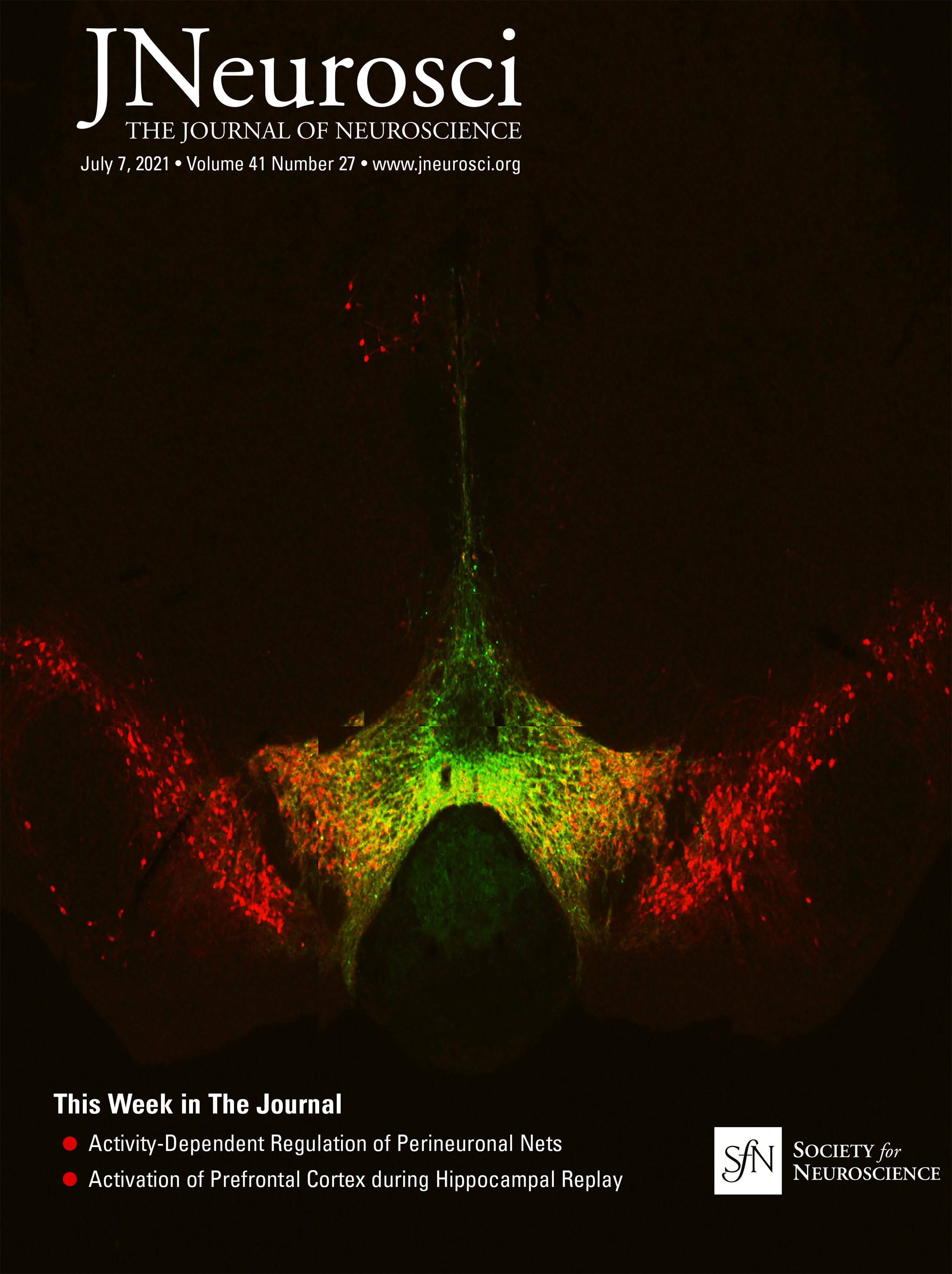
Journal ArticlePerineuronal net (PNN) accumulation around parvalbumin-expressing (PV) inhibitory interneurons marks the closure of critical periods of high plasticity, whereas PNN removal reinstates juvenile plasticity in the adult cortex. Using targeted chemogenetic in vivo approaches in the adult mouse visual cortex, we found that transient inhibition of PV interneurons, through metabotropic or ionotropic chemogenetic tools, induced PNN regression. EEG recordings indicated that inhibition of PV interneurons did not elicit unbalanced network excitation. Likewise, inhibition of local excitatory neurons also induced PNN regression, whereas chemogenetic excitation of either PV or excitatory neurons did not reduce the PNN. We also observed that chemogenetically inhibited PV interneurons exhibited reduced PNN compared with their untransduced neighbors, and confirmed that single PV interneurons express multiple genes enabling individual regulation of their own PNN density. Our results indicate that PNN density is regulated in...Jul 7, 2021
-
Journal ArticleThis is the story of a search for a cortical map of auditory space. The search began with a study that was reported in the first issue of The Journal of Neuroscience ([Middlebrooks and Pettigrew, 1981][1]). That paper described some unexpected features of spatial sensitivity in the auditory cortex while failing to demonstrate the expected map. In the ensuing 40 years, we have encountered the following: panoramic spatial coding by single neurons; a rich variety of response patterns that are unmasked in the absence of general anesthesia; sharpening of spatial sensitivity when an animal is engaged in a listening task; and reorganization of spatial sensitivity in the presence of competing sounds. We have not encountered a map, but not through lack of trying. On the basis of years of negative results by our group and others, and positive results that are inconsistent with static point-to-point topography, we are confident in concluding that there just ain't no map. Instead, we have come to appreciate the highly...Jul 7, 2021
-
-
Journal ArticleGabrielle Devienne, Sandrine Picaud, Ivan Cohen, Juliette Piquet, Ludovic Tricoire, et al. (see pages [5779–5790][1]) Critical periods of heightened plasticity are a common feature of cortical development. For example, blocking input from one eye during a short window after eye opening greatlyJul 7, 2021
-
 Journal ArticleMotivational deficits characterized by an unwillingness to overcome effortful costs are a common feature of neuropsychiatric and neurological disorders that are insufficiently understood and treated. Dopamine (DA) signaling in the nucleus accumbens (NAc) facilitates goal-seeking, but how NAc DA release encodes motivationally-salient stimuli to influence effortful investment is not clear. Using fast-scan cyclic voltammetry (FSCV) in male and female mice, we find that NAc DA release diametrically responds to cues signaling increasing cost of reward, while DA release to the reward itself is unaffected by its cost. Because endocannabinoid (eCB) signaling facilitates goal-seeking and NAc DA release, we further investigated whether repeated augmentation of the eCB 2-arachidonoylglycerol (2-AG) with a low dose of a monoacylglycerol lipase (MAGL) inhibitor facilitates motivation and DA signaling without the development of tolerance. We find that chronic MAGL treatment stably facilitates goal-seeking and DA encodin...Jul 6, 2021
 -
Journal ArticleSome of the most impressive functional specialization in the human brain is found in occipitotemporal cortex (OTC), where several areas exhibit selectivity for a small number of visual categories, such as faces and bodies, and spatially cluster based on stimulus animacy. Previous studies suggest this animacy organization reflects the representation of an intuitive taxonomic hierarchy, distinct from the presence of face- and body-selective areas in OTC. Using human fMRI, we investigated the independent contribution of these two factors – the face-body division and taxonomic hierarchy – in accounting for the animacy organization of OTC, and whether they might also be reflected in the architecture of several deep neural networks that have not been explicitly trained to differentiate taxonomic relations. We found that graded visual selectivity, based on animal resemblance to human faces and bodies, masquerades as an apparent animacy continuum, which suggests that taxonomy is not a separate factor underlying th...Jul 6, 2021
-
Journal ArticleOver the past decades, a plethora of studies have linked cortical γ oscillations (∼30–100 Hz) to neurocomputational mechanisms. Their functional relevance, however, is still passionately debated. Here, we asked whether endogenous γ oscillations in the human brain can be entrained by a rhythmic photic drive >50 Hz. A noninvasive modulation of endogenous brain rhythms allows conclusions about their causal involvement in neurocognition. To this end, we systematically investigated oscillatory responses to a rapid sinusoidal flicker in the absence and presence of endogenous γ oscillations using magnetoencephalography (MEG) in combination with a high-frequency projector. The photic drive produced a robust response over visual cortex to stimulation frequencies of up to 80 Hz. Strong, endogenous γ oscillations were induced using moving grating stimuli as repeatedly done in previous research. When superimposing the flicker and the gratings, there was no evidence for phase or frequency entrainment of the endogenous ...Jul 6, 2021
-
Journal ArticlePaternal care plays a critical role in the development of brain and behaviors in offspring in monogamous species. However, the neurobiological mechanisms, especially the neuronal circuity, underlying paternal care is largely unknown. Using socially monogamous male mandarin voles ( Microtus mandarinus ) with high levels of paternal care, we found that paraventricular nucleus of the hypothalamus (PVN) to ventral tegmental area (VTA) or nucleus accumbens (NAc) oxytocin (OT) neurons are activated during paternal care. Chemogenetic activation/inhibition of the PVN OT projection to VTA promoted/decreased paternal care, respectively. Chemogenetic inhibition of the PVN to VTA OT pathway reduced dopamine (DA) release in the NAc of male mandarin voles during licking and grooming of pups as revealed by in vivo fiber photometry. Optogenetic activation/inhibition of the VTA to NAc DA pathway possibly enhanced/suppressed paternal behaviors, respectively. Furthermore, chemogenetic activation/inhibition of PVN to NAc OT c...Jul 5, 2021




