



Filter
-
(133)
-
(733)
-
(4)
-
(1)
-
(47833)
-
(91)
-
(25)
-
(14)
-
(433)
-
(7)
-
(182)
-
(8)
-
(33)
-
(17)
-
(7)
-
(9)
-
(9)
-
(5)
-
(21)
-
(8)
-
(12)
-
(9)
-
(3)
-
(10)
-
(10)
-
(56)
-
(45)
-
(12)
-
(3)
-
(7)
-
(6)
-
(5)
-
(8)
-
(7)
-
(11)
-
(58)
-
(13)
-
(30)
-
(8)
-
(5)
-
(10)
-
(5)
-
(15)
-
(4)
1831 - 1840
of 52756 results
-
 Journal ArticleSelective modifications in the expression or function of dendritic ion channels regulate the propagation of synaptic inputs and determine the intrinsic excitability of a neuron. Hyperpolarization-activated cyclic nucleotide–gated (HCN) channels open upon membrane hyperpolarization and conduct a depolarizing inward current ( I h). HCN channels are enriched in the dendrites of hippocampal pyramidal neurons where they regulate the integration of synaptic inputs. Synaptic plasticity can bidirectionally modify dendritic HCN channels in excitatory neurons depending on the strength of synaptic potentiation. In inhibitory neurons, however, the dendritic expression and modulation of HCN channels are largely unknown. In this study, we systematically compared the modulation of I h by synaptic potentiation in hippocampal CA1 pyramidal neurons and stratum radiatum (sRad) interneurons in mouse organotypic cultures. I h properties were similar in inhibitory and excitatory neurons and contributed to resting membrane poten...Nov 1, 2024
 -
Journal ArticleFear generalization is a hallmark of anxiety disorders. Experimentally, fear generalization can be difficult to dissociate from its counterpart, fear discrimination. Here, we use minimal threat learning procedures to reveal such a dissociation. We show that in Long–Evans rats, an auditory threat cue predicting footshock on 10% of trials produces a discriminated fear response that does not generalize to a neutral auditory cue. In contrast, even slightly higher footshock probabilities (30 and 20%) produce fear generalization. AAV-mediated, caspase-3 deletion of ventral pallidum neurons abolishes fear generalization and reduces threat cue responding during extinction. The ventral pallidum's contribution to fear generalization and extinction threat responding does not depend on inputs from the nucleus accumbens. The results demonstrate a minimal threat learning approach to dissociate fear discrimination from fear generalization and a novel role for the ventral pallidum in generalizing and expressing fear.Nov 1, 2024
-
 Journal ArticleRelationships among membrane currents allow central pattern generator (CPG) neurons to reliably drive motor programs. We hypothesize that continually active CPG neurons utilize activity-dependent feedback to correlate expression of ion channel genes to balance essential membrane currents. However, episodically activated neurons experience absences of activity-dependent feedback and, thus, presumably employ other strategies to coregulate the balance of ionic currents necessary to generate appropriate output after periods of quiescence. To investigate this, we compared continually active pyloric dilator (PD) neurons with episodically active lateral gastric (LG) CPG neurons of the stomatogastric ganglion (STG) in male Cancer borealis crabs. After experimentally activating LG for 8 h, we measured three potassium currents and abundances of their corresponding channel mRNAs. We found that ionic current relationships were correlated in LG's silent state, but ion channel mRNA relationships were correlated in the a...Nov 1, 2024
 -
Journal ArticleThis study aims to elucidate the methodology and compare the accuracy of different blood biomarkers for diagnosing ischemic stroke (IS). We reviewed 29 articles retrieved from PubMed, MEDLINE, Web of Science, and CINAHL Plus with Full Text. Among these, 23 articles involving 3,494 participants were suitable for meta-analysis. The pooled area under the curve (AUC) of all studies for meta-analysis was 0.89. The pooled sensitivity and specificity were 0.76 (0.74–0.78) and 0.84 (0.83–0.86), respectively. Blood biomarkers from noninpatient settings demonstrated better diagnostic performance than those in inpatient settings (AUC 0.91 vs 0.88). Smaller sample sizes (<100) showed better performance than larger ones (≥100; AUC 0.92 vs 0.86). Blood biomarkers from acute IS (AIS) patients showed higher diagnostic values than those from IS and other stroke types (AUC 0.91 vs 0.87). The diagnostic performance of multiple blood biomarkers was superior to that of a single biomarker (AUC 0.91 vs 0.88). The diagnostic valu...Nov 1, 2024
-
 Journal ArticleAge-related brain changes affect sleep and are reflected in properties of sleep slow-waves, however, the precise mechanisms behind these changes are still not completely understood. Here, we adapt a previously established whole-brain model relating structural connectivity changes to resting state dynamics, and extend it to a slow-wave sleep brain state. In particular, starting from a representative connectome at the beginning of the aging trajectory, we have gradually reduced the inter-hemispheric connections, and simulated sleep-like slow-wave activity. We show that the main empirically observed trends, namely a decrease in duration and increase in variability of the slow waves are captured by the model. Furthermore, comparing the simulated EEG activity to the source signals, we suggest that the empirically observed decrease in amplitude of the slow waves is caused by the decrease in synchrony between brain regions.Nov 1, 2024
 -
 Journal ArticleAggression and mating of male mice are strongly associated with Esr1-expressing neurons in the bed nucleus of the stria terminalis (BNSTpr) and hypothalamus in the vomeronasal pathway. By projecting to the downstream hypothalamus, the upstream BNSTprEsr1 gates mating and aggression of male mice and maternal behavior of female mice. The medial preoptic area (MPOA) and ventrolateral subdivision of the ventromedial hypothalamus (VMHvl) are two subdivisions of the hypothalamus downstream. In addition to receiving projections from upstream BNSTpr, there is also a mutual projection between MPOA and VMHvl. In the process of transforming sex information into mating and aggression, Esr1-expressing neurons in BNSTpr, MPOA, and VMHvl act as messengers of information, finally producing inhibitory or excitatory projection. These projections are different in direction, but they all work together to control the behavior selection that is most conducive to defense and reproduction when male mice encounter female or male m...Nov 1, 2024
 -
 Journal ArticleBrain-derived estrogen (17β-estradiol, E2) is a neuromodulator that plays important roles in neural plasticity and network excitability. Chronic inhibition of estrogen synthesis is used in adjuvant breast cancer therapy for estrogen receptor-positive tumors and may have been associated with cognitive and affective side effects. Here, we have developed a model of adjuvant therapy in female ovariectomized mice in which the E2 biosynthetic enzyme aromatase is inhibited by letrozole (1 mg/kg/day, i.p., for up to 3 weeks), Using two-photon longitudinal in vivo imaging in Thy1-GFP-M mice, we found that spine density in the apical dendrites of neocortical layer 5 pyramidal cells was unaffected by letrozole treatment but spine turnover was reduced. LTP in layer 4 to layer 2/3 synapses in the somatosensory cortex was also reduced in slices from letrozole-treated mice, showing deficits in structural and functional plasticity resulting from aromatase inhibition. Ovariectomized mice performed worse than intact control...Nov 1, 2024
 -
 Article Professional DevelopmentJoshua Levitz has developed new approaches to study G protein-coupled receptors, a type of receptor found in cell membranes. He created a method to manipulate the activity of these receptors with synthetic chemical photo-switches.Apr 19, 2016
 -
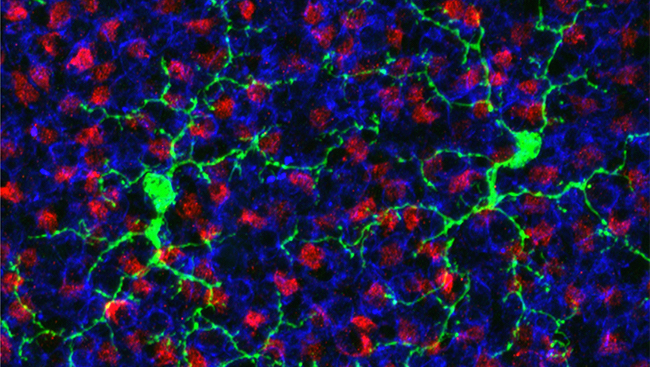 Article Scientific ResearchIn everyday life, emotional scenes captivate us, and we remember them more readily than ordinary scenes and events. Pathways that convey sensory signals reach neurons in the thalamus, which then convey the signals to the cerebral cortex, the brain’s outer rim.Apr 14, 2016
 -
 Article Professional DevelopmentIn its Gray Matters report, the United States Presidential Commission for the Study of Bioethical Issues underscored the importance of integrating ethics and neuroscience early and throughout the research endeavor.Apr 14, 2016




