



Filter
-
(133)
-
(733)
-
(4)
-
(1)
-
(47830)
-
(91)
-
(25)
-
(14)
-
(433)
-
(7)
-
(181)
-
(8)
-
(33)
-
(17)
-
(7)
-
(9)
-
(9)
-
(5)
-
(21)
-
(8)
-
(12)
-
(9)
-
(3)
-
(10)
-
(10)
-
(56)
-
(45)
-
(12)
-
(3)
-
(7)
-
(6)
-
(5)
-
(8)
-
(7)
-
(11)
-
(58)
-
(13)
-
(30)
-
(8)
-
(5)
-
(10)
-
(5)
-
(14)
-
(4)
761 - 770
of 52751 results
-
 Journal ArticleAversion modulation is a key component of hedonic processing, and its dysfunction is evident in psychiatric illnesses. The infralimbic cortex (IL) to nucleus accumbens shell (NAcSh) pathway is essential in hedonic processing in rodents but operates differentially across sex, with beta (20 Hz) oscillatory activity involved in learned aversion in male but not female rats. In this study, we used taste reactivity (TR) and electrophysiology to examine the role of high gamma (80 Hz) activity in affect modulation, specifically innate (quinine) and learned (conditioned taste aversion, CTA) aversion, in male and female Sprague Dawley rats. Local field potential (LFP) recordings in males showed no changes in IL or NAcSh activity, or in IL→NAcSh functional connectivity, in the high gamma frequency band during innate or learned aversion. In contrast, in females, quinine elicited an increase in IL and NAcSh 80 Hz LFP activity and IL→NAcSh functional connectivity. Interestingly, LFP directionality analyses in females in...Sep 1, 2025
 -
 Journal ArticleCancer patients experience circadian rhythm disruptions during and after chemotherapy that can contribute to debilitating side effects. It is unknown how chemotherapy mediates circadian disruptions and specifically the extent to which these disruptions occur at the level of the principal clock, the suprachiasmatic nuclei (SCN) of the hypothalamus. In the present study, we assessed how the commonly used chemotherapeutic, paclitaxel, impacts the SCN molecular clock and SCN-dependent behavioral adaptations to circadian challenges in female mice. Following a repeated chemotherapy regimen, we measured rhythmic SCN expression of molecular clock and circadian-associated transcripts. Paclitaxel chemotherapy disrupted the SCN molecular clock through abolished rhythmicity ( Bmal1 , Nr1d2 ) and damped rhythmic transcription ( Ciart , Dbp , Nr1d1 , Per2 ) of key molecular clock genes. We further determined chemotherapy-induced changes to SCN function by measuring circadian wheel running adaptations to a jet lag phase-...Sep 1, 2025
 -
 Journal ArticleThe causal relationship between gut microbiota (GM) and white matter injury and communication remains unclear. We aimed to scrutinize the plausible causal impact of GM on white matter hyperintensities (WMHs), white matter microstructure, white matter connectivity, and multiple neurological diseases via Mendelian randomization study. We identified four WMH-related bacterial taxa, including class Melainabacteria , order Gastranaerophilales , family Alcaligenaceae , and genus Ruminiclostridium 6 . In addition, three bacterial taxa were discovered that have consistent effect on multiple aspects of white matter microstructure. Furthermore, we found 12 strong associations between genetic liability in GM and white matter connectivity. Among these bacterial taxa, the family Clostridiaceae 1 demonstrated a protective effect against ischemic stroke (IS). The genus Barnesiella showed protective effect on IS and small vessel stroke while posed a risk effect on neuromyelitis optica spectrum disorder (NMOSD), as well as...Sep 1, 2025
 -
 Article Scientific ResearchWhy we need neuro-psychiatric monitoring and registries during the Global Pandemic There is a growing awareness of COVID-19-associated CNS dysfunction likely caused by SARS-CoV-2 direct or indirect CNS invasion. This raises the possibility of a neuro-phenotype of COVID-19 with acute and delayed neuro-psychiatric effects. To this end, a few groups are advocating for prospective trials to monitor the evolution of neurologic symptoms associated with COVID-19 as well as the establishment of International COVID-19 Neurologic Registries. There are multiple potential benefits to neuro-psych registries and clinical trials.Feb 3, 2021
 -
 Article Professional DevelopmentFour years ago, in my second year of graduate school, I wrote about coping with failure as a graduate student. I was frustrated I couldn’t answer scientific questions because I was spending all of my time trying to get basic techniques to work. Since then, I continued to experience disappointment, both in and out of the lab. I’ve recently been reflecting on what I would now tell my younger self, and I’m sharing those thoughts in the hope that they might help someone else. Let yourself grieve. When we experience disappointment, there’s a sharp emotional response. That response has to pass before we can evaluate what happened and decide what to do next. The first few times we’re disappointed, it takes a long time to process and dispel our negative feelings. Eventually, we begin to heal from disappointment faster. We can’t force rational processes onto emotion – emotions happen in their own time, through a system older and deeper than our executive functioning. But we can understand how our own feelings work and create space for them to happen and to minimize the damage they inflict on our lives. That can mean taking an afternoon or day to sulk after a frustrating experiment or “not discussed” grant application. The pain will eventually subside, and then you can think. And each time, with each disappointment, the cycle will get shorter.Jan 28, 2021
 -
 Video Webinar AdvocacyAfter watching the video below, join us February 10th at 1:00pm for a live chat on the Neuronline Community and learn about the ways you can incorporate more sustainable practices in your work, and ask your questions on how to help move the field towards an environmentally friendly framework This special interest event from the FENS (Federation of European Neuroscience Societies) 2020 Virtual Forum offered an opportunity to discuss what scientists can do to adopt a more sustainable model for life sciences. The organizers presented the results of a small survey performed among neuroscientists and their research institutes to trigger discussion and start identifying solutions regarding the environmental footprint of the life science community. A panel of academics, activists, and life science industry representatives, among others, shared their viewpoints and experiences implementing concrete actions towards an environmentally friendly life science framework. Learn more and check out the conversations in the video (above or below). Organized by FENS-Kavli Network of Excellence (FKNE).Jan 27, 2021
 -
 Video Annual Meeting OutreachRecent studies in the field of neuroscience illustrate the importance of creativity across our life spans. Using examples such as ballet lessons before kindergarten, band practice in college, and music therapy following a stroke, among others, this Public Advocacy Forum panel explore how and why the arts influence us so deeply and how we can use creativity to be healthier and more productive throughout our lives.Jan 27, 2021
 -
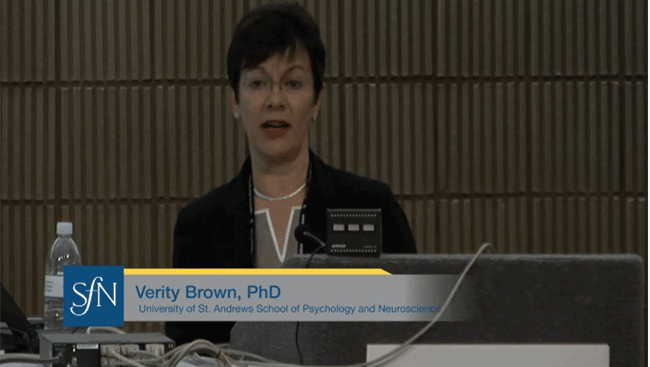 Video Annual Meeting Professional DevelopmentThis playlist walks through the entire process of deciding when to write, how to write, and where to publish your manuscript. Verity Brown, editor-in-chief of Neuroscience & Biobehavioral Reviews, discusses many helpful tips and tricks that these videos can help any neuroscientist learn new things about getting published.Jan 26, 2021
 -
 Article Scientific ResearchMaterial below summarizes the article, Vibrational Detection of Odorant Functional Groups by Drosophila Melanogaster, published on October 26, 2017, in eNeuro and authored by Klio Maniati, Katherine-Joanne Haralambous, Luca Turin, and Efthimios M.C. Skoulakis. We are interested in tests that could help decide between the vibrational theory of odor and the lock-and-key theory, a controversial question in the field of olfaction. Is odor character of a molecule determined by its shape or its vibrations? In a shape theory, the smell of an odorant is encoded in the shape of the odorant molecule, which in turn determines the receptors in which it fits. This is a lock-and-key theory: the shapes of both locks and keys matter to the pattern of receptor activation. Picture a thought experiment in which the shapes of the olfactory receptor binding sites are all altered, while leaving wiring identical to the brain. The receptor activation pattern will be different, and therefore odorants will be perceived to have a different smell or odor character.Jan 21, 2021
 -
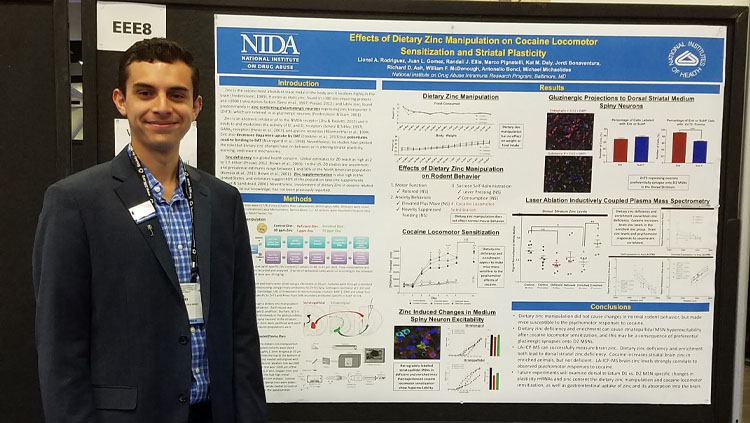 Article CommunityLionel Rodriguez is a neuroscience PhD candidate at Johns Hopkins. In this interview, Lionel discusses dealing with implicit bias and imposter syndrome. As a Gay, Latinx scientist, he also gives his hopes for the future of approaching discussions of equitable treatment and inclusion of historically marginalized communities in STEM.Jan 19, 2021




