



Filter
-
(133)
-
(735)
-
(4)
-
(1)
-
(47863)
-
(93)
-
(25)
-
(14)
-
(434)
-
(7)
-
(186)
-
(8)
-
(33)
-
(17)
-
(7)
-
(10)
-
(9)
-
(5)
-
(21)
-
(8)
-
(12)
-
(9)
-
(3)
-
(10)
-
(10)
-
(56)
-
(46)
-
(12)
-
(3)
-
(7)
-
(6)
-
(5)
-
(8)
-
(7)
-
(11)
-
(58)
-
(13)
-
(31)
-
(8)
-
(5)
-
(10)
-
(5)
-
(16)
-
(4)
9591 - 9600
of 52804 results
-
 Journal ArticleFragile X syndrome (FXS) is the leading monogenetic cause of cognitive impairment and autism spectrum disorder. Area CA1 of the hippocampus receives current information about the external world from the entorhinal cortex via the temporoammonic (TA) pathway. Given its role in learning and memory, it is surprising that little is known about TA long-term potentiation (TA-LTP) in FXS. We found that TA-LTP was impaired in male fmr1 KO mice. Although there were no significant differences in basal synaptic transmission, synaptically evoked dendritic calcium signals were smaller in KO neurons. Using dendritic recording, we found no difference in complex spikes or pharmacologically isolated Ca2+ spikes; however, the threshold for fast, Na+-dependent dendritic spikes was depolarized in fmr1 KO mice. Cell-attached patch-clamp recordings found no difference in Na+ channels between wild-type and fmr1 KO CA1 dendrites. Dendritic spike threshold and TA-LTP were restored by blocking A-type K+ channels with either 150 µm B...Jul 7, 2021
 -
Journal ArticleInsect gustatory systems comprise multiple taste organs for detecting chemicals that signal palatable or noxious quality. Although much is known about how taste neurons sense various chemicals, many questions remain about how individual taste neurons in each taste organ control feeding. Here, we use the Drosophila pharynx as a model to investigate how taste information is encoded at the cellular level to regulate consumption of sugars and amino acids. We first generate taste-blind animals and establish a critical role for pharyngeal input in food selection. We then investigate feeding behavior of both male and female flies in which only selected classes of pharyngeal neurons are restored via binary choice feeding preference assays as well as Fly Liquid-Food Interaction Counter assays. We find instances of integration as well as redundancy in how pharyngeal neurons control behavioral responses to sugars and amino acids. Additionally, we find that pharyngeal neurons drive sugar feeding preference based on sw...Jul 7, 2021
-
Journal ArticleNeural circuitry generating locomotor rhythm and pattern is located in the spinal cord. Most spinal cord injuries (SCIs) occur above the level of spinal locomotor neurons; therefore, these circuits are a target for improving motor function after SCI. Despite being relatively intact below the injury, locomotor circuitry undergoes substantial plasticity with the loss of descending control. Information regarding cell type-specific plasticity within locomotor circuits is limited. Shox2 interneurons (INs) have been linked to locomotor rhythm generation and patterning, making them a potential therapeutic target for the restoration of locomotion after SCI. The goal of the present study was to identify SCI-induced plasticity at the level of Shox2 INs in a complete thoracic transection model in adult male and female mice. Whole-cell patch-clamp recordings of Shox2 INs revealed minimal changes in intrinsic excitability properties after SCI. However, afferent stimulation resulted in mixed excitatory and inhibitory in...Jul 7, 2021
-
Journal ArticleSystemic treatment with resiniferatoxin (RTX) induces small-fiber sensory neuropathy by damaging TRPV1-expressing primary sensory neurons and causes distinct thermal sensory impairment and tactile allodynia, which resemble the unique clinical features of postherpetic neuralgia. However, the synaptic plasticity associated with RTX-induced tactile allodynia remains unknown. In this study, we found that RTX-induced neuropathy is associated with α2δ-1 upregulation in the dorsal root ganglion (DRG) and increased physical interaction between α2δ-1 and GluN1 in the spinal cord synaptosomes. RNAscope in situ hybridization showed that RTX treatment significantly increased α2δ-1 expression in DRG neurons labeled with calcitonin gene-related peptide, isolectin B4, NF200, and tyrosine hydroxylase. Electrophysiological recordings revealed that RTX treatment augmented the frequency of miniature excitatory postsynaptic currents (mEPSCs) and the amplitude of evoked EPSCs in spinal dorsal horn neurons, and these effects we...Jul 7, 2021
-
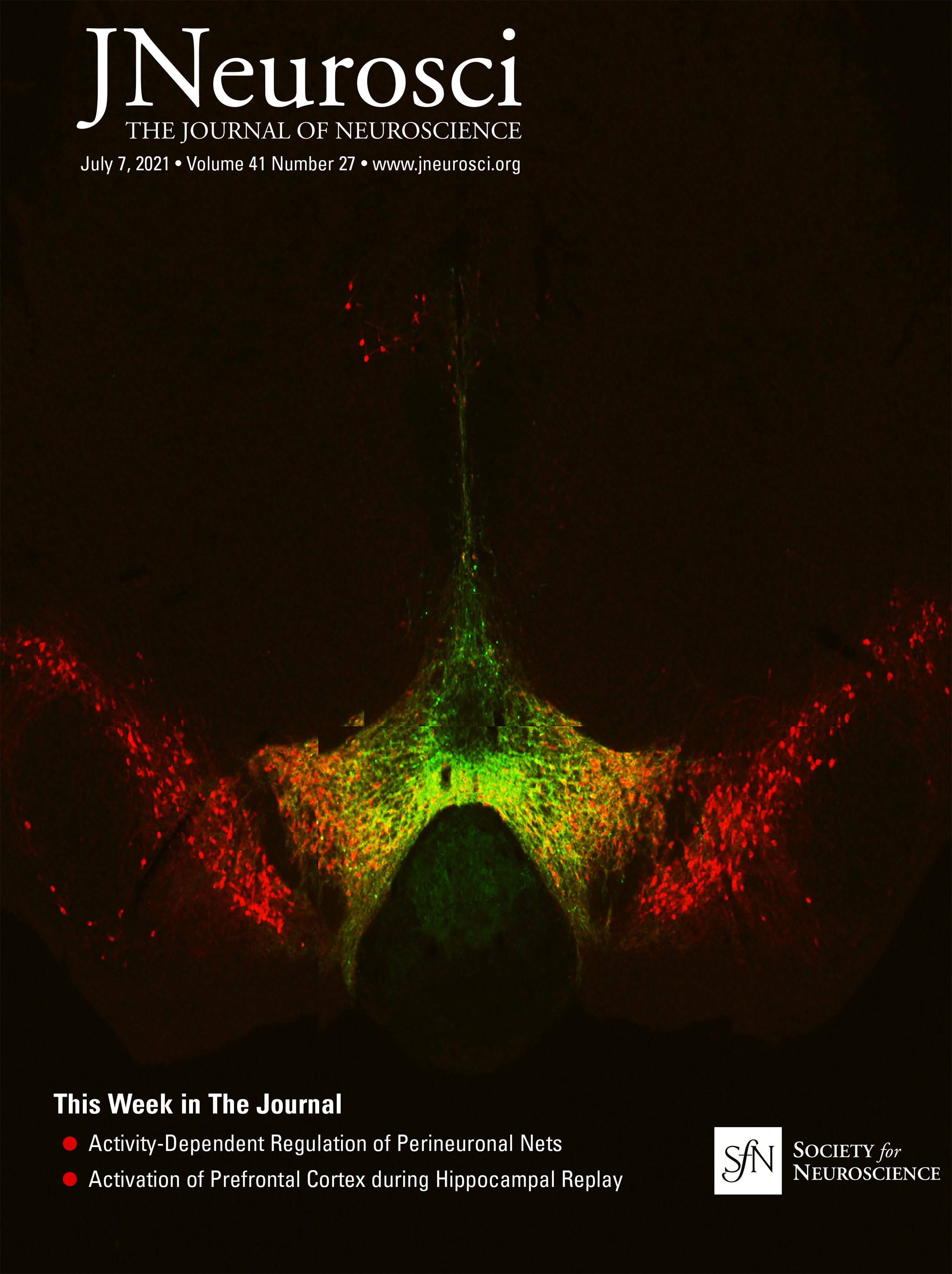
Journal ArticleDiverse functions such as decision-making and memory consolidation may depend on communication between neurons in the hippocampus (HP) and prefrontal cortex (PFC). HP replay is a candidate mechanism to facilitate this communication, however details remain largely unknown because of the technical challenges of recording sufficient numbers of HP neurons for replay while also recording PFC neurons. Here, we implanted male rats with 40-tetrode drives, split between HP and PFC, during learning of a Y-maze spatial memory task. Surprisingly, we found that in contrast to their non-selectivity for maze arm during movement, a portion of PFC neurons were highly selective for HP replay of different arms. Moreover, PFC neurons' selectivity to HP non-local arm representation during running tended to match their replay arm selectivity and was predictive of future choice. Thus, PFC activity that is tuned to HP activity is best explained by non-local HP position representations rather than HP representation of actual posit...Jul 7, 2021
-
 Journal ArticleSome of the most impressive functional specialization in the human brain is found in occipitotemporal cortex (OTC), where several areas exhibit selectivity for a small number of visual categories, such as faces and bodies, and spatially cluster based on stimulus animacy. Previous studies suggest this animacy organization reflects the representation of an intuitive taxonomic hierarchy, distinct from the presence of face- and body-selective areas in OTC. Using human fMRI, we investigated the independent contribution of these two factors – the face-body division and taxonomic hierarchy – in accounting for the animacy organization of OTC, and whether they might also be reflected in the architecture of several deep neural networks that have not been explicitly trained to differentiate taxonomic relations. We found that graded visual selectivity, based on animal resemblance to human faces and bodies, masquerades as an apparent animacy continuum, which suggests that taxonomy is not a separate factor underlying th...Jul 6, 2021
 -
Journal ArticleOver the past decades, a plethora of studies have linked cortical γ oscillations (∼30–100 Hz) to neurocomputational mechanisms. Their functional relevance, however, is still passionately debated. Here, we asked whether endogenous γ oscillations in the human brain can be entrained by a rhythmic photic drive >50 Hz. A noninvasive modulation of endogenous brain rhythms allows conclusions about their causal involvement in neurocognition. To this end, we systematically investigated oscillatory responses to a rapid sinusoidal flicker in the absence and presence of endogenous γ oscillations using magnetoencephalography (MEG) in combination with a high-frequency projector. The photic drive produced a robust response over visual cortex to stimulation frequencies of up to 80 Hz. Strong, endogenous γ oscillations were induced using moving grating stimuli as repeatedly done in previous research. When superimposing the flicker and the gratings, there was no evidence for phase or frequency entrainment of the endogenous ...Jul 6, 2021
-
Journal ArticleMotivational deficits characterized by an unwillingness to overcome effortful costs are a common feature of neuropsychiatric and neurological disorders that are insufficiently understood and treated. Dopamine (DA) signaling in the nucleus accumbens (NAc) facilitates goal-seeking, but how NAc DA release encodes motivationally-salient stimuli to influence effortful investment is not clear. Using fast-scan cyclic voltammetry (FSCV) in male and female mice, we find that NAc DA release diametrically responds to cues signaling increasing cost of reward, while DA release to the reward itself is unaffected by its cost. Because endocannabinoid (eCB) signaling facilitates goal-seeking and NAc DA release, we further investigated whether repeated augmentation of the eCB 2-arachidonoylglycerol (2-AG) with a low dose of a monoacylglycerol lipase (MAGL) inhibitor facilitates motivation and DA signaling without the development of tolerance. We find that chronic MAGL treatment stably facilitates goal-seeking and DA encodin...Jul 6, 2021
-
Journal ArticlePaternal care plays a critical role in the development of brain and behaviors in offspring in monogamous species. However, the neurobiological mechanisms, especially the neuronal circuity, underlying paternal care is largely unknown. Using socially monogamous male mandarin voles ( Microtus mandarinus ) with high levels of paternal care, we found that paraventricular nucleus of the hypothalamus (PVN) to ventral tegmental area (VTA) or nucleus accumbens (NAc) oxytocin (OT) neurons are activated during paternal care. Chemogenetic activation/inhibition of the PVN OT projection to VTA promoted/decreased paternal care, respectively. Chemogenetic inhibition of the PVN to VTA OT pathway reduced dopamine (DA) release in the NAc of male mandarin voles during licking and grooming of pups as revealed by in vivo fiber photometry. Optogenetic activation/inhibition of the VTA to NAc DA pathway possibly enhanced/suppressed paternal behaviors, respectively. Furthermore, chemogenetic activation/inhibition of PVN to NAc OT c...Jul 5, 2021
-
Journal ArticleThe adaptable transcriptional response to changes in food availability not only ensures animal survival, but also lets progressing with embryonic development. Interestingly, the central nervous system is preferentially protected to periods of malnutrition, a phenomenon known as ‘ brain sparing ’. However, the mechanisms that mediates this response remains poorly understood. To get a better understanding of this, we used Drosophila melanogaster as a model, analysing the transcriptional response of neural stem cells (neuroblasts) and glia of the blood-brain barrier (BBB), from larvae of both sexes, during nutrient restriction using targeted DamID. We found differentially expressed genes in both neuroblasts and glia of the BBB, although the effect of nutrient deficiency was primarily observed in the BBB. We characterised the function of a nutritional sensitive gene expressed in the BBB, the serine protease homologue, scarface ( scaf ). Scaf is expressed in subperineurial glia in the BBB in response to nutriti...Jul 1, 2021




