



Filter
-
(133)
-
(733)
-
(4)
-
(1)
-
(47847)
-
(92)
-
(25)
-
(14)
-
(435)
-
(7)
-
(184)
-
(8)
-
(33)
-
(17)
-
(7)
-
(9)
-
(9)
-
(5)
-
(21)
-
(8)
-
(12)
-
(9)
-
(3)
-
(10)
-
(10)
-
(56)
-
(45)
-
(12)
-
(3)
-
(7)
-
(6)
-
(5)
-
(8)
-
(7)
-
(11)
-
(58)
-
(13)
-
(31)
-
(8)
-
(5)
-
(10)
-
(5)
-
(16)
-
(4)
5581 - 5590
of 52776 results
-
 Discover tips for navigating SfN’s annual meeting in this collection of resources. You’ll find advice for networking, starting conversations, identifying events and posters you want to attend, building out your schedule, and more.
 -
Learn from other neuroscientists’ perspectives and personal stories in interviews with experts, advice articles, how-to guides, and more featuring scientists from all levels working across the field.
-
Learn how to talk about your research with nonscientists in a way that promotes biomedical and animal research with articles, training videos, and more for new and experienced advocates.
-
 SfN has partnered with the National Institute of Neurological Disorders and Stroke (NINDS) and members of the scientific community to develop a multimodal training program aiming to inform and empower neuroscientists at all career stages to enhance the rigor and reproducibility of their research. These resources will focus on the sociology of science, raising awareness around interpersonal factors that influence laboratory practices and professional activities. Ongoing programming, developed from 2019-2021, is organized around three priority topics: 1. Objectivity and scientific judgments. 2. Data collection, management, and sharing. 3. Scientific culture and incentives. We are looking to the neuroscience community to help shape future resources in this program, which aims to inspire positive behavior change in the biomedical research field. Identify issues that are important to you by: - Participating in a discussion. - Sharing topic ideas or your own experience with cultural barriers to rigor in an anonymous survey.
 -
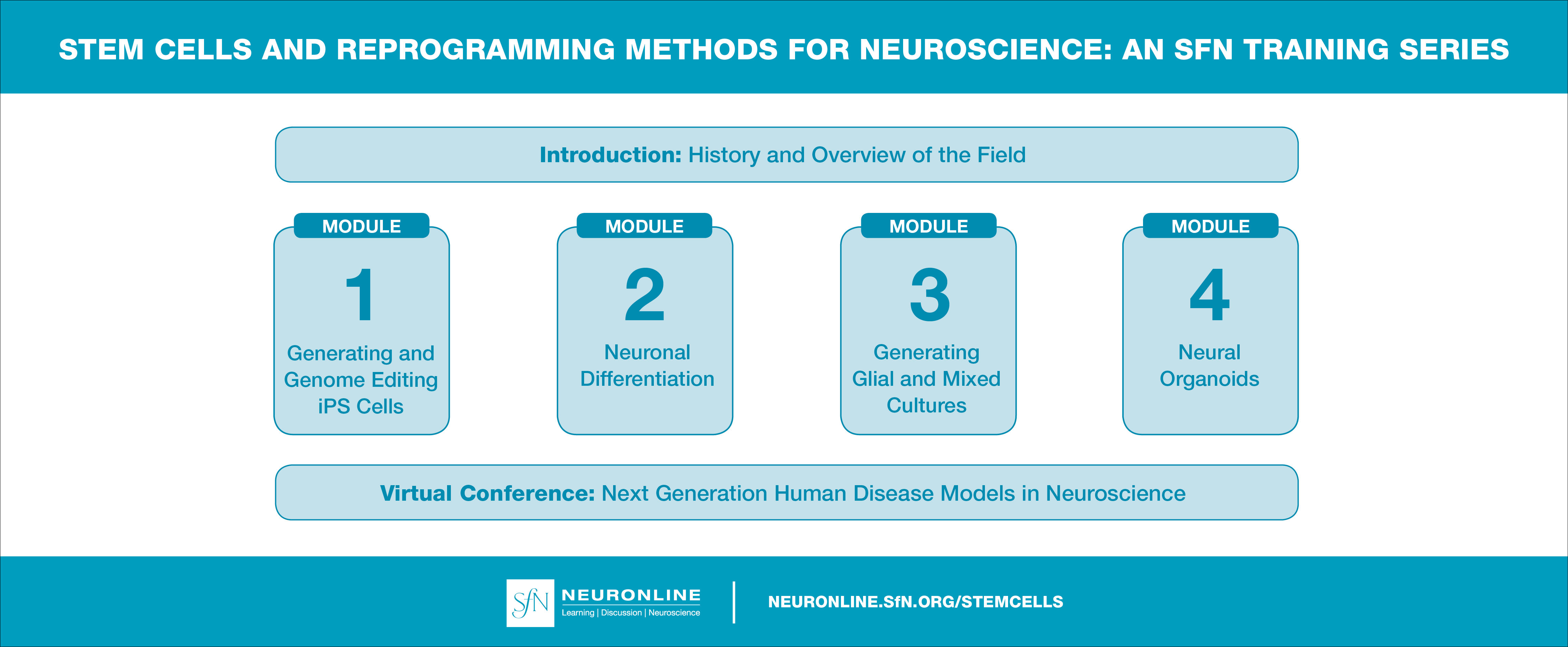 Training SeriesWelcome to SfN’s Training Series: Stem Cells and Reprogramming Methods for Neuroscience. These resources will help advance your understanding of how to generate neural subtypes using stem cells or other reprogramming tools to solve a question in neuroscience. Advances in stem cell biology and cellular reprogramming technology allow scientists to create research models that can improve their understanding of the structure and function of human brains and brain diseases. Stem cells and reprogramming technologies make it possible to generate two and three-dimensional tissues in culture dishes that are derived from human cells and composed of neural subtypes. These tissues capture the genetic diversity of the human population, share molecular and functional features with their in vivo counterparts, and can be used to study disease processes, to assess gene function, or to do investigative, exploratory biology research. Training Modules The series’ five training modules were organized in partnership with Marius Wernig (Stanford University), Kristin Baldwin (Scripps Research Institute), and Lorenz Studer (Memorial Sloan Kettering Cancer Center, and consist of short lectures and demonstration videos; curated sets of protocols, datasets, and other experimental resources; and recommended reading lists. The training modules provide: An introduction to and historical overview of the field of stem cell biology and reprogramming technologies; A foundational understanding of the biological concepts and methodologies for generating, characterizing, validating, maintaining, and assaying neurons, glia, mixed cultures, and neural organoids derived from stem cells; Information on key techniques, procedures, and trouble-shooting tips for generating and functionally screening neurons, glia, mixed cultures, and neural organoids derived from stem cells; and An understanding of the promise of stem cell models to model human conditions and disease phenotypes. The training modules are aimed at neuroscientists who: Are considering using human cell models in the future and want to learn more about the potential and current limitations of the field. May have started using stem cell biology and reprogramming methods and want to increase their familiarity with these technologies, with their applications, and how to best apply these methods. Virtual Conference The training modules complement a virtual conference, Next Generation Human Disease Models in Neuroscience, organized in partnership with Marius Wernig and Lorenz Studer. The conference showcases cutting-edge research from leading labs worldwide that are using human cell models to investigate new biological questions and broaden our understanding of human diseases ranging from neurodevelopment to neurodegeneration.
 -
View scientific training series, downloadable toolkits, annual meeting events by year, and more, created and curated by leaders in neuroscience and SfN partners from across the world.




