



Filter
-
(133)
-
(735)
-
(4)
-
(1)
-
(47868)
-
(93)
-
(25)
-
(14)
-
(434)
-
(7)
-
(186)
-
(8)
-
(33)
-
(17)
-
(7)
-
(10)
-
(9)
-
(5)
-
(21)
-
(8)
-
(12)
-
(9)
-
(3)
-
(10)
-
(10)
-
(56)
-
(46)
-
(12)
-
(3)
-
(7)
-
(6)
-
(5)
-
(8)
-
(7)
-
(11)
-
(58)
-
(13)
-
(31)
-
(8)
-
(5)
-
(10)
-
(5)
-
(16)
-
(4)
11211 - 11220
of 52809 results
-
Journal ArticleNeurogenesis is now known to play a role in adult hypothalamic function, yet the cell-cell mechanisms regulating this neurogenesis remain poorly understood. Here we show that Hedgehog/Gli signaling positively regulates hypothalamic neurogenesis in both larval and adult zebrafish and is necessary and sufficient for normal hypothalamic proliferation rates. Hedgehog-responsive radial glia represent a relatively highly proliferative precursor population that gives rise to dopaminergic, serotonergic, and GABAergic neurons. in situ and transgenic reporter analyses revealed substantial heterogeneity in cell-cell signaling within the hypothalamic niche, with slow cycling Nestin-expressing cells residing among distinct and overlapping populations of Sonic Hh (Shh)-expressing, Hh-responsive, Notch-responsive, and Wnt-responsive radial glia. This work shows for the first time that Hh/Gli-signaling is a key component of the complex cell-cell signaling environment that regulates hypothalamic neurogenesis throughout lif...Oct 26, 2020
-
 Journal ArticleHippocampal CA1 place cell spatial maps are known to alter their firing properties in response to contextual fear conditioning, a process called “remapping.” In the present study, we use chronic calcium imaging to examine remapping during fear retrieval and extinction of an inhibitory avoidance task in mice of both sexes over an extended period of time and with thousands of neurons. We demonstrate that hippocampal ensembles encode space at a finer scale following fear memory acquisition. This effect is strongest near the shock grid. We also characterize the long-term effects of shock on place cell ensemble stability, demonstrating that shock delivery induces several days of high fear and low between-session place field stability, followed by a new, stable spatial representation that appears after fear extinction. Finally, we identify a novel group of CA1 neurons that robustly encode freeze behavior independently from spatial location. Thus, following fear acquisition, hippocampal CA1 place cells sharpen th...Oct 21, 2020
 -
Journal ArticleSelective attention is a core cognitive function for efficient processing of information. Although it is well known that attention can modulate neural responses in many brain areas, the computational principles underlying attentional modulation remain unclear. Contrary to the prevailing view of a high-dimensional, distributed neural representation, here we show a surprisingly simple, biased neural representation for feature-based attention in a large dataset including five human fMRI studies. We found that when human participants (both sexes) selected one feature from a compound stimulus, voxels in many cortical areas responded consistently higher to one attended feature over the other. This univariate bias was consistent across brain areas within individual subjects. Importantly, this univariate bias showed a progressively stronger magnitude along the cortical hierarchy. In frontoparietal areas, the bias was strongest and contributed largely to pattern-based decoding, whereas early visual areas lacked suc...Oct 21, 2020
-
Journal ArticleThe ability of animals to retrieve memories stored in response to the environment is essential for behavioral adaptation. Norepinephrine (NE)-containing neurons in the brain play a key role in the modulation of synaptic plasticity underlying various processes of memory formation. However, the role of the central NE system in memory retrieval remains unclear. Here, we developed a novel chemogenetic activation strategy exploiting insect olfactory ionotropic receptors (IRs), termed “IR-mediated neuronal activation,” and used it for selective stimulation of NE neurons in the locus coeruleus (LC). Drosophila melanogaster IR84a and IR8a subunits were expressed in LC NE neurons in transgenic mice. Application of phenylacetic acid (a specific ligand for the IR84a/IR8a complex) at appropriate doses induced excitatory responses of NE neurons expressing the receptors in both slice preparations and in vivo electrophysiological conditions, resulting in a marked increase of NE release in the LC nerve terminal regions (m...Oct 21, 2020
-
Journal ArticleOct 21, 2020
-
Journal ArticlePrevailing theories posit that the hippocampus rapidly learns stimulus conjunctions during novel experiences, whereas the neocortex learns slowly through subsequent, off-line interaction with the hippocampus. Parallel evidence, however, shows that the medial prefrontal cortex (mPFC; a critical node of the neocortical network supporting long-term memory storage) undergoes rapid modifications of gene expression, synaptic structure, and physiology at the time of encoding. These observations, along with impaired learning with disrupted mPFC, suggest that mPFC neurons may exhibit rapid neural plasticity during novel experiences; however, direct empirical evidence is lacking. We extracellularly recorded action potentials of cells in the prelimbic region of the mPFC, while male rats received a sequence of stimulus presentations for the first time in life. Moment-to-moment tracking of neural ensemble firing patterns revealed that the prelimbic network activity exhibited an abrupt transition within 1 min after the ...Oct 21, 2020
-
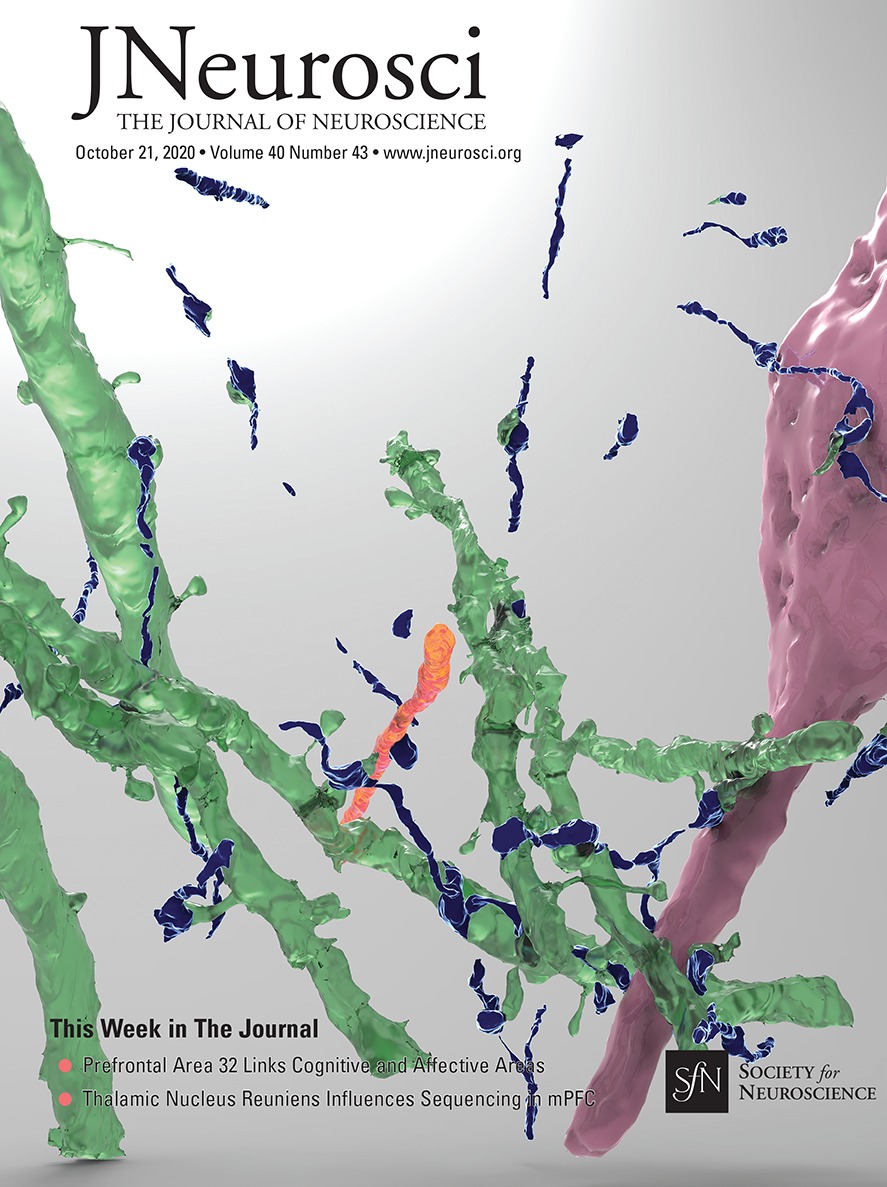
Journal ArticleThe delicate balance among primate prefrontal networks is necessary for homeostasis and behavioral flexibility. Dorsolateral prefrontal cortex (dlPFC) is associated with cognition, while the most ventromedial subgenual cingulate area 25 (A25) is associated with emotion and emotional expression. Yet A25 is weakly connected with dlPFC, and it is unknown how the two regions communicate. In rhesus monkeys of both sexes, we investigated how these functionally distinct areas may interact through pregenual anterior cingulate area 32 (A32), which is strongly connected with both. We found that dlPFC innervated the deep layers of A32, while A32 innervated all layers of A25, mostly targeting spines of excitatory neurons. Approximately 20% of A32 terminations formed synapses on inhibitory neurons in A25, notably the powerful parvalbumin inhibitory neurons in the deep layers, and the disinhibitory calretinin neurons in the superficial layers. By innervating distinct inhibitory microenvironments in laminar compartments,...Oct 21, 2020
-
Journal ArticleMary Kate P. Joyce, Miguel Ángel García-Cabezas, Yohan J. John, and Helen Barbas (see pages [8306–8328][1]) Responding appropriately to threats is essential for survival, but hypersensitivity to potential threats can be maladaptive. Therefore, activity in area 25 (A25) of the ventromedialOct 21, 2020
-
Journal ArticleTraditionally, the brainstem has been seen as hardwired and poorly capable of plastic adaptations following spinal cord injury (SCI). Data acquired over the past decades, however, suggest differently: following SCI in various animal models (lamprey, chick, rodents, nonhuman primates), different forms of spontaneous anatomic plasticity of reticulospinal projections, many of them originating from the gigantocellular reticular nucleus (NRG), have been observed. In line with these anatomic observations, animals and humans with incomplete SCI often show various degrees of spontaneous motor recovery of hindlimb/leg function. Here, we investigated the functional relevance of two different modes of reticulospinal fiber growth after cervical hemisection, local rewiring of axotomized projections at the lesion site versus compensatory outgrowth of spared axons, using projection-specific, adeno-associated virus-mediated chemogenetic neuronal silencing. Detailed assessment of joint movements and limb kinetics during ov...Oct 21, 2020
-
Journal ArticleReelin plays versatile roles in neocortical development. The C-terminal region (CTR) of Reelin is required for the correct formation of the superficial structure of the neocortex; however, the mechanisms by which this position-specific effect occurs remain largely unknown. In this study, we demonstrate that Reelin with an intact CTR binds to neuropilin-1 (Nrp1), a transmembrane protein. Both male and female mice were used. Nrp1 is localized with very-low-density lipoprotein receptor (VLDLR), a canonical Reelin receptor, in the superficial layers of the developing neocortex. It forms a complex with VLDLR, and this interaction is modulated by the alternative splicing of VLDLR. Reelin with an intact CTR binds more strongly to the VLDLR/Nrp1 complex than to VLDLR alone. Knockdown of Nrp1 in neurons leads to the accumulation of Dab1 protein. Since the degradation of Dab1 is induced by Reelin signaling, it is suggested that Nrp1 augments Reelin signaling. The interaction between Reelin and Nrp1 is required for n...Oct 21, 2020




