



Filter
-
(133)
-
(733)
-
(4)
-
(1)
-
(47833)
-
(91)
-
(25)
-
(14)
-
(433)
-
(7)
-
(182)
-
(8)
-
(33)
-
(17)
-
(7)
-
(9)
-
(9)
-
(5)
-
(21)
-
(8)
-
(12)
-
(9)
-
(3)
-
(10)
-
(10)
-
(56)
-
(45)
-
(12)
-
(3)
-
(7)
-
(6)
-
(5)
-
(8)
-
(7)
-
(11)
-
(58)
-
(13)
-
(30)
-
(8)
-
(5)
-
(10)
-
(5)
-
(15)
-
(4)
2071 - 2080
of 52756 results
-
 Journal ArticleSocial recognition is an essential part of social function and often promotes specific social behaviors based on prior experience. Social and defensive behaviors in particular often emerge with prior experiences of familiarity or novelty/stress, respectively. This is also commonly seen in rodents towards same-strain and inter-strain conspecifics. Medial amygdala (MeA) activity guides social choice based on age and sex recognition and is sensitive to social experiences. However, little is known about whether the MeA exhibits differential responses based on strain or how this is impacted by experience. Social stress impacts posterior MeA (MeAp) function and can shift measures of social engagement. However, it is unclear how stress impacts MeAp activity and contributes to altered social behavior. The primary goal of this study in adult male Sprague Dawley rats was to determine whether prior stress experience with a different strain (Long Evans) rat impacts MeAp responses to same-strain and different-strain co...Sep 11, 2024
 -
Journal ArticleConscious reportability of visual input is associated with a bimodal neural response in primary visual cortex (V1): an early-latency response coupled to stimulus features and a late-latency response coupled to stimulus report or detection. This late wave of activity, central to major theories of consciousness, is thought to be driven by prefrontal cortex (PFC), responsible for “igniting” it. Here we analyzed two electrophysiological studies in mice performing different stimulus detection tasks, and characterize neural activity profiles in three key cortical regions: V1, posterior parietal cortex (PPC) and PFC. We then developed a minimal network model, constrained by known connectivity between these regions, reproducing the spatio-temporal propagation of visual- and report-related activity. Remarkably, while PFC was indeed necessary to generate report-related activity in V1, this occurred only through the mediation of PPC. PPC, and not PFC, had the final veto in enabling the report-related late wave of V1 ...Sep 11, 2024
-
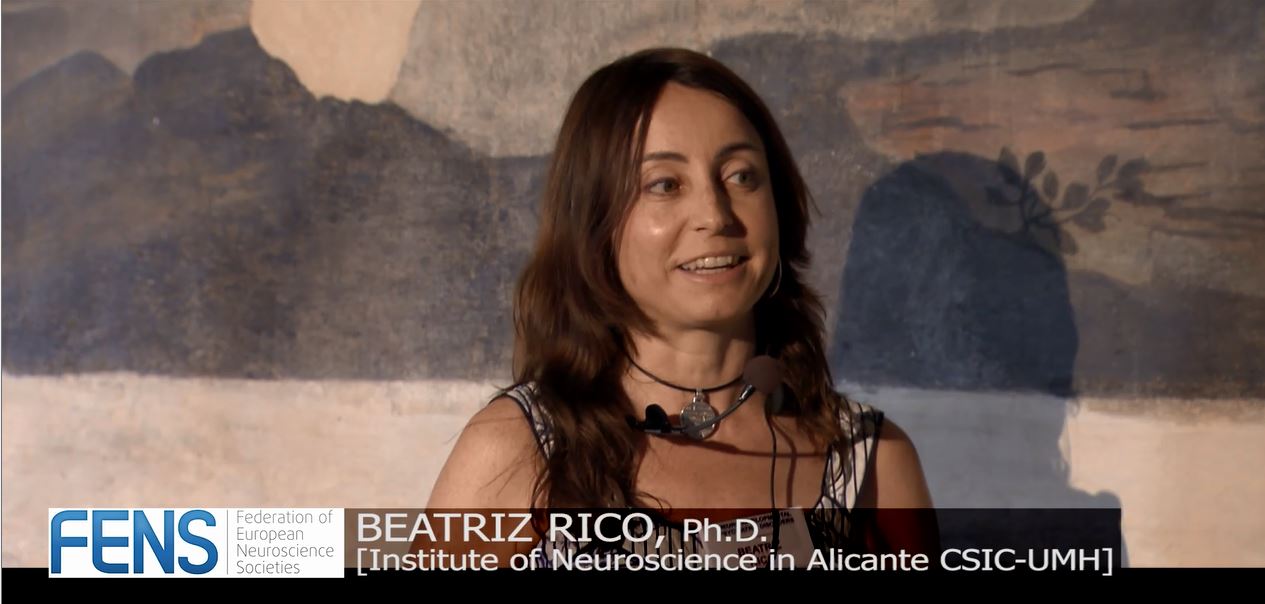 Video Scientific ResearchThe FENS-SfN Summer School on Neurodevelopmental Psychiatric Disorders took place June 22-28, 2014, in Bertinoro, Italy. Dr. Beatriz Rico from the Institute of Neuroscience in Alicante gives a talk on GABAergic circuitry assembly and schizophrenia.May 1, 2015
 -
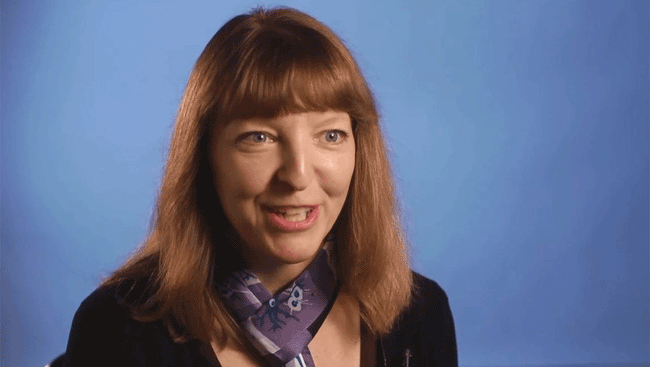 Video DiversityMary Morrison, assistant professor at Lycoming College, and Jill Becker, professor of psychology at the University of Michigan, talk about how to support students from diverse backgrounds in academiaMay 1, 2015
 -
 TrainingAs the knowledge base in neuroscience continues to expand, educators need timely resources to engage their students. Educational Resources in Neuroscience (ERIN), a web portal developed by the Society for Neuroscience (SfN) with funding from the National Science Foundation (NSF), is an invaluable tool to help undergraduate, graduate, and clinical education professors find state-of-the art resources.May 1, 2015
 -
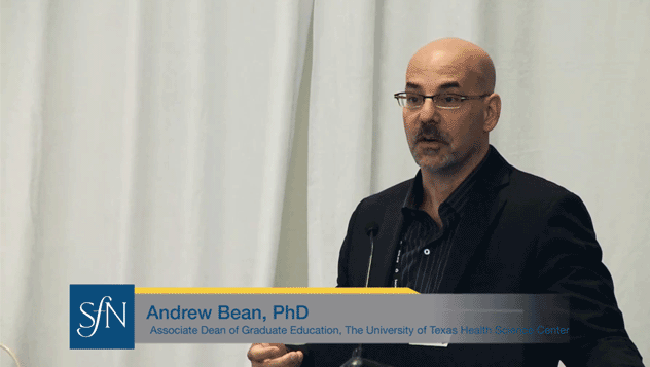 Video Career PathsMany students want to find a non-academic career after graduation. Preparing for these paths takes a different set of skills than academia. Andrew Bean discusses this reality, and the variety of career options that are available for neuroscientists.May 1, 2015
 -
 Article Professional DevelopmentThe qualities of a good protégé include effective communication, trust, flexibility, patience, openness, optimism, and persistence.May 1, 2015
 -
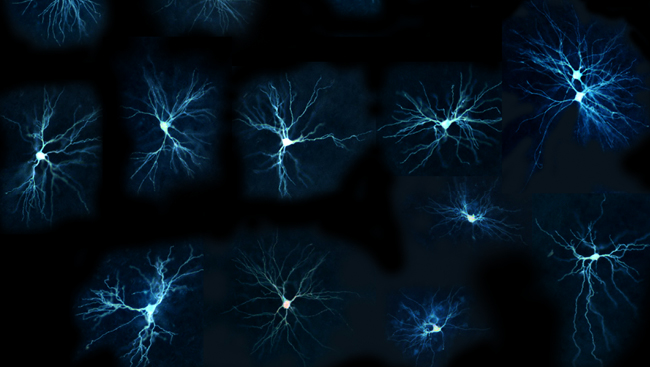 Article Career PathsWhen thinking of a career in science editing and publishing, most people assume it means working for a peer-reviewed journal, like The Journal of Neuroscience.May 1, 2015
 -
 Article Career PathsIt may not be the most obvious career path, but working in the government can utilize scientific skills and knowledge developed during your PhD training.May 1, 2015
 -
 Article DiversityHow can you be successful if you don’t know the rules? How can you advance if you don’t have clear, constructive feedback?May 1, 2015




