



Filter
-
(133)
-
(733)
-
(4)
-
(1)
-
(47830)
-
(91)
-
(25)
-
(14)
-
(433)
-
(7)
-
(181)
-
(8)
-
(33)
-
(17)
-
(7)
-
(9)
-
(9)
-
(5)
-
(21)
-
(8)
-
(12)
-
(9)
-
(3)
-
(10)
-
(10)
-
(56)
-
(45)
-
(12)
-
(3)
-
(7)
-
(6)
-
(5)
-
(8)
-
(7)
-
(11)
-
(58)
-
(13)
-
(30)
-
(8)
-
(5)
-
(10)
-
(5)
-
(14)
-
(4)
1241 - 1250
of 52751 results
-
 Article Annual Meeting Professional DevelopmentAre you planning on attending Neuroscience 2023?Sep 14, 2018
 -
 Video AdvocacyThere are a few ways institutions can discuss animal research, according to Mar Sanchez, associate professor of psychiatry and behavioral sciences at Emory University, core scientist at the Yerkes National Primate Research Center, and past committee chair of SfN’s Committee on Animal Research. She notes that institutions “have to be open to disclosing that they are doing animal research and the value of the animal research.” In addition, institutions “have to be planning. They have to be ready in case that their researchers get under attack by animal rights extremists.” Watch this short video to learn: - Why it’s important to engage your institution. - What strategies institutions can take. - What may result without institutional preparedness.Sep 12, 2018
 -
 Article Professional DevelopmentWith so many posters, talks, symposiums, exhibits, socials, and more, it can seem like there are as many ways to approach the meeting as there are attendees.Sep 11, 2018
 -
 Journal ArticleAttention deficit hyperactivity disorder (ADHD) adversely affects the learning, social interaction, and daily living of affected children. Atomoxetine (ATX) hydrochloride (HCI) has been widely used in clinical practice. Electroencephalogram (EEG) biofeedback, as a non-pharmacological treatment approach, has also demonstrated potential in improving symptoms in children with ADHD. We aimed to investigate the clinical efficacy of combining ATX HCI with EEG biofeedback in the treatment of ADHD in children. We hypothesized that this combined therapy would be more effective in alleviating symptoms in children with ADHD. Ninety children with ADHD were randomly separated into the control group (receiving ATX HCI treatment for 12 weeks) and study group (receiving ATX HCI treatment for 12 weeks combined with 60 sessions of EEG biofeedback treatment) (n = 45). Swanson, Nolan and Pelham-IV (SNAP-IV) rating scale scores, Integrated Visual and Auditory Continuous Performance Test (IVA-CPT) results, Conners Parent Sympto...Mar 19, 2025
 -
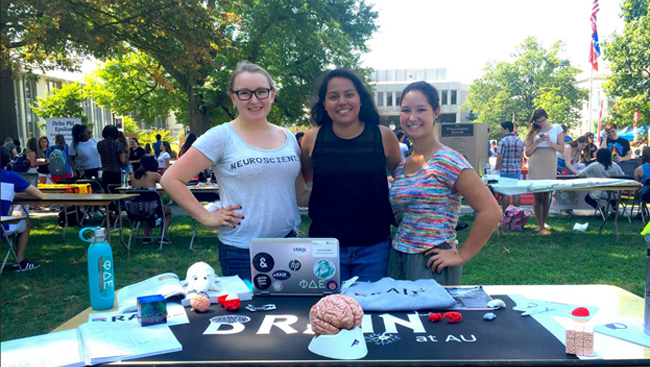 Article OutreachSamantha White serves as a judge and tutor for Washington DC’s local Brain Bee each year. About her time as an undergraduate student at American University (she graduated in 2018), she says, “Balancing classes, work, lab time, and a social life got complicated, but I always found time to engage with the community.” Here, read how making time for outreach has influenced her career aspirations and her advice for getting involved. What initially sparked your interest in outreach? Community service has always been a part of my life. My role models growing up always emphasized how import it is to give back. As a college student, the best way I knew how to do that was donating time and enthusiasm for causes I care about: education and STEM outreach. During my junior year, I started a neuroscience club on campus with some friends. We were looking for ways to get members involved in the DC community. That led us to the DC Brain Bee. It’s a fun event where, even as a judge, we had the chance to quiz ourselves on brain basics and encourage high school students throughout the competition. It was really exciting to see the students get fired up about neuroscience. Their energy was infectious. We all left the event inspired to study even more.Sep 6, 2018
 -
 Article Professional DevelopmentElizabeth Glover, a postdoctoral fellow at the Medical University of South Carolina and member of SfN’s Trainee Advisory Committee, is in her last year of being a postdoc and looking to make the transition to independent faculty.Sep 5, 2018
 -
Journal ArticleNeurons adapt to chronic activity changes by modifying synaptic properties, including neurotransmitter release. However, whether neuropeptide release via dense core vesicles (DCVs)—a distinct regulated secretory pathway—undergoes similar adaptation remains unclear. Here, we demonstrate that 24-hour action potential blockade leads to significant DCV accumulation in primary mouse cortical neurons of both sexes. Reactivation with action potential trains induced enhanced Ca2+-influx and 700% more DCV exocytosis compared to control neurons. Notably, total DCV cargo protein levels were unchanged, while mRNA levels of corresponding genes were reduced. Blocking neurotransmitter release with Tetanus toxin induced DCV accumulation, similar to that induced by network silencing with TTX. Hence, chronic network silencing triggers increased DCV accumulation due to reduced exocytosis during silencing. These accumulated DCVs can be released upon reactivation resulting in a massive potentiation of DCV exocytosis, possibly ...Mar 18, 2025
-
Journal ArticleStress is a common occurrence for military personnel. This can include the stress of deployment and active combat. Anxiety is considered a reaction to stress and with anxiety related disorders on the rise, it is imperative that stress be considered a pre-existing condition when studying a number of neurological conditions. To determine the effects of stress on the behavioral outcomes of traumatic brain injury (TBI), we used a 3-day acute unpredictable stress (AUS) model followed by blast induce neurotrauma (BINT) to assessed social anhedonia and anxiety-like behaviors in male and female rats. The animals were divided into 4 groups including an unstressed and uninjured control (Con), stress only animals (AUS), injury only animals (BINT), and animals that received both stress and injury (AUS+BINT). In the males, behavioral tests such as elevated plus and 3-chamber sociability showed that stress plays a dominant role in determining behavioral outcomes after TBI with the AUS+BINT animals behaving more similarl...Mar 17, 2025
-
Journal ArticleResponse preparation is accomplished by gradual accumulation in neural activity until a threshold is reached. In humans, such a preparatory signal, referred to as the lateralized readiness potential, can be observed in the EEG over sensorimotor cortical areas before execution of a voluntary movement. Although well-described for manual movements, less is known about preparatory EEG potentials for saccadic eye movements in humans and nonhuman primates. Hence, we describe a lateralized readiness potential over the frontolateral cortex in macaque monkeys. Homologous to humans, we observed lateralized electrical potentials ramping before the execution of both rewarded and non-rewarded contralateral saccades. This potential parallels the neural spiking of saccadic movement neurons in the frontal eye field, suggesting that it may offer a non-invasive correlate of intracortical spiking activity. However, unlike neural spiking in the frontal eye field, polarization in frontolateral channels did not distinguish betw...Mar 17, 2025
-
 Article Professional DevelopmentLinda Porrino, a department chair at Wake Forest School of Medicine, reflects on what she looks for when hiring new faculty. If you’re considering an academic career now or in the future, read her advice on how to gain experience as a student, make a good impression in the interview, negotiate for what you need, and more.Aug 29, 2018




