



Filter
-
(133)
-
(733)
-
(4)
-
(1)
-
(47830)
-
(91)
-
(25)
-
(14)
-
(433)
-
(7)
-
(181)
-
(8)
-
(33)
-
(17)
-
(7)
-
(9)
-
(9)
-
(5)
-
(21)
-
(8)
-
(12)
-
(9)
-
(3)
-
(10)
-
(10)
-
(56)
-
(45)
-
(12)
-
(3)
-
(7)
-
(6)
-
(5)
-
(8)
-
(7)
-
(11)
-
(58)
-
(13)
-
(30)
-
(8)
-
(5)
-
(10)
-
(5)
-
(14)
-
(4)
771 - 780
of 52751 results
-
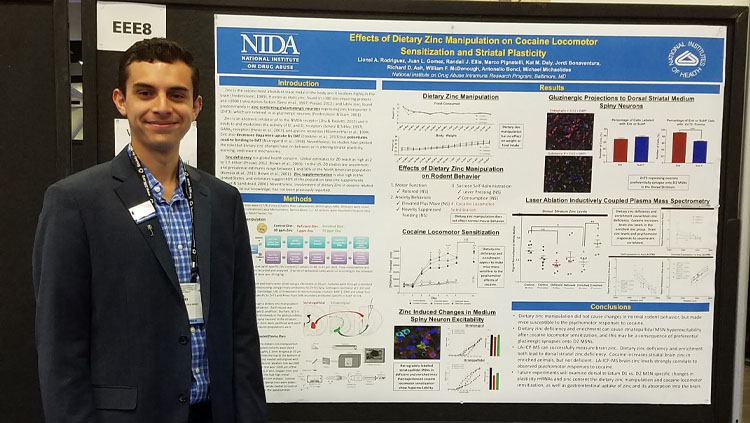 Article DiversityLionel Rodriguez is a neuroscience PhD candidate at Johns Hopkins. In this interview, Lionel discusses dealing with implicit bias and imposter syndrome. As a Gay, Latinx scientist, he also gives his hopes for the future of approaching discussions of equitable treatment and inclusion of historically marginalized communities in STEM.Jan 19, 2021
 -
 Article AdvocacyLars Kristiansen, the executive director of the Federation of European Neuroscience Societies (FENS), leads neuroscience advocacy conversations and initiatives across 33 European countries. Here, he highlights the advocacy culture around Europe as he shares ways all scientists can become stronger advocates — coordinating knowledge to develop a unified message, preparing for your country-specific context, and gaining public support for science through clear and compelling outreach. Brain disease is a global societal issue. How should that knowledge impact regional advocacy efforts? As scientists involved in advocacy, it’s important to coordinate messaging and align it to the global agenda. We don’t have global decision makers, but there are certainly global drivers that impact science funding. It’s not a coincidence you see large scale brain initiatives arise at approximately the same time in Europe, the United States, and elsewhere. Conversations between these large initiatives drive the agenda of what’s needed on a global scale to understand brain disease. Those drivers lead us to identify the topics that we as a community — within our regional context — will be able to take up and advocate for. To do that effectively, we need to coordinate knowledge.Jan 14, 2021
 -
 Article CommunityBita Moghaddam is the Ruth Matarazzo Professor of behavioral neuroscience at Oregon Health and Science University. At the time of this interview in March 2020, she was also the chair of her department. Bita shares how she stays focused despite the prejudices she has faced as an immigrant woman and person of color. She also shares the importance of good mentors and the impact they had on her career.Jan 12, 2021
 -
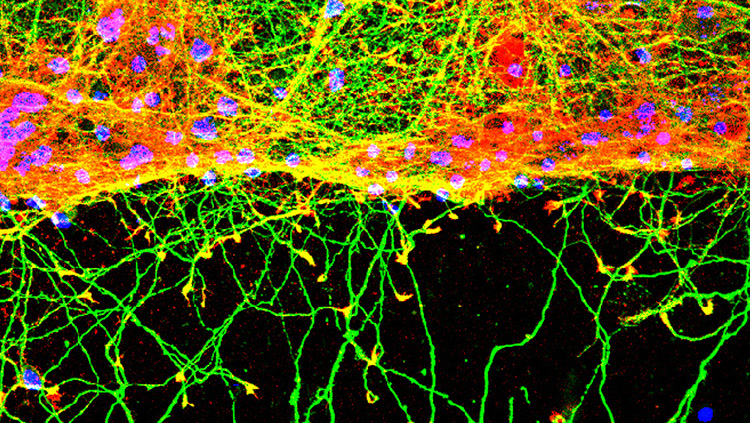 Article Professional DevelopmentNeuroscience has escaped the confines of the laboratory and is now popping up in business settings. More specifically, neuroscience is now playing a visible role in supporting the development of new business leaders. Neuroleadership is the intersection of neuroscience (the study of how the brain works) and leadership development (the rapid professional development of people in management positions). In short, now that we have a better idea of how the brain works, businesses will have an easier job of molding employees to become better managers. The dilemma that neuroleadership, a field of professional education that is based on neuroscience, faces is how to systematically handle the hard job of translating the technical products of a rigorous scientific field into public interest concepts useful to non-scientists.Jan 7, 2021
 -
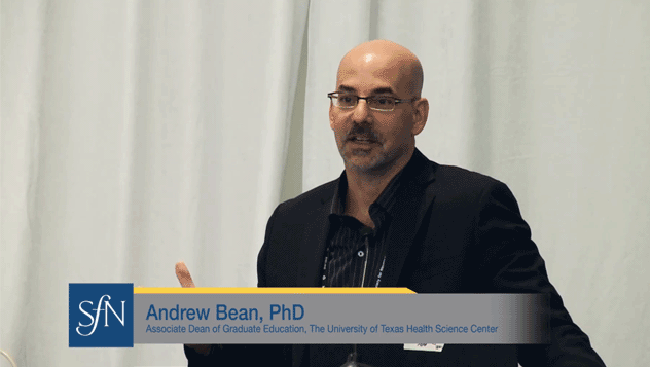 Video Career PathsDo you know what career trajectories are available with an MS versus a PhD in neuroscience? Andrew Bean talks about the differences between degrees, and what’s really needed for a non-academic career.Jan 6, 2021
 -
 Journal ArticleTest–Retest Reliability of TRF-Derived Measures of Cortical Tracking of the Speech Envelope | eNeuroCortical tracking of the speech envelope is an emerging, noninvasive measure of neurophysiological processing of speech that is being widely adopted. It demonstrates good ecological validity, as it allows researchers to study human processing of continuous, naturalistic speech containing dynamic spectrotemporal variations and rich linguistic content. While measures of cortical tracking have strong clinical and research applications, there is a lack of research documenting the reliability of these measures, including how they are affected by the stimulus and how the stimulus is represented, as well as electroencephalography (EEG) acquisition and analysis parameters. In this study, we measured the test–retest reliability of cortical tracking of the speech envelope across different stimuli (an audiobook vs a podcast), stimulus features (broadband envelope and its derivative, multiband envelope and its derivative), reference electrodes (average mastoid vs common average reference), and EEG frequency bands (del...Aug 26, 2025
 -
 Article CommunityGentry Patrick is the director of mentorship and diversity at the University of California at San Diego. Patrick serves as an active mentor for underrepresented student researchers and advocates for the convergence of diversity and academic excellence. Through his own efforts and experiences, he understands the importance of strength in numbers for change to take effect in the scientific community. In the interview below, learn how he continues to educate others to use their platform as science educators to empower young scientists.Jan 5, 2021
 -
Article DiversityGentry Patrick is the director of mentorship and diversity at the University of California at San Diego. Patrick serves as an active mentor for underrepresented student researchers and advocates for the convergence of diversity and academic excellence. Through his own efforts and experiences, he understands the importance of strength in numbers for change to take effect in the scientific community. In the interview below, learn how he continues to educate others to use their platform as science educators to empower young scientists.Jan 5, 2021
-
Journal ArticlePathological levels of beta amyloid (Aβ) lead to disruption and elimination of synapses in brain as the result of direct neurotoxicity as well as neuroinflammation. The synaptic impact of beta amyloid includes altered morphology and reduced number of dendritic spines at excitatory synapses, evident in the brains of individuals with Alzheimer’s disease. Here, we assessed the ability of an identified neuroprotective peptide, YEVHHQ, derived from the N-terminal domain of Aβ, known as the AβCore, to protect against Aβ-induced alterations in dendritic spines. Our approach involved both 2D and 3D imaging of spine morphology in hippocampal neuron cultures from mice of either sex, with the 3D imaging focusing on the postsynaptic density (PSD), as its morphology is tightly correlated with synaptic strength, and presynaptic terminal morphology and density to assess the impact on both sides of the synapse. We present evidence for uniform prevention by the AβCore of Aβ-induced reductions in spine cross-sectional size ...Aug 25, 2025
-
Journal ArticleUnderstanding how neural circuits integrate sensory and state information to support context-dependent behavior is a central challenge in neuroscience. Oviposition is a complex process during which a fruit fly integrates context and sensory information to choose an optimal location to lay her eggs. The circuit that controls oviposition is known, but how the oviposition circuit integrates multiple sensory modalities and internal states is not. Using the Hemibrain connectome, we identified the Oviposition Inhibitory Neuron (oviIN) as a key hub in the oviposition circuit and analyzed its inputs to uncover potential parallel pathways that may be responsible for computations related to sensory integration and decision-making. We applied a network analysis to the subconnectome of inputs to the oviIN to identify clusters of interconnected neurons – many of which are uncharacterized cell types. Our findings indicate that the inputs to oviIN form multiple parallel pathways through the unstructured neuropils of the ...Aug 25, 2025




