



Filter
-
(133)
-
(733)
-
(4)
-
(1)
-
(47833)
-
(91)
-
(25)
-
(14)
-
(433)
-
(7)
-
(182)
-
(8)
-
(33)
-
(17)
-
(7)
-
(9)
-
(9)
-
(5)
-
(21)
-
(8)
-
(12)
-
(9)
-
(3)
-
(10)
-
(10)
-
(56)
-
(45)
-
(12)
-
(3)
-
(7)
-
(6)
-
(5)
-
(8)
-
(7)
-
(11)
-
(58)
-
(13)
-
(30)
-
(8)
-
(5)
-
(10)
-
(5)
-
(15)
-
(4)
1801 - 1810
of 52756 results
-
 Journal ArticleRelationships among membrane currents allow central pattern generator (CPG) neurons to reliably drive motor programs. We hypothesize that continually active CPG neurons utilize activity-dependent feedback to correlate expression of ion channel genes to balance essential membrane currents. However, episodically activated neurons experience absences of activity-dependent feedback, and thus, presumably employ other strategies to coregulate the balance of ionic currents necessary to generate appropriate output after periods of quiescence. To investigate this, we compared continually active pyloric dilator (PD) neurons with episodically active lateral gastric (LG) CPG neurons of the stomatogastric ganglion (STG) in male Cancer borealis crabs. After experimentally activating LG for 8 hours, we measured 3 potassium currents and abundances of their corresponding mRNAs. We found that ionic current relationships were correlated in LG’s silent state, but ion channel mRNA relationships were correlated in the active st...Nov 4, 2024
 -
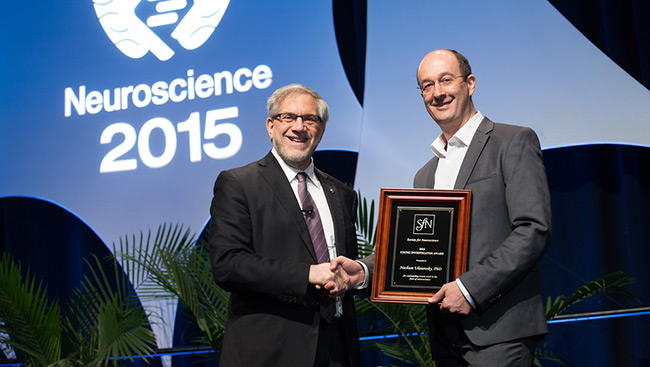 Article Professional DevelopmentNachum Ulanovsky was the first to record neural activity in a freely moving bat. By doing so, he was able to investigate how cells in the hippocampus encode a spatial representation of the three-dimensional environment. For these accomplishments, Ulanovsky received the Young Investigator Award in 2015. Here, he discusses his research.May 10, 2016
 -
 Video Annual Meeting Professional DevelopmentHear how you can best use your international experience as a graduate student, postdoctoral trainee, or your sabbatical to move your career forward. Speakers talk from personal experience and pay careful attention to individuals from developing countries who spend time in a developed country.May 10, 2016
 -
 Article Scientific ResearchAstrocyte activation (reactive gliosis) accompanies most central nervous system pathologies (CNS), including brain injury conditions. During astrocyte activation, the expression of many genes is modified, thus changing the cells’ protein expression profile and behavior. A well-known feature of the process is the increased production of intermediate filament proteins.May 5, 2016
 -
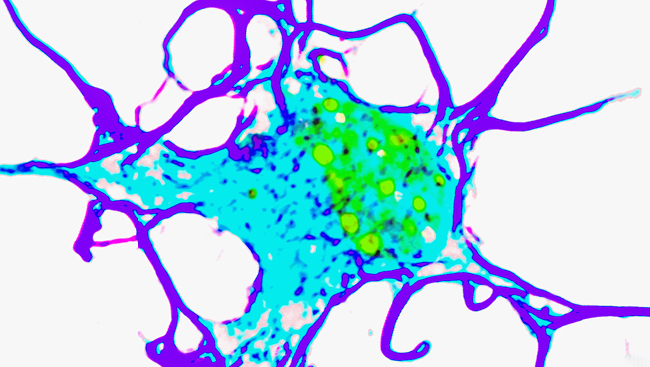 Video Annual Meeting Career PathsAt the Neuroscience 2013 Careers Beyond the Bench workshop, Katja Brose, the editor of Neuron, explains how she transitioned from research to science publishing. While she is not behind the bench, Brose’s role in publishing keeps her involved and active within the neuroscience community.May 3, 2016
 -
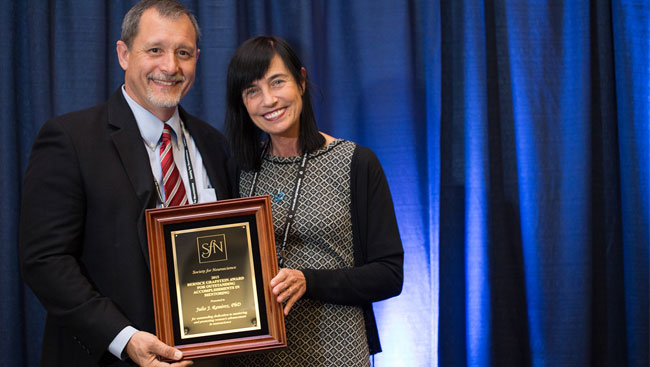 Article Professional DevelopmentMentoring advances the field of neuroscience by ensuring that trainees begin their careers with the necessary skills, scientific understanding, and other support to achieve success. Julio Ramirez, professor and chair of the psychology department at Davidson College, is leading efforts to improve mentoring for undergraduates studying neuroscience. He received the Bernice Grafstein Award for Outstanding Accomplishments in Mentoring in 2015 for his contributions. Here, Ramirez discusses his mentoring approach.May 3, 2016
 -
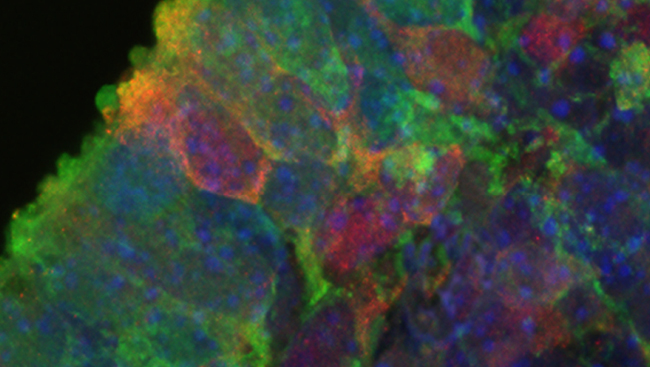 Article Scientific ResearchTraditional microscopy techniques are limiting in that most only reflect two dimensions of a three-dimensional biological system.Apr 28, 2016
 -
 Article DiversityA study examining student evaluations in France and the United States revealed the continued impact of implicit bias — the often-subtle discrimination based on cultural stereotypes — on evaluation of women and why it needs to be addressed. But what can actually be done? Anne Etgen, neuroscientist and professor emerita at Albert Einstein College of Medicine, comments on measures that can be taken in the neuroscience field.Apr 26, 2016
 -
 Annual Meeting Video Scientific ResearchRigorous conduct of science is the cornerstone of the scientific endeavor, touching on established practices for experimental design, data analysis, and transparency, as well as other issues like publishing and funding pressures. Knowing how to address these issues is critical for a successful career in science. This workshop explores practical examples of the challenges and solutions in conducting rigorous science from the real-life examples of neuroscientists at various career stages. It focuses on development of the interpersonal, scientific, and technical skills necessary to address various issues in scientific rigor, such as what to do when you can't replicate a published result, how to get support from a mentor, and how to cope with various career pressures that might affect the quality of your science.Apr 26, 2016
 -
Article CommunityA study examining student evaluations in France and the United States revealed the continued impact of implicit bias — the often-subtle discrimination based on cultural stereotypes — on evaluation of women and why it needs to be addressed. But what can actually be done? Anne Etgen, neuroscientist and professor emerita at Albert Einstein College of Medicine, comments on measures that can be taken in the neuroscience field.Apr 26, 2016




