



Filter
-
(133)
-
(733)
-
(4)
-
(1)
-
(47830)
-
(91)
-
(25)
-
(14)
-
(433)
-
(7)
-
(181)
-
(8)
-
(33)
-
(17)
-
(7)
-
(9)
-
(9)
-
(5)
-
(21)
-
(8)
-
(12)
-
(9)
-
(3)
-
(10)
-
(10)
-
(56)
-
(45)
-
(12)
-
(3)
-
(7)
-
(6)
-
(5)
-
(8)
-
(7)
-
(11)
-
(58)
-
(13)
-
(30)
-
(8)
-
(5)
-
(10)
-
(5)
-
(14)
-
(4)
991 - 1000
of 52751 results
-
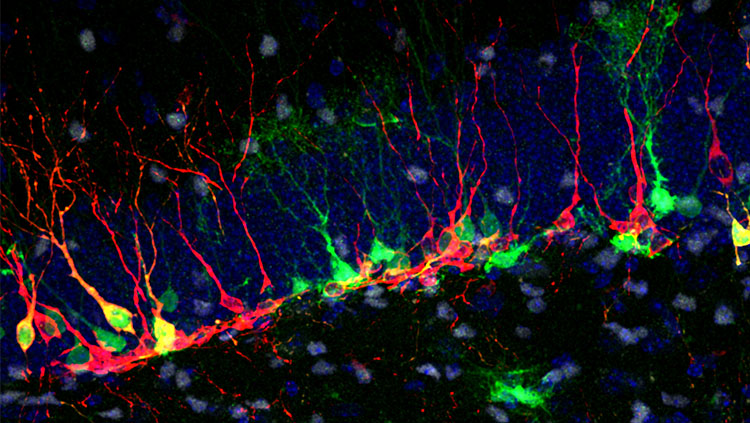 Virtual Conference Professional DevelopmentThis event took place on January 22, 2020 and is no longer available on-demand.Dec 4, 2019
 -
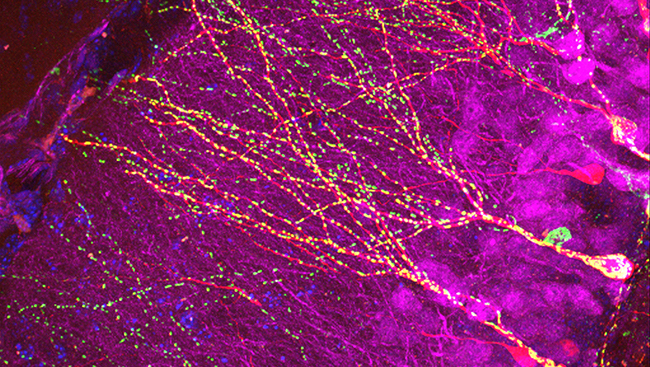 Article Professional DevelopmentA 62-year-old woman named Mary was found to have poisoned her husband who was terminally ill with cancer. The defendant displays a PET scan of her brain showing hyper-metabolic lesions in the temporal and frontal lobes of the brain. This could mean she suffers from frontotemporal dementia (FTD), a disorder that includes the following symptoms: socially inappropriate behavior, lack of sympathy/empathy, apathy, stereotypical/repetitive movement, and executive dysfunction. Imagine you are on a jury for Mary’s trial. Are the neuroimages enough evidence to show that Mary should be less responsible for her crime?Dec 3, 2019
 -
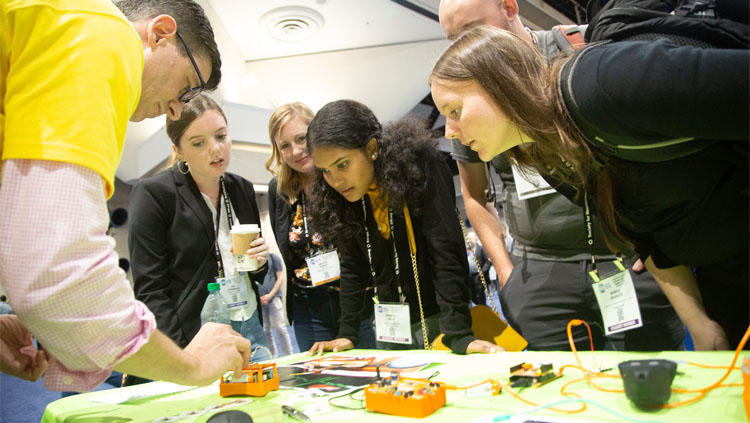 Article OutreachHosting a booth at a conference or other event can be a great way to raise brain awareness, connect with people with interests similar to yours, and encourage others to get involved in their community. When preparing to exhibit at a public event, it’s important to start planning early. With careful preparation and organization, you can ensure your outreach is a success. Follow the steps below to help you plan for and run a booth that gets people talking about the brain.Nov 26, 2019
 -
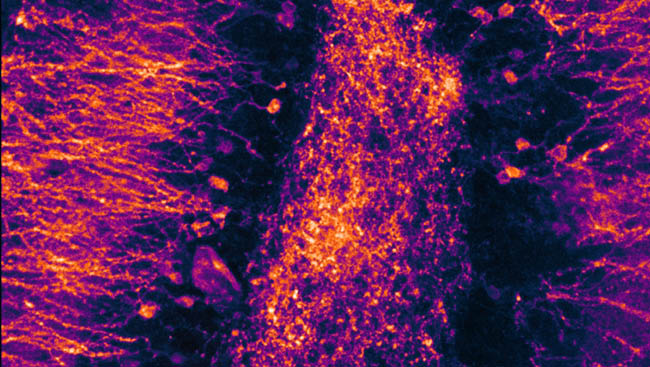 Video Annual Meeting Scientific ResearchData science is fast-growing across the neuroscience field. In this Short Course, leading experts teach basic data skills that all neuroscientists should know and detail advanced data science methods that can be used in different circumstances.Nov 25, 2019
 -
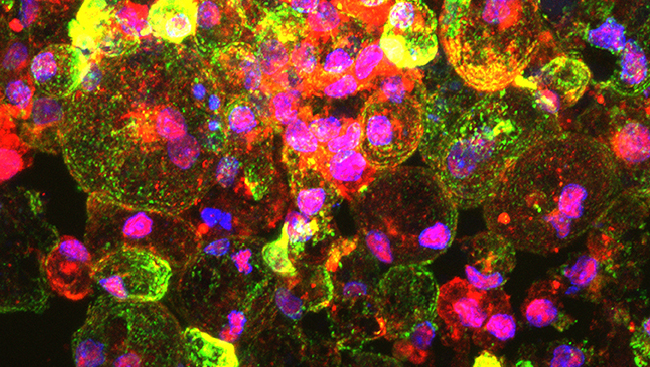 Article Scientific ResearchReward-related stimuli can potently influence behavior. For example, exposure to drug-paired cues can trigger drug seeking, use, and relapse in people suffering from addiction. What are the mechanisms whereby cue exposure might translate into harmful addictive behavior? One candidate mechanism we studied is an influence on cost-benefit decision making: Cue exposure might bias cost-benefit analysis such that drug use might seem like a good idea in the moment, with the benefits judged to outweigh the costs. Earlier findings indeed suggested that reward-paired cues promoted riskier choice in rats. We examined whether reward-paired sensory cues altered choice under uncertainty and risk in two laboratory gambling tasks. One was the Iowa Gambling Task, in which participants gambled based on what they learned about gambles from the outcomes (wins or losses) of their earlier choices. The second was a “two-choice lottery” task in which participants chose between a gamble that gave them a better chance of winning a smaller amount versus a gamble that gave them less of a chance of winning a larger amount. We had 131 volunteers perform these decision-making tasks with and without the cues accompanying win feedback. While participants performed these tasks, we used eye tracking to examine eye fixations during decision-making and pupil dilation as an index of arousal.Nov 21, 2019
 -
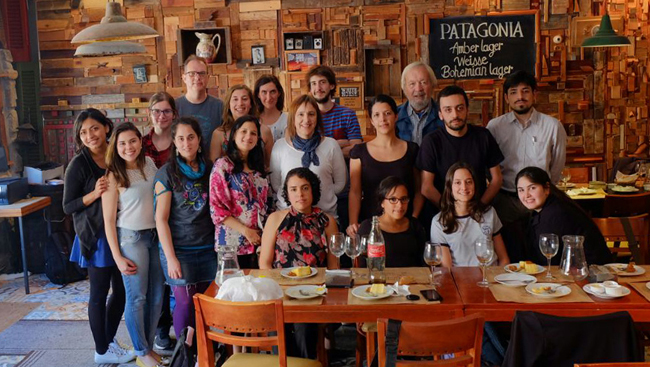 Article Professional DevelopmentGiovanne Baroni Diniz, a PhD candidate at the University of São Paulo, has proactively sought opportunities to conduct science abroad. He’s visited labs and attended conferences in the United States and Canada, completed a fellowship with SfN’s Latin American Training Program (LATP), spent three months researching in France, and visited other countries for professional growth. Here, he reflects on how those experiences have impacted his outlook on the field and inspired him to contribute to an inclusive culture. Why did you want to gain experience abroad? We get so used to how science is done in our home countries. When you go abroad, you realize some of what you assumed was standard was actually just part of the local scientific culture and not happening everywhere. It can be challenging to adapt to a new culture, but eventually you learn from the differences and gain a new perspective. Diversity is really important in the workplace. Especially because we are trying to solve problems, getting fresh perspectives and looking at questions from different angles is so important for science.Nov 20, 2019
 -
 Journal ArticleHumans exhibit laterality preferences, with handedness being the most extensively studied. Accordingly, brain-handedness associations are well documented. However, laterality preferences extend beyond handedness to include other limbs and organs, such as footedness and eyedness. Despite these distinctions, brain-footedness and brain-eyedness associations using resting-state functional connectomes remain largely unexplored. We utilize two large datasets, the Human Connectome Project-Development (HCP-D) and Human Connectome Project-Aging (HCP-A), to study the associations between sidedness (i.e., handedness, footedness, and eyedness) and whole-brain functional connectomes. While hand and foot preferences were correlated significantly, they explained less than 40% of the variance, suggesting some distinctions between the measures. For both cohorts, significant associations between handedness and connectivity were observed (p<0.05, NBS corrected). Notable patterns include increased connectivity for left-handed...Jun 5, 2025
 -
Journal ArticleRecent fMRI studies reported transformed representations between perception and visual working memory (VWM) in human early visual cortex (EVC). This is inconsistent with the still widely cited original proposal of the sensory account of VWM, which argues for a shared perception-VWM representation based on successful cross-decoding of the two representations. Although cross-decoding was usually lower than within-VWM decoding and consistent with transformed VWM representations, this has been attributed to experimental differences between perceptual and VWM tasks: once they are equated, the same representation is expected to exist in both. Including human participants of both sexes, this study compared target and distractor representations during the same VWM delay period for the same objects, thereby equating experimental differences. Even with strong VWM representations present throughout occipitotemporal cortex (OTC, including EVC) and posterior parietal cortex (PPC), fMRI cross-decoding revealed significa...Jun 5, 2025
-
Journal ArticleSavings refers to the gain in performance upon relearning. In sensorimotor adaptation, savings is tested by having participants adapt to perturbed feedback and, following a washout block during which the system resets to baseline, presenting the same perturbation again. While savings has been observed with these tasks, we have shown that the contribution from implicit adaptation, a process that uses errors to recalibrate the sensorimotor map, is attenuated upon relearning (Avraham et al., 2021). Here, we test the hypothesis that this attenuation is due to interference arising from the different relationship between the movement and the feedback during washout. Removing the perturbation at the start of the washout block typically results in a salient error signal in the opposite direction to that observed during learning. We first replicated the finding that implicit adaptation is attenuated following a washout period that introduces salient opposite errors. When we eliminated feedback during washout, relea...Jun 5, 2025
-
Journal ArticleMazes are a fundamental and widespread tool in behavior and systems neuroscience research in rodents, especially in spatial navigation and spatial memory investigations in freely behaving animals. However, their form and inflexibility often restrict potential experimental paradigms that involve multiple or adaptive maze designs. Unique layouts often lead to elevated costs, whether financially or in terms of time investment from scientists. To alleviate these issues, we have developed an automated, modular maze system that is flexible and scalable. This open source Adapt-A-Maze (AAM) system will allow for experiments with multiple track configurations in rapid succession. Additionally, the flexibility can expedite prototyping of behavioral paradigms. Automation ensures less variability in experimental parameters and higher throughput. Finally, the standardized componentry enhances experimental repeatability within labs and replicability across labs. Our maze was successfully used across labs, in multiple ex...Jun 5, 2025




