



Filter
-
(133)
-
(735)
-
(4)
-
(1)
-
(47863)
-
(93)
-
(25)
-
(14)
-
(434)
-
(7)
-
(186)
-
(8)
-
(33)
-
(17)
-
(7)
-
(10)
-
(9)
-
(5)
-
(21)
-
(8)
-
(12)
-
(9)
-
(3)
-
(10)
-
(10)
-
(56)
-
(46)
-
(12)
-
(3)
-
(7)
-
(6)
-
(5)
-
(8)
-
(7)
-
(11)
-
(58)
-
(13)
-
(31)
-
(8)
-
(5)
-
(10)
-
(5)
-
(16)
-
(4)
9581 - 9590
of 52804 results
-
 Journal ArticleThe dorsal region of the bed nucleus of the stria terminalis (dBNST) receives substantial dopaminergic input which overlaps with norepinephrine input implicated in stress responses. Using ex vivo fast scan cyclic voltammetry in male C57BL6 mouse brain slices, we demonstrate that electrically stimulated dBNST catecholamine signals are of substantially lower magnitude and have slower uptake rates compared with caudate signals. Dopamine terminal autoreceptor activation inhibited roughly half of the catecholamine transient, and noradrenergic autoreceptor activation produced an ∼30% inhibition. Dopamine transporter blockade with either cocaine or GBR12909 significantly augmented catecholamine signal duration. We optogenetically targeted dopamine terminals in the dBNST of transgenic ( TH:Cre ) mice of either sex and, using ex vivo whole-cell electrophysiology, we demonstrate that optically stimulated dopamine release induces slow outward membrane currents and an associated hyperpolarization response in a subset ...Jul 7, 2021
 -
Journal ArticleInsect gustatory systems comprise multiple taste organs for detecting chemicals that signal palatable or noxious quality. Although much is known about how taste neurons sense various chemicals, many questions remain about how individual taste neurons in each taste organ control feeding. Here, we use the Drosophila pharynx as a model to investigate how taste information is encoded at the cellular level to regulate consumption of sugars and amino acids. We first generate taste-blind animals and establish a critical role for pharyngeal input in food selection. We then investigate feeding behavior of both male and female flies in which only selected classes of pharyngeal neurons are restored via binary choice feeding preference assays as well as Fly Liquid-Food Interaction Counter assays. We find instances of integration as well as redundancy in how pharyngeal neurons control behavioral responses to sugars and amino acids. Additionally, we find that pharyngeal neurons drive sugar feeding preference based on sw...Jul 7, 2021
-
Journal ArticleFragile X syndrome (FXS) is the leading monogenetic cause of cognitive impairment and autism spectrum disorder. Area CA1 of the hippocampus receives current information about the external world from the entorhinal cortex via the temporoammonic (TA) pathway. Given its role in learning and memory, it is surprising that little is known about TA long-term potentiation (TA-LTP) in FXS. We found that TA-LTP was impaired in male fmr1 KO mice. Although there were no significant differences in basal synaptic transmission, synaptically evoked dendritic calcium signals were smaller in KO neurons. Using dendritic recording, we found no difference in complex spikes or pharmacologically isolated Ca2+ spikes; however, the threshold for fast, Na+-dependent dendritic spikes was depolarized in fmr1 KO mice. Cell-attached patch-clamp recordings found no difference in Na+ channels between wild-type and fmr1 KO CA1 dendrites. Dendritic spike threshold and TA-LTP were restored by blocking A-type K+ channels with either 150 µm B...Jul 7, 2021
-
Journal ArticleNeural circuitry generating locomotor rhythm and pattern is located in the spinal cord. Most spinal cord injuries (SCIs) occur above the level of spinal locomotor neurons; therefore, these circuits are a target for improving motor function after SCI. Despite being relatively intact below the injury, locomotor circuitry undergoes substantial plasticity with the loss of descending control. Information regarding cell type-specific plasticity within locomotor circuits is limited. Shox2 interneurons (INs) have been linked to locomotor rhythm generation and patterning, making them a potential therapeutic target for the restoration of locomotion after SCI. The goal of the present study was to identify SCI-induced plasticity at the level of Shox2 INs in a complete thoracic transection model in adult male and female mice. Whole-cell patch-clamp recordings of Shox2 INs revealed minimal changes in intrinsic excitability properties after SCI. However, afferent stimulation resulted in mixed excitatory and inhibitory in...Jul 7, 2021
-
Journal ArticleGabrielle Devienne, Sandrine Picaud, Ivan Cohen, Juliette Piquet, Ludovic Tricoire, et al. (see pages [5779–5790][1]) Critical periods of heightened plasticity are a common feature of cortical development. For example, blocking input from one eye during a short window after eye opening greatlyJul 7, 2021
-
Journal ArticleThis is the story of a search for a cortical map of auditory space. The search began with a study that was reported in the first issue of The Journal of Neuroscience ([Middlebrooks and Pettigrew, 1981][1]). That paper described some unexpected features of spatial sensitivity in the auditory cortex while failing to demonstrate the expected map. In the ensuing 40 years, we have encountered the following: panoramic spatial coding by single neurons; a rich variety of response patterns that are unmasked in the absence of general anesthesia; sharpening of spatial sensitivity when an animal is engaged in a listening task; and reorganization of spatial sensitivity in the presence of competing sounds. We have not encountered a map, but not through lack of trying. On the basis of years of negative results by our group and others, and positive results that are inconsistent with static point-to-point topography, we are confident in concluding that there just ain't no map. Instead, we have come to appreciate the highly...Jul 7, 2021
-
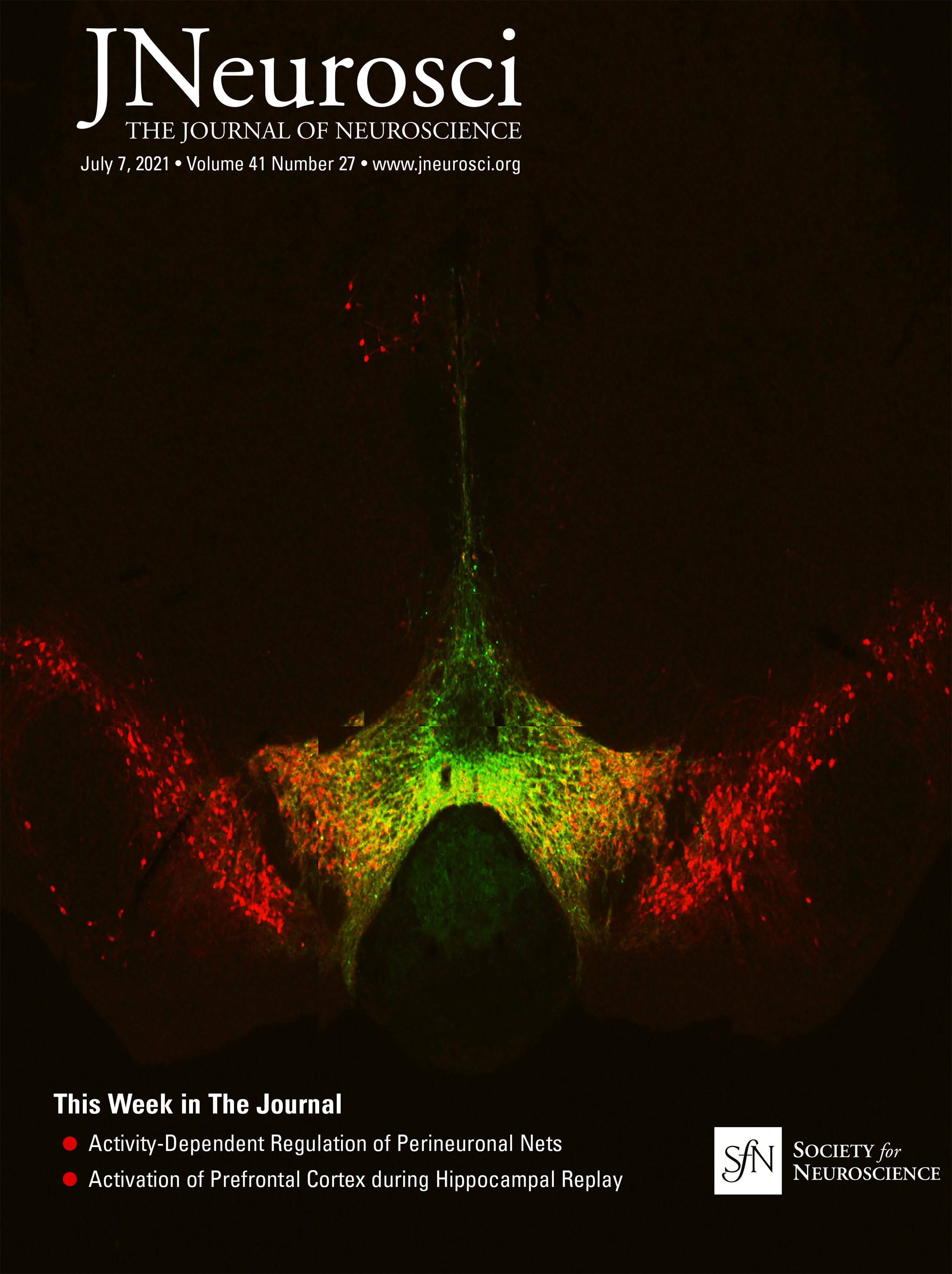
Journal ArticlePerineuronal net (PNN) accumulation around parvalbumin-expressing (PV) inhibitory interneurons marks the closure of critical periods of high plasticity, whereas PNN removal reinstates juvenile plasticity in the adult cortex. Using targeted chemogenetic in vivo approaches in the adult mouse visual cortex, we found that transient inhibition of PV interneurons, through metabotropic or ionotropic chemogenetic tools, induced PNN regression. EEG recordings indicated that inhibition of PV interneurons did not elicit unbalanced network excitation. Likewise, inhibition of local excitatory neurons also induced PNN regression, whereas chemogenetic excitation of either PV or excitatory neurons did not reduce the PNN. We also observed that chemogenetically inhibited PV interneurons exhibited reduced PNN compared with their untransduced neighbors, and confirmed that single PV interneurons express multiple genes enabling individual regulation of their own PNN density. Our results indicate that PNN density is regulated in...Jul 7, 2021
-
Journal ArticleSystemic administration of ML297, a selective activator of G-protein-gated inwardly rectifying K+ (GIRK) channels, decreases innate avoidance behavior in male C57BL/6J mice. The cellular mechanisms mediating the ML297-induced suppression of avoidance behavior are unknown. Here, we show that systemic ML297 administration suppresses elevated plus maze (EPM)-induced neuronal activation in the ventral hippocampus (vHPC) and basolateral amygdala (BLA) and that ML297 activates GIRK1-containing GIRK channels in these limbic structures. While intracranial infusion of ML297 into the vHPC suppressed avoidance behavior in the EPM test, mirroring the effect of systemic ML297, intra-BLA administration of ML297 provoked the opposite effect. Using neuron-specific viral genetic and chemogenetic approaches, we found that the combined inhibition of excitatory neurons in CA3 and dentate gyrus (DG) subregions of the vHPC was sufficient to decrease innate avoidance behavior in the EPM, open-field, and light-dark tests in male ...Jul 7, 2021
-
Journal ArticleSynapses are actively dismantled to mediate circuit refinement, but the developmental pathways that regulate synaptic disassembly are largely unknown. We have previously shown that the epithelial sodium channel ENaC/UNC-8 triggers an activity-dependent mechanism that drives the removal of presynaptic proteins liprin-α/SYD-2, Synaptobrevin/SNB-1, RAB-3, and Endophilin/UNC-57 in remodeling GABAergic neurons in Caenorhabditis elegans ([Miller-Fleming et al., 2016][1]). Here, we report that the conserved transcription factor Iroquois/IRX-1 regulates UNC-8 expression as well as an additional pathway, independent of UNC-8, that functions in parallel to dismantle functional presynaptic terminals. We show that the additional IRX-1-regulated pathway is selectively required for the removal of the presynaptic proteins, Munc13/UNC-13 and ELKS, which normally mediate synaptic vesicle (SV) fusion and neurotransmitter release. Our findings are notable because they highlight the key role of transcriptional regulation in s...Jul 7, 2021
-




