



Filter
-
(133)
-
(733)
-
(4)
-
(1)
-
(47830)
-
(91)
-
(25)
-
(14)
-
(433)
-
(7)
-
(181)
-
(8)
-
(33)
-
(17)
-
(7)
-
(9)
-
(9)
-
(5)
-
(21)
-
(8)
-
(12)
-
(9)
-
(3)
-
(10)
-
(10)
-
(56)
-
(45)
-
(12)
-
(3)
-
(7)
-
(6)
-
(5)
-
(8)
-
(7)
-
(11)
-
(58)
-
(13)
-
(30)
-
(8)
-
(5)
-
(10)
-
(5)
-
(14)
-
(4)
951 - 960
of 52751 results
-
 Journal ArticleExperimental behavioral neuroscience relies on the ability to deliver precise amounts of liquid volumes to animal subjects. Among others, it allows the progressive shaping of behavior through successive, automated, reinforcement, thus allowing training in more demanding behavioral tasks and the manipulation of variables that underlie the decision-making process. Here we introduce a stepper motor-based, fully integrated, open-source solution, that allows the reproducible delivery of small (<1μl) liquid volumes. The system can be controlled via software using the Harp protocol (e.g., from Bonsai or Python interfaces), or directly through a low-level I/O interface. Both the control software and electronics are compatible with a wide variety of motor models and mechanical designs. However, we also provide schematics, and step-by-step assembly instructions, for the mechanical design used and characterized in this manuscript. We provide benchmarks of the full integrated system using a computer vision method capa...Jul 1, 2025
 -
 Journal ArticleEarly childhood is a critical period showing experience-dependent changes in brain structure and function. The complex link between the structural connectivity (SC) and functional connectivity (FC) of the brain is of particular interest. However, its relationship with both age and attention in early childhood is not well understood. In this study, children between the ages of 4 and 7, and at a 1 year follow-up visit, underwent neuroimaging (diffusion-weighted and passive-viewing functional magnetic resonance imaging) and assessments for selective, sustained, and executive attention. We examined regional graph metrics and SC–FC coupling of the structural and functional networks. Partial least squares was used to investigate longitudinal brain measure changes and cross-sectional associations with age and attention. We observed longitudinal changes in functional graph metrics and age-related decreases in SC modularity. Region-wise graph analyses revealed variable brain–behavior relationships across the brain,...Jul 1, 2025
 -
 Journal ArticleRecognition of conspecific individuals in mammals is an important skill, thought to be mediated by a distributed array of neural networks, including those processing olfactory cues. Recent data from our groups have shown that social memory can be supported by olfactory cues alone and that interactions with an individual lead to increased neural representations of that individual in the anterior olfactory nucleus, an olfactory network strongly modulated by the neuropeptide oxytocin. We here show, using a computational model, how enhanced representations in the AON can easily arise during the encoding phase, how they can be modulated by OXT, and how a dynamic memory signature in the form of enhanced oscillations in the beta range arises from the architecture of the neural networks involved. These findings have implications for our understanding how social memories are formed and retrieved and generate further hypotheses that can be tested experimentally.Jul 1, 2025
 -
 Journal ArticleWe have documented the early embryonic development of hypothalamic neurons expressing β-endorphin, α-melanocyte–stimulating hormone, neuropeptide Y, and kisspeptin in rhesus macaques, an animal model that is very similar to humans. Neurons expressing both β-End and αMSH are the first to develop and are initially located in the lateral basal hypothalamus (LBH) as early as day 32–34 of gestation. By day 45 of gestation, these neurons have migrated into the medial basal hypothalamic (MBH) area as their final destination. NPY neurons within the ARH develop later and first appear at day 44 of fetal life, at which time a cluster of neurons is present within the ARH–MBH area. NPY neurons continue to be expressed within the ARH area at all of the later fetal ages analyzed. Similarly, kisspeptin neurons develop later compared with β-End, although only a few cells are present in the ARH by day 44 of gestation, at which time kisspeptin is also expressed in the developing anterior lobe of the pituitary. By day 70 of g...Jul 1, 2025
 -
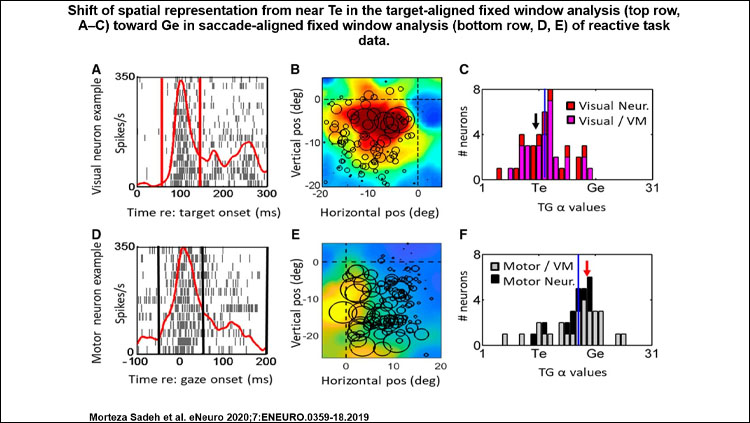 Article Scientific ResearchMaterial below summarizes the article Timing Determines Tuning: A Rapid Spatial Transformation in Superior Colliculus Neurons during Reactive Gaze Shifts, published on December 2, 2019, in eNeuro and authored by Morteza Sadeh, Amirsaman Sajad, Hongying Wang, Xiaogang Yan, and John Douglas Crawford. Highlights During gaze shifts of the eyes and head, the superior colliculus rapidly transforms a visual signal related to target direction into a motor command for gaze direction. This visuomotor transition involves a relay of signals between cells with visual, visuomotor, and motor responses, each contributing to the overall transformation. The difference between the visual input and motor output seems to arise from internal noise, correlating to behavioral errors that may reflect the health of the system.Mar 26, 2020
 -
 Article Professional DevelopmentImagine you are the parent of two children. Your oldest, a boy, was diagnosed with autism last year and just celebrated his fourth birthday. Your youngest, a girl, is six months old. You’ve heard that autism runs in families; you know this means that your daughter is at higher risk than most children. But you’ve also heard that boys tend to get autism at a higher rate than girls. Your daughter, like her brother, is a poor sleeper, and sometimes you wonder whether she is more interested in looking at the ceiling fan than at you…but other times she smiles at you or her brother and seems very engaged. You find yourself making comparisons between your two children frequently, and wondering…will she have autism too? A friend tells you that just last year, researchers were able to scan the brains of babies when they were six to twelve months old and predict, for the first time, who would develop autism by age two. Your friend then poses the inevitable question: would you want this test for your daughter?Mar 25, 2020
 -
 Journal ArticleOur ability to shift from one emotion to the next allows us to adapt our behaviors to a constantly changing and often uncertain environment. Although previous studies have identified cortical and subcortical regions involved in affective responding, none have shown how these regions track and represent transitions between different emotional states nor how such responses are modulated based on the recent emotional context. To study this, we commissioned new musical pieces designed to systematically move participants (N = 39, 20 males and 19 females) through different emotional states during fMRI and to manipulate the emotional context in which different participants heard a musical motif. Using a combination of data-driven (Hidden Markov modeling) and hypothesis-driven methods, we confirmed that spatiotemporal patterns of activation along the temporal-parietal axis reflect transitions between music-evoked emotions. We found that the spatial and temporal signatures of these neural response patterns, as well...Jun 30, 2025
 -
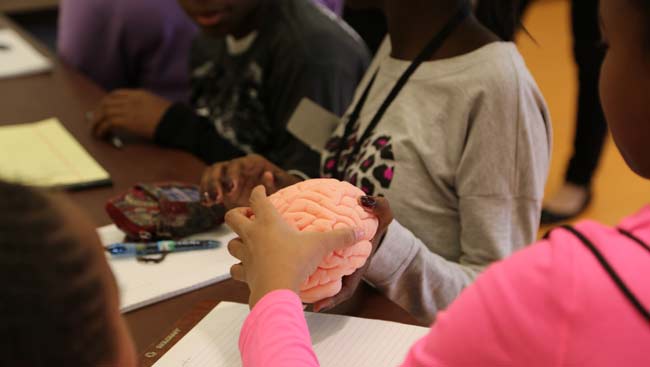 Article OutreachHaung (Ho) Yu is part of the Greater New York City Chapter of SfN (braiNY), which brings together like-minded neuroscience organizations to better neuroscience education and outreach. Over the years, braiNY have seen steady growth and increased reach. Here are three things the chapter does to impact their audiences.Mar 19, 2020
 -
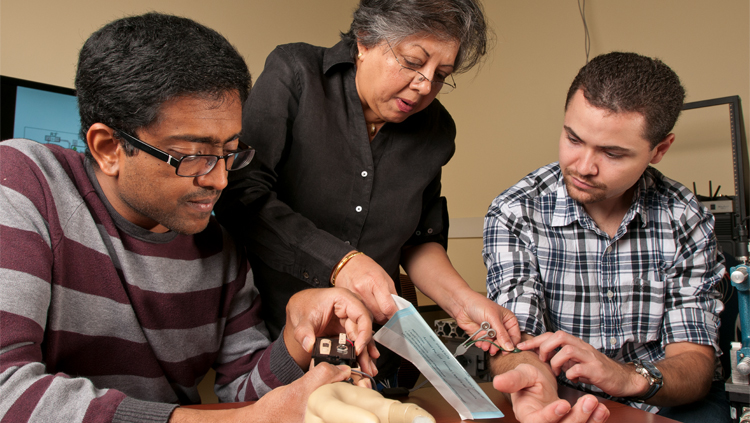 Article Career PathsThis resource was featured in the NeuroJobs Career Center. Visit today to search the world’s largest source of neuroscience opportunities. As director of the Adaptive Neural Systems Laboratory and the owner of more than a half dozen patents, Ranu Jung designs neural engineering projects that drive the process of transforming basic discoveries into clinical applications. In this interview she explains how collaborative projects can at once advance the understanding of the brain and the development of medical devices. She also talks about what sparks questions for her, the advantages of adaptability, and where to find support. This article is part of Neuronline's interview series "Entrepreneurial Women Combining Neuroscience, Engineering, and Tech," which highlights the career paths and scientific accomplishments of female leaders and role models who are creatively bridging disciplines to improve lives.Mar 16, 2020
 -
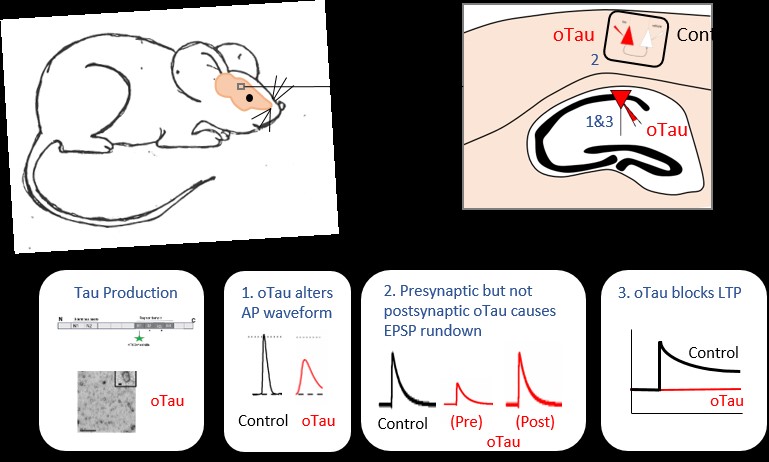 Article Scientific ResearchMaterial below summarizes the article Introduction of Tau Oligomers into Cortical Neurons Alters Action Potential Dynamics and Disrupts Synaptic Transmission and Plasticity, published on September 25, 2019, in eNeuro and authored by Emily Hill, Thomas K. Karikari, Kevin G. Moffat, Magnus J. E. Richardson, and Mark J. Wall. Highlights Introduction of nanomolar concentrations of tau oligomers into cortical neurons causes significant changes in action potential kinetics in a 40-minute timeframe. Introduction of tau oligomers into the presynaptic cell of synaptically connected pairs impairs basal synaptic transmission and enhances short-term depression. Introduction of tau oligomers into the postsynaptic cell of synaptically connected pairs has no effect on basal synaptic transmission but markedly impairs synaptic plasticity (long-term potentiation).Mar 12, 2020




