



Filter
-
(133)
-
(733)
-
(4)
-
(1)
-
(47832)
-
(91)
-
(25)
-
(14)
-
(433)
-
(7)
-
(181)
-
(8)
-
(33)
-
(17)
-
(7)
-
(9)
-
(9)
-
(5)
-
(21)
-
(8)
-
(12)
-
(9)
-
(3)
-
(10)
-
(10)
-
(56)
-
(45)
-
(12)
-
(3)
-
(7)
-
(6)
-
(5)
-
(8)
-
(7)
-
(11)
-
(58)
-
(13)
-
(30)
-
(8)
-
(5)
-
(10)
-
(5)
-
(14)
-
(4)
2101 - 2110
of 52753 results
-
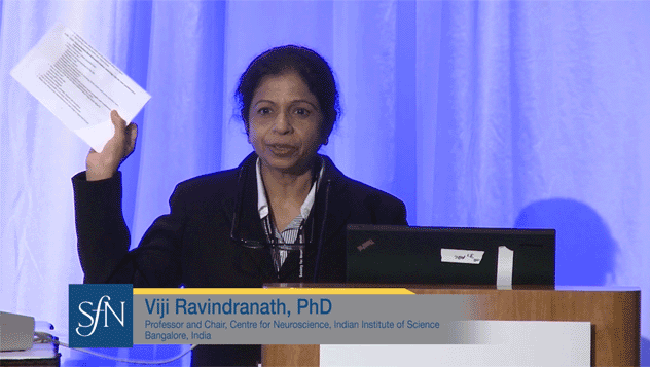 Video Annual Meeting Professional DevelopmentChoosing your postdoc is an important decision in a neuroscientist’s career. In this playlist, Viji Ravindranath walks through what not to do, what you absolutely should do, how to transition out of your postdoc, and answers questions that many trainees have about the process.Apr 3, 2015
 -
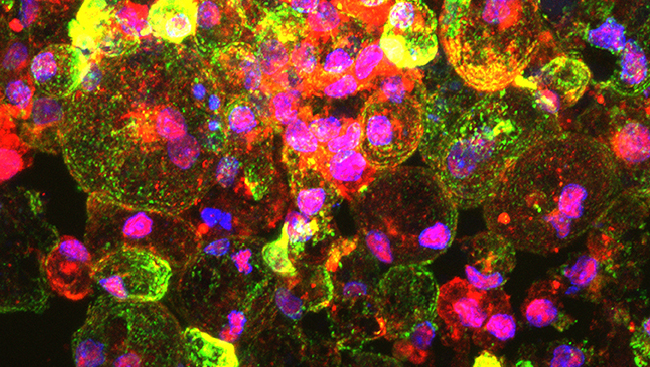 Article Career PathsNo matter the task, you take an energetic, creative approach. No matter how busy you are, you’re willing to help others because you value their success.Apr 3, 2015
 -
 Video Annual Meeting Professional DevelopmentHow can training programs better prepare students for different career options? By bridging the disconnect between mentors as traditional role models for academic careers and the reality that students are taking other routes in science. Find out how to adjust your training programs in these videos with Alan Sved.Apr 3, 2015
 -
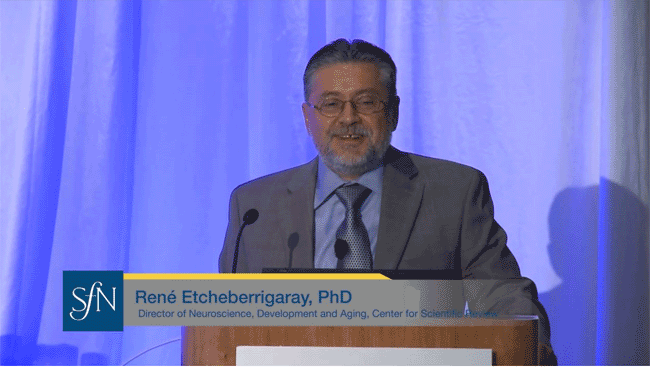 Video Annual Meeting Professional DevelopmentFeel in-control when applying for an NIH grant mechanism. Know how the peer review process works and what you can expect. In these videos, René Etcheberrigaray lays it all out for you.Apr 3, 2015
 -
 Journal ArticlePrevious physiological and psychophysical studies have explored whether feedback to the cochlea from the efferent system influences forward masking. The present work proposes that the limited growth-of-masking (GOM) observed in auditory-nerve (AN) fibers may have been misunderstood; namely, that this limitation may be due to the influence of anesthesia on the efferent system. Building on the premise that the unanesthetized AN may exhibit GOM similar to more central nuclei, the present computational modeling study demonstrates that feedback from the medial olivocochlear (MOC) efferents may contribute to GOM observed physiologically in onset-type neurons in both the cochlear nucleus and inferior colliculus (IC). Additionally, the computational model of MOC efferents used here generates a decrease in masking with longer masker-signal delays similar to that observed in IC physiology and in psychophysical studies. An advantage of this explanation over alternative physiological explanations (e.g., that forward m...Sep 4, 2024
 -
Journal ArticleAstrocytes are essential for the formation and maintenance of neural networks. However, a major technical challenge for investigating astrocyte function and disease-related pathophysiology has been the limited ability to obtain functional human astrocytes. Despite recent advances in human pluripotent stem cell (hPSC) techniques, primary rodent astrocytes remain the gold standard in co-culture with human neurons. We demonstrate that a combination of leukemia inhibitory factor (LIF) and bone morphogenetic protein-4 (BMP4) directs hPSC-derived neural precursor cells to a highly pure population of astroglia in 28 days. Using single-cell RNA sequencing, we confirm the astroglial identity of these cells and highlight profound transcriptional adaptations in co-cultured hPSC-derived astrocytes and neurons, consistent with their further maturation. In co-culture with human neurons, multielectrode array recordings revealed robust network activity of human neurons in a co-culture with hPSC-derived or rat astrocytes (...Sep 3, 2024
-
 Journal ArticleA new era of disease-modifying therapy for Alzheimer's disease (AD) arrived in 2021 following the Food and Drug Administration's (FDA) decision to grant accelerated approval for aducanumab, an anti-β-amyloid (Aβ) monoclonal antibody designed to target Aβ aggregates, a biological component of AD. More recently, trial outcomes for lecanemab and donanemab, two additional antibodies of this drug class, have shown favorable and significant slowing of metrics for cognitive and functional decline. Lecanemab and donanemab have since received similar FDA approval to aducanumab in January 2023 and July 2024, respectively. Given that these therapies are a clearly emerging tool in the repertoire of clinicians treating AD and related dementias, a critical dialogue has been ongoing regarding the potential impacts and place for these therapies. Here, we seek to contextualize this debate by first considering factors involved in theoretically extrapolating current randomized control trial outcomes to estimate meaningful cl...Sep 1, 2024
 -
Journal ArticleAstrocytes are essential for the formation and maintenance of neural networks. However, a major technical challenge for investigating astrocyte function and disease-related pathophysiology has been the limited ability to obtain functional human astrocytes. Despite recent advances in human pluripotent stem cell (hPSC) techniques, primary rodent astrocytes remain the gold standard in coculture with human neurons. We demonstrate that a combination of leukemia inhibitory factor (LIF) and bone morphogenetic protein-4 (BMP4) directs hPSC-derived neural precursor cells to a highly pure population of astroglia in 28 d. Using single-cell RNA sequencing, we confirm the astroglial identity of these cells and highlight profound transcriptional adaptations in cocultured hPSC-derived astrocytes and neurons, consistent with their further maturation. In coculture with human neurons, multielectrode array recordings revealed robust network activity of human neurons in a coculture with hPSC-derived or rat astrocytes [3.63 ± ...Sep 1, 2024
-
 Journal ArticleHomeostatic plasticity represents a set of mechanisms thought to stabilize some function of neural activity. Here, we identified the specific features of cellular or network activity that were maintained after the perturbation of GABAergic blockade in two different systems: mouse cortical neuronal cultures where GABA is inhibitory and motoneurons in the isolated embryonic chick spinal cord where GABA is excitatory (males and females combined in both systems). We conducted a comprehensive analysis of various spiking activity characteristics following GABAergic blockade. We observed significant variability in many features after blocking GABAA receptors (e.g., burst frequency, burst duration, overall spike frequency in culture). These results are consistent with the idea that neuronal networks achieve activity goals using different strategies (degeneracy). On the other hand, some features were consistently altered after receptor blockade in the spinal cord preparation (e.g., overall spike frequency). Regardl...Sep 1, 2024
 -
 Journal ArticleMusicians can have better abilities to understand speech in adverse condition such as background noise than non-musicians. However, the neural mechanisms behind such enhanced behavioral performances remain largely unclear. Studies have found that the subcortical frequency-following response to the fundamental frequency of speech and its higher harmonics (speech-FFR) may be involved since it is larger in people with musical training than in those without. Recent research has shown that the speech-FFR consists of a cortical contribution in addition to the subcortical sources. Both the subcortical and the cortical contribution are modulated by selective attention to one of two competing speakers. However, it is unknown whether the strength of the cortical contribution to the speech-FFR, or its attention modulation, is influenced by musical training. Here we investigate these issues through magnetoencephalographic (MEG) recordings of 52 subjects (18 musicians, 25 non-musicians, and 9 neutral participants) list...Sep 1, 2024




