



Filter
-
(133)
-
(733)
-
(4)
-
(1)
-
(47832)
-
(91)
-
(25)
-
(14)
-
(433)
-
(7)
-
(181)
-
(8)
-
(33)
-
(17)
-
(7)
-
(9)
-
(9)
-
(5)
-
(21)
-
(8)
-
(12)
-
(9)
-
(3)
-
(10)
-
(10)
-
(56)
-
(45)
-
(12)
-
(3)
-
(7)
-
(6)
-
(5)
-
(8)
-
(7)
-
(11)
-
(58)
-
(13)
-
(30)
-
(8)
-
(5)
-
(10)
-
(5)
-
(14)
-
(4)
2051 - 2060
of 52753 results
-
 Article Professional DevelopmentWhether you’re preparing your first article or looking for a refresher, use this guide to help you answer the basics on authorship, editorial handling, and peer review.May 15, 2015
 -
 Article Professional DevelopmentAre you just starting your career? Set yourself up for success in NIH’s grant application process by understanding NIH’s mission, nature, structure, and key personnel.May 15, 2015
 -
 Article Professional DevelopmentStudying internationally is one thing, and navigating the complex process from when you accept to when you arrive is another.May 15, 2015
 -
 TrainingStudents may decide to leave the bench for different reasons, including tight funding in academia and interest in opportunities in industry and other related careers.May 15, 2015
 -
 Journal ArticleCa2+-binding proteins (CaBPs; CaBP1-5) are a subfamily of neuronal Ca2+ sensors with high homology to calmodulin. Notably, CaBP4, which is exclusively expressed in rod and cone photoreceptors, is crucial for maintaining normal retinal functions. However, the functional roles of CaBP1, CaBP2, and CaBP5 in the retina remain elusive, primarily due to limited understanding of their expression patterns within inner retinal neurons. In this study, we conducted a comprehensive transcript analysis using single-cell RNA sequencing datasets to investigate the gene expression profiles of CaBPs in mouse and human retinal neurons. Our findings revealed notable similarities in the overall expression patterns of CaBPs across both species. Specifically, nearly all amacrine cell, ganglion cell, and horizontal cell types exclusively expressed CaBP1. In contrast, the majority of bipolar cell types, including rod bipolar (RB) cells, expressed distinct combinations of CaBP1, CaBP2, and CaBP5, rather than a single CaBP as previ...Sep 11, 2024
 -
Journal ArticleSocial recognition is an essential part of social function and often promotes specific social behaviors based on prior experience. Social and defensive behaviors in particular often emerge with prior experiences of familiarity or novelty/stress, respectively. This is also commonly seen in rodents towards same-strain and inter-strain conspecifics. Medial amygdala (MeA) activity guides social choice based on age and sex recognition and is sensitive to social experiences. However, little is known about whether the MeA exhibits differential responses based on strain or how this is impacted by experience. Social stress impacts posterior MeA (MeAp) function and can shift measures of social engagement. However, it is unclear how stress impacts MeAp activity and contributes to altered social behavior. The primary goal of this study in adult male Sprague Dawley rats was to determine whether prior stress experience with a different strain (Long Evans) rat impacts MeAp responses to same-strain and different-strain co...Sep 11, 2024
-
Journal ArticleConscious reportability of visual input is associated with a bimodal neural response in primary visual cortex (V1): an early-latency response coupled to stimulus features and a late-latency response coupled to stimulus report or detection. This late wave of activity, central to major theories of consciousness, is thought to be driven by prefrontal cortex (PFC), responsible for “igniting” it. Here we analyzed two electrophysiological studies in mice performing different stimulus detection tasks, and characterize neural activity profiles in three key cortical regions: V1, posterior parietal cortex (PPC) and PFC. We then developed a minimal network model, constrained by known connectivity between these regions, reproducing the spatio-temporal propagation of visual- and report-related activity. Remarkably, while PFC was indeed necessary to generate report-related activity in V1, this occurred only through the mediation of PPC. PPC, and not PFC, had the final veto in enabling the report-related late wave of V1 ...Sep 11, 2024
-
 Article Professional DevelopmentWriting good NIH grant applications can be tricky. To help new and established applicants submit better applications, NIH’s Center for Scientific Review (CSR) has shared insights of six former study section chairs explaining common elements of impactful applications they’ve seen.May 8, 2015
 -
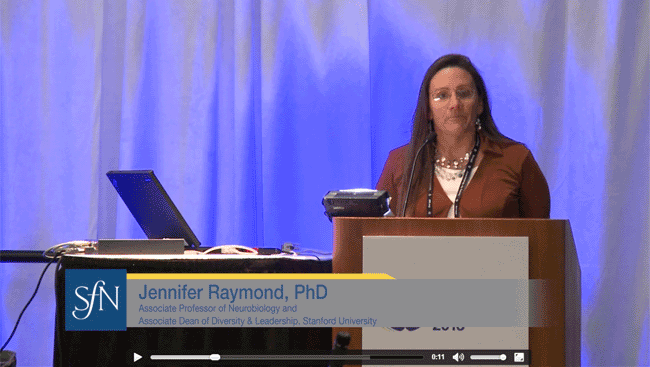 Video DiversityDiversity — or lack thereof — can make or break neuroscience discovery. With departments still struggling to retain women and underrepresented minorities, it’s clear that change is needed.May 8, 2015
 -
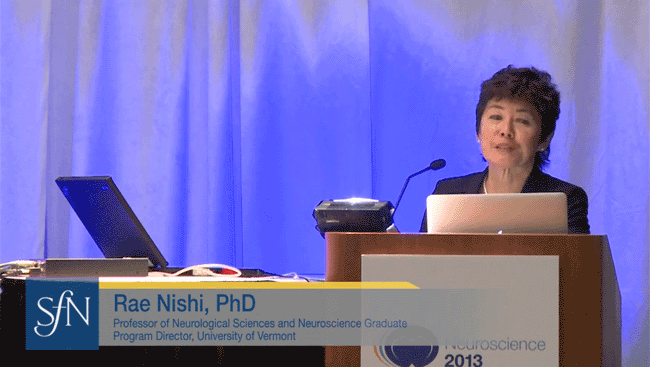 Video DiversityOne program’s progress in increasing diversity could hold important takeaways for you. Hear how Rae Nishi has led the University of Vermont’s neuroscience graduate program to prioritize and increase diversity, and what it means for the students and future of neuroscience.May 8, 2015




