



Filter
-
(133)
-
(733)
-
(4)
-
(1)
-
(47832)
-
(91)
-
(25)
-
(14)
-
(433)
-
(7)
-
(181)
-
(8)
-
(33)
-
(17)
-
(7)
-
(9)
-
(9)
-
(5)
-
(21)
-
(8)
-
(12)
-
(9)
-
(3)
-
(10)
-
(10)
-
(56)
-
(45)
-
(12)
-
(3)
-
(7)
-
(6)
-
(5)
-
(8)
-
(7)
-
(11)
-
(58)
-
(13)
-
(30)
-
(8)
-
(5)
-
(10)
-
(5)
-
(14)
-
(4)
1671 - 1680
of 52753 results
-
 Journal ArticleDelay discounting (DD) is a phenomenon where individuals devalue a reward associated with a temporal delay, with the rate of devaluation being representative of impulsive-like behavior. Here we first sought to develop and validate a mouse DD task to study brain circuits involved in DD decision-making within short developmental time windows, given widespread evidence of developmental regulation of impulse control and risk-taking. We optimized a T-maze DD task for mice that enables training and DD trials within two weeks. Mice learned to choose between a large and a small reward located at opposite arms of a T-maze. Once training criteria were met, mice underwent DD whereby the large reward choice was associated with a temporal delay. Task validation showed that adolescent C57BL/6J mice display increased preference for the small reward upon a temporal delay, confirming increased impulsivity compared to adults. We next used this DD task to explore the neural basis of decision-making. We used tyrosine hydroxyl...Dec 3, 2024
 -
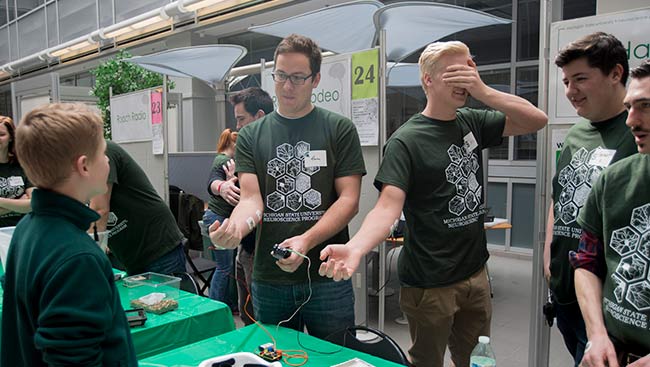 Article OutreachIn addition to teaching neuroscience courses at Michigan State University (MSU), Jennifer Taylor and Casey Henley serve as the neuroscience program’s outreach co-coordinators.Nov 29, 2016
 -
 Article AdvocacyAs undergraduate students, we are at the earliest stages of our neuroscience careers.Nov 29, 2016
 -
Journal ArticleIncreasing data suggest a crucial relationship between glycolipid metabolic disorder and neuropsychiatric injury. The aim of this study is to investigate the behavioral performance changes and neuropathological injuries in mice challenged with high-fat diet (HFD) and streptozotocin (STZ). The glucose metabolism indicators and behavioral performance were detected. The mRNA expression of IL-1β, IL-6, TNF-α, ocln, zo-1, and clnds and protein expression of APP, p-Tau, p-IRS1, p-AKT, p-ERK, and TREM1/2 were measured. The fluorescence intensities of MAP-2, NeuN, APP, p-Tau, GFAP, and IBA-1 were observed. The results showed that combination of HFD and STZ/I.P. could induce glucose metabolic turmoil and Alzheimer's disease (AD)-like neuropsychiatric dysfunction in mice, as indicated by the increased concentrations of fasting blood glucose and impaired learning and memory ability. Moreover, the model mice presented increased levels of APP, p-Tau, p-IRS1, TREM2, IL-1β, IL-6, TNF-α, ocln, zo-1, and clnds; decreased l...Dec 1, 2024
-
 Journal ArticleNeuropathic pain (NP) caused by sciatic nerve injury can significantly impact the quality of life of patients. The M1 phenotype of microglia has been reported to promote the progression of NP. Procaine is a lipid-soluble local anesthetic drug that exerts narcotic analgesic effects. Nevertheless, the detailed effect of procaine in NP is not clear. In order to explore the role of procaine in the polarization of NP microglia, HAPI cells were exposed to LPS to polarize into M1 type. In addition, the number of the M1 phenotype of HAPI cells was assessed using flow cytometry. The binding site between CCL5 and STAT3 was explored using the dual luciferase assay. Furthermore, in vivo experiments were applied for testing the impact of procaine on NP. LPS significantly inhibited HAPI cell viability, which was reversed by procaine. Consistently, procaine alleviated LPS-induced upregulation of inflammatory factors. Additionally, it significantly inhibited HAPI cell M1 polarization induced by LPS. Meanwhile, overexpress...Dec 1, 2024
 -
Journal ArticleMaintaining concentration on demanding cognitive tasks, such as vigilance (VG) and working memory (WM) tasks, is crucial for successful task completion. Previous research suggests that internal concentration maintenance fluctuates, potentially declining to suboptimal states, which can influence trial-by-trial performance in these tasks. However, the timescale of such alertness maintenance, as indicated by slow changes in pupil diameter, has not been thoroughly investigated. This study explored whether “pupil trends”—which selectively signal suboptimal tonic alertness maintenance at various timescales—negatively correlate with trial-by-trial performance in VG and WM tasks. Using the psychomotor vigilance task (VG) and the visual–spatial two-back task (WM), we found that human pupil trends lasting over 10 s were significantly higher in trials with longer reaction times, indicating poorer performance, compared with shorter reaction time trials, which indicated better performance. The attention network test fu...Dec 1, 2024
-
Journal ArticleUnique microglial states have been identified in Alzheimer's disease (AD) model mice and postmortem AD brains. Although it has been well documented that amyloid-β accumulation induces the alteration of microglial states, the relationship between tau pathology and microglial states remains incompletely understood because of a lack of suitable AD models. In the present study, we generated a novel AD model mouse by the intracerebral administration of tau purified from human brains with primary age-related tauopathy into App knock-in mice with humanized tau. Immunohistochemical analyses revealed that Dectin-1-positive disease-associated microglia were increased in the AD model mice after tau accumulation in the brain. We then performed single-nucleus RNA sequencing on the AD model mice to evaluate the differences in microglial states with and without tau propagation and accumulation. By taking advantage of spatial transcriptomics and existing single-cell RNA sequencing datasets, we showed for the first time th...Dec 1, 2024
-
 Journal ArticleWe use sensory feedback to form our perception, and control our movements and forces (actions). There is an ongoing debate about the relation between perception and action, with evidence in both directions. For example, there are cases in which perceptual illusions affect action signals and cases where they do not. However, even when they do, it is unknown if perceptual information can be inferred from action signals alone. To answer this question, we utilized a perceptual illusion created by artificial tactile skin stretch, which increases stiffness perception, and affects grip force. We used data recorded in a stiffness discrimination task in which participants compared pairs of virtual objects, comprised of force and artificial skin stretch and indicated which they perceived as stiffer. We explored if models could predict the participants’ perceptual responses, and the increase in stiffness perception caused by the skin stretch, solely from their recorded action signals. That is, with no information pro...Dec 1, 2024
 -
 Journal ArticleSingle-nucleus RNA-sequencing (snRNA-seq) has revealed new levels of cellular organization and diversity within the human brain. However, full-length mRNA isoforms are not resolved in typical snRNA-seq analyses using short-read sequencing that cannot capture full-length transcripts. Here we combine standard 10x Genomics short-read snRNA-seq with targeted PacBio long-read snRNA-seq to examine isoforms of genes associated with neurological diseases at the single-cell level from prefrontal cortex samples of diseased and nondiseased human brain, assessing over 165,000 cells. Samples from 25 postmortem donors with Alzheimer's disease (AD), dementia with Lewy bodies (DLB), or Parkinson's disease (PD), along with age-matched controls, were compared. Analysis of the short-read libraries identified shared and distinct gene expression changes across the diseases. The same libraries were then assayed using enrichment probes to target 50 disease-related genes followed by long-read PacBio sequencing, enabling linkage b...Dec 1, 2024
 -
Journal ArticleIn an effort to increase access to neuroscience education in underserved communities, we created an educational program that utilizes a simple task to measure place preference of the cockroach ( Gromphadorhina portentosa ) and the open-source free software, SLEAP Estimates Animal Poses (SLEAP) to quantify behavior. Cockroaches ( n = 18) were trained to explore a linear track for 2 min while exposed to either air, vapor, or vapor with nicotine from a port on one side of the linear track over 14 d. The time the animal took to reach the port was measured, along with distance traveled, time spent in each zone, and velocity. As characterizing behavior is challenging and inaccessible for nonexperts new to behavioral research, we created an educational program using the machine learning algorithm, SLEAP, and cloud-based (i.e., Google Colab) low-cost platforms for data analysis. We found that SLEAP was within a 0.5% margin of error when compared with manually scoring the data. Cockroaches were found to have an in...Dec 1, 2024




