



Filter
-
(133)
-
(733)
-
(4)
-
(1)
-
(47833)
-
(91)
-
(25)
-
(14)
-
(433)
-
(7)
-
(182)
-
(8)
-
(33)
-
(17)
-
(7)
-
(9)
-
(9)
-
(5)
-
(21)
-
(8)
-
(12)
-
(9)
-
(3)
-
(10)
-
(10)
-
(56)
-
(45)
-
(12)
-
(3)
-
(7)
-
(6)
-
(5)
-
(8)
-
(7)
-
(11)
-
(58)
-
(13)
-
(30)
-
(8)
-
(5)
-
(10)
-
(5)
-
(15)
-
(4)
2101 - 2110
of 52756 results
-
 Article DiversityThink about a time when you didn’t receive the recognition you felt you deserved, or when you hadn’t been heard on a particular issue. How productive were you? Did you still feel connected to your team, or did you withdraw?Apr 3, 2015
 -
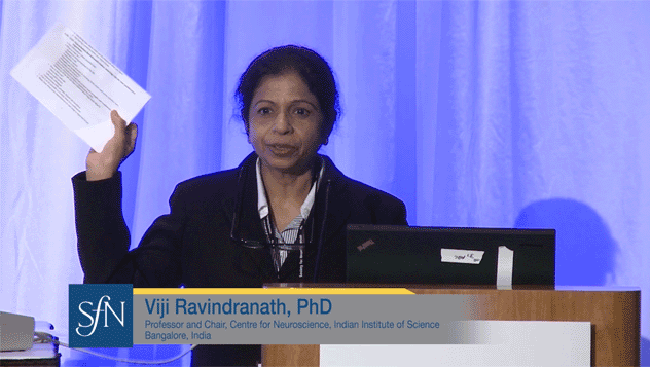 Video Annual Meeting Professional DevelopmentChoosing your postdoc is an important decision in a neuroscientist’s career. In this playlist, Viji Ravindranath walks through what not to do, what you absolutely should do, how to transition out of your postdoc, and answers questions that many trainees have about the process.Apr 3, 2015
 -
 Article Career PathsNo matter the task, you take an energetic, creative approach. No matter how busy you are, you’re willing to help others because you value their success.Apr 3, 2015
 -
 Video Annual Meeting Professional DevelopmentHow can training programs better prepare students for different career options? By bridging the disconnect between mentors as traditional role models for academic careers and the reality that students are taking other routes in science. Find out how to adjust your training programs in these videos with Alan Sved.Apr 3, 2015
 -
 Video Annual Meeting Professional DevelopmentFeel in-control when applying for an NIH grant mechanism. Know how the peer review process works and what you can expect. In these videos, René Etcheberrigaray lays it all out for you.Apr 3, 2015
 -
 Journal ArticleHow the human brain reconstructs, step-by-step, the core elements of past experiences is still unclear. Here, we map the spatio-temporal trajectories along which visual object memories are reconstructed during associative recall. Specifically, we inquire whether retrieval reinstates feature representations in a copy-like but reversed direction with respect to the initial perceptual experience, or alternatively, this reconstruction involves format transformations and regions beyond initial perception. Participants from two cohorts studied new associations between verbs and randomly paired object images and subsequently recalled the objects when presented with the corresponding verb cue. We first analyse multivariate fMRI patterns to map where in the brain high- and low-level object features can be decoded during perception and retrieval, showing that retrieval is dominated by conceptual features, represented in comparatively late visual and parietal areas. A separately acquired EEG dataset is then used to t...Sep 6, 2024
 -
Journal ArticlePrevious physiological and psychophysical studies have explored whether feedback to the cochlea from the efferent system influences forward masking. The present work proposes that the limited growth-of-masking (GOM) observed in auditory-nerve (AN) fibers may have been misunderstood; namely, that this limitation may be due to the influence of anesthesia on the efferent system. Building on the premise that the unanesthetized AN may exhibit GOM similar to more central nuclei, the present computational modeling study demonstrates that feedback from the medial olivocochlear (MOC) efferents may contribute to GOM observed physiologically in onset-type neurons in both the cochlear nucleus and inferior colliculus (IC). Additionally, the computational model of MOC efferents used here generates a decrease in masking with longer masker-signal delays similar to that observed in IC physiology and in psychophysical studies. An advantage of this explanation over alternative physiological explanations (e.g., that forward m...Sep 4, 2024
-
Journal ArticleAstrocytes are essential for the formation and maintenance of neural networks. However, a major technical challenge for investigating astrocyte function and disease-related pathophysiology has been the limited ability to obtain functional human astrocytes. Despite recent advances in human pluripotent stem cell (hPSC) techniques, primary rodent astrocytes remain the gold standard in co-culture with human neurons. We demonstrate that a combination of leukemia inhibitory factor (LIF) and bone morphogenetic protein-4 (BMP4) directs hPSC-derived neural precursor cells to a highly pure population of astroglia in 28 days. Using single-cell RNA sequencing, we confirm the astroglial identity of these cells and highlight profound transcriptional adaptations in co-cultured hPSC-derived astrocytes and neurons, consistent with their further maturation. In co-culture with human neurons, multielectrode array recordings revealed robust network activity of human neurons in a co-culture with hPSC-derived or rat astrocytes (...Sep 3, 2024
-
 TrainingThe field of neuroscience embodies a very active international scientific community that drives the need for neuroscience training programs to internationalize their training efforts. Increasing efforts to attract and acclimate students will leverage diverse scientific collaboration with academic success. This webinar showcases two neuroscience training programs, and describe how each support their international student body by addressing language barriers, pre-course requirements, and general adaptation to a new country. The program also features the perspectives of two students.Mar 1, 2015
 -
 Journal ArticleSome visual neurons in the dragonfly ( Hemicordulia tau ) optic lobe respond to small, moving targets, likely underlying their fast pursuit of prey and conspecifics. In response to repetitive targets presented at short intervals, the spiking activity of these “small target motion detector” (STMD) neurons diminishes over time. Previous experiments limited this adaptation by including intertrial rest periods of varying durations. However, the characteristics of this effect have never been quantified. Here, using extracellular recording techniques lasting for several hours, we quantified both the spatial and temporal properties of STMD adaptation. We found that the time course of adaptation was variable across STMD units. In any one STMD, a repeated series led to more rapid adaptation, a minor accumulative effect more akin to habituation. Following an adapting stimulus, responses recovered quickly, though the rate of recovery decreased nonlinearly over time. We found that the region of adaptation is highly lo...Sep 1, 2024




