



Filter
-
(133)
-
(733)
-
(4)
-
(1)
-
(47832)
-
(91)
-
(25)
-
(14)
-
(433)
-
(7)
-
(181)
-
(8)
-
(33)
-
(17)
-
(7)
-
(9)
-
(9)
-
(5)
-
(21)
-
(8)
-
(12)
-
(9)
-
(3)
-
(10)
-
(10)
-
(56)
-
(45)
-
(12)
-
(3)
-
(7)
-
(6)
-
(5)
-
(8)
-
(7)
-
(11)
-
(58)
-
(13)
-
(30)
-
(8)
-
(5)
-
(10)
-
(5)
-
(14)
-
(4)
1351 - 1360
of 52753 results
-
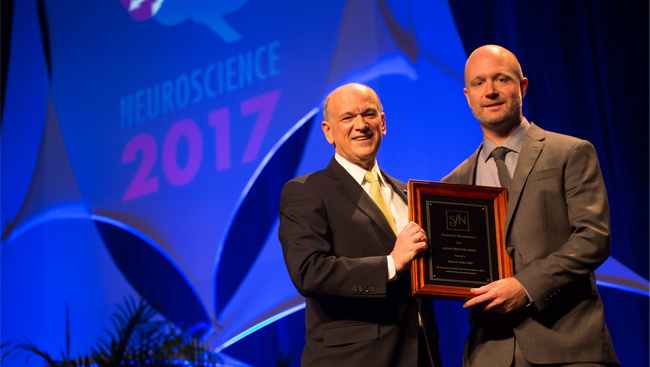 Article Annual Meeting Scientific ResearchIn the last seven years Garret Stuber, an associate professor at the University of North Carolina, has worked to characterize neural circuits underlying addiction, depression, and eating disorders. Through his use of optogenetics, his findings have contributed to a more foundational understanding of how drug addiction affects the brain, focusing on synaptic plasticity. For this work, he received the Jacob P. Waletzky Award in 2017. What initially let you to study addiction, depression, and eating disorders? Addiction, and neuropsychiatric disease in general, take a tremendous toll on society. These disorders are incredibly expensive from a public health perspective, and they likely — directly or indirectly — impact everyone to some extent. People close to me have dealt with addiction and mental illness, which has driven me to dedicate my career to better understanding the neurobiology of addiction and reward and, more broadly, of motivated behavior. I’ve been focused on this since I was an undergraduate and to this day I’m still extremely passionate about this research.May 1, 2018
 -
 Video DiversityMagda Giordano, professor and chair of the department of behavioral and cognitive neurobiology at the Institute of Neurobiology at the National University of Mexico (UNAM), shares how to advocate for yourself. She points out that advocating for oneself is something not necessarily officially taught and easy to do, but rather learned along the way. “I had to pick it up as my career went along because I did not feel very comfortable selling myself as something very special,” shares Giordano. When advocating for yourself, she stresses it’s not only your words that count, but also your work product. “Even if you write a beautiful letter, if you have nothing concrete to show for yourself, then there's no possibility of advocating for yourself.” Watch the video to learn how to showcase your achievements and advocate for yourself.Apr 30, 2018
 -
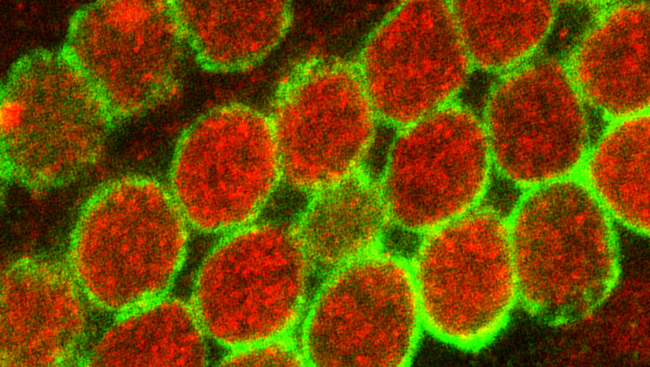 Article Professional DevelopmentThrough work with rhesus monkeys, Kati Gothard’s lab seeks to understand the neural basis of emotion and social behavior. She has experience communicating about her work with animals to a variety of audiences and also served on SfN’s Committee on Animals in Research. In a recent Neuronline article, she shares two stories where honest and open communication with the public paid off. Here, she gets into the approaches for communicating your work in a way that connects, and how to press on when you face harsh criticism.Apr 25, 2018
 -
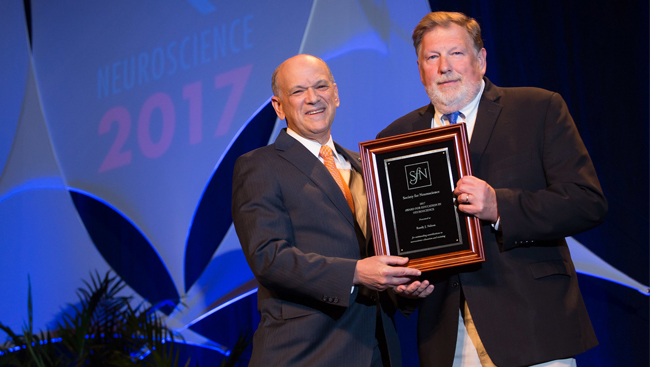 Article Annual Meeting Professional DevelopmentThroughout his career, Randy Nelson has worked to improve neuroscience education beyond his regular teaching obligations. He’s developed undergraduate programs at Johns Hopkins University and The Ohio State University and published more than 400 peer-reviewed articles and 11 books, including one textbook widely used in North America and Europe. In addition, he makes time to mentor, run a collaborative lab, and serve on the advisory board for several training grants. For his contributions to neuroscience education, he won the Award for Education in Neuroscience in 2017. What led you to become so involved in other activities beyond teaching in the classroom? I love the energy of teaching undergrads, both in the classroom and in the lab. My interest in mentoring came from being allowed to work with grad students and postdocs as an undergraduate student and from my own experiences of having excellent mentors in graduate school. Irv Zucker, my graduate mentor at Berkeley, was excellent at motivating his trainees to succeed, and he also did an outstanding job teaching us how to ask scientific questions and design clean experiments. I’ve also been fortunate to have other mentors during my career, including David Crews at The University of Texas, and, especially Sol Snyder, my chair at Hopkins.Apr 24, 2018
 -
 Journal ArticleBinocular disparity is used for perception and action in three dimensions. Neurons in the primary visual cortex respond to binocular disparity in random dot patterns, even when the contrast is inverted between eyes (false depth cue). In contrast, neurons in the ventral stream largely cease to respond to false depth cues. This study evaluated whether GABAergic inhibition is involved in suppressing false depth cues in the human ventral visual cortex. We compared GABAergic inhibition (GABA+) and glutamatergic excitation (Glx) during the viewing of correlated and anticorrelated binocular disparity in 18 participants using single voxel proton magnetic-resonance spectroscopy (MRS). Measurements were taken from the early visual cortex (EVC) and the lateral occipital cortex (LO). Three visual conditions were presented per voxel location: correlated binocular disparity; anticorrelated binocular disparity; or a blank grey screen with a fixation cross. To identify differences in neurochemistry, GABA+ or Glx levels w...Feb 25, 2025
 -
Journal ArticleMotor skill learning enables organisms to interact effectively with their environment, relying on neural mechanisms that integrate sensory feedback with motor output. While sensory feedback, such as auditory cues linked to motor actions, enhances motor performance in humans, its mechanism of action is poorly understood. Developing a reliable animal model of augmented motor skill learning is crucial to begin dissects the biological systems that underpin this enhancement. We hypothesized that continuous auditory feedback during a motor task would promote complex motor skill acquisition in mice. We developed a closed-loop system using DeepLabCut for real-time markerless tracking of mouse forepaw movements with high processing speed and low latency. By encoding forepaw movements into auditory tones of different frequencies, mice received continuous auditory feedback during a reaching task requiring vertical displacement of the left forepaw to a target. Adult mice were trained over four days with either auditor...Feb 25, 2025
-
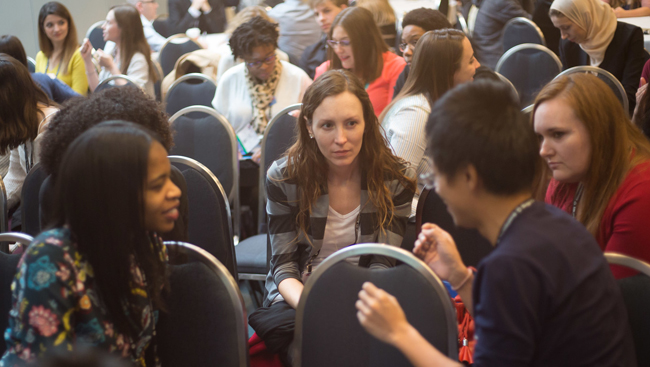 Annual Meeting Video AdvocacyNever has it been more important to increase understanding of the value of science for improving human health. Communicating the exciting implications of neuroscience discoveries to an audience of nonscientists, however, requires thought, skill, and a bit of theater to achieve that “aha!” moment. In this Neuroscience 2017 event, experienced scientists and a Washington Post reporter give TED-style talks sharing insight so you walk away knowing how to present complicated research in ways that engage an audience and establish rapport while also translating the impact of incremental discoveries.Apr 18, 2018
 -
 Virtual Conference Scientific ResearchThis event took place on June 4, 2018 and is no longer available on-demand.Apr 18, 2018
 -
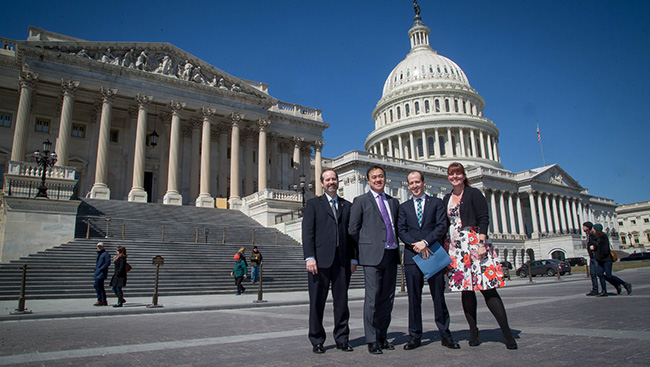 Webinar AdvocacyGain insight from experts on how to inspire your scientist peers and nonscientists to engage in advocacy and outreach in support of science. Through participating in public activities such as Science on Tap and Nerd Nite, holding informal coffee meetings with your colleagues, and partaking in other activities, you can empower others to get involved.Apr 18, 2018
 -
Journal ArticleWhile ketamine, an NMDA receptor antagonist, is effective in treating major depression, studies have not addressed the safety of repeated ketamine infusions in depressed patients with comorbid Alcohol Use Disorder (AUD). In this study, we aimed to determine whether a history of chronic social isolation and alcohol exposure alter the reinforcing properties of ketamine in male and female rats. Rats were pair-housed or socially isolated for 12 weeks and underwent intermittent access to 20% alcohol. Subsequently, rats underwent intravenous ketamine self-administration under a fixed ratio 1 schedule, followed by extinction training and one session of cue-induced reinstatement. Dendritic spine morphology was examined in the nucleus accumbens, an important area implicated in reward and motivation. Our results show that females self-administered more ketamine than males, a history of alcohol increased ketamine intake in females, and a history of isolation or alcohol independently increased ketamine intake in males...Feb 24, 2025




