



Filter
-
(133)
-
(733)
-
(4)
-
(1)
-
(47830)
-
(91)
-
(25)
-
(14)
-
(433)
-
(7)
-
(181)
-
(8)
-
(33)
-
(17)
-
(7)
-
(9)
-
(9)
-
(5)
-
(21)
-
(8)
-
(12)
-
(9)
-
(3)
-
(10)
-
(10)
-
(56)
-
(45)
-
(12)
-
(3)
-
(7)
-
(6)
-
(5)
-
(8)
-
(7)
-
(11)
-
(58)
-
(13)
-
(30)
-
(8)
-
(5)
-
(10)
-
(5)
-
(14)
-
(4)
1131 - 1140
of 52751 results
-
 Journal ArticleIn the Syngap+/- model of SYNGAP1-related intellectual disability (SRID), excessive neuronal protein synthesis is linked to deficits in synaptic plasticity. Here, we use Translating Ribosome Affinity Purification and RNA-seq (TRAP-seq) to identify mistranslating mRNAs in Syngap+/- CA1 pyramidal neurons that exhibit occluded long-term potentiation (LTP). We find the translation environment is significantly altered in a manner that is distinct from the Fmr1-/y model of Fragile X Syndrome (FXS), another monogenic model of autism and intellectual disability (ID). The Syngap+/- translatome is enriched for regulators of DNA repair, and mimics changes induced with chemical LTP (cLTP) in WT. This includes a striking upregulation in the translation of mRNAs with a longer length (>2kb) coding sequence (CDS). In contrast, long CDS transcripts are downregulated with induction of Gp1 metabotropic glutamate receptor induced long-term depression (mGluR-LTD) in WT, and in the Fmr1-/y model that exhibits occluded mGluR-LTD...Apr 28, 2025
 -
 Article Scientific ResearchYou know that eating is vital for your survival, but have you ever thought about how your brain controls how much you eat, when you eat, and what you eat? This is not a trivial question because two-thirds of Americans are either overweight or obese, and overeating is a major cause of this epidemic.Apr 18, 2019
 -
 Webinar Professional DevelopmentThis webinar will show you the broad landscape of European neuroscience networks. Following an introduction to networks and their role in neuroscience, you’ll hear presentations focusing on specific types of networks, with concrete examples. You’ll listen to testimonials from scientists at different career stages on how they’ve benefited from being part of a network. You’ll also have the chance to ask panelists your questions during a live Q&A.Apr 17, 2019
 -
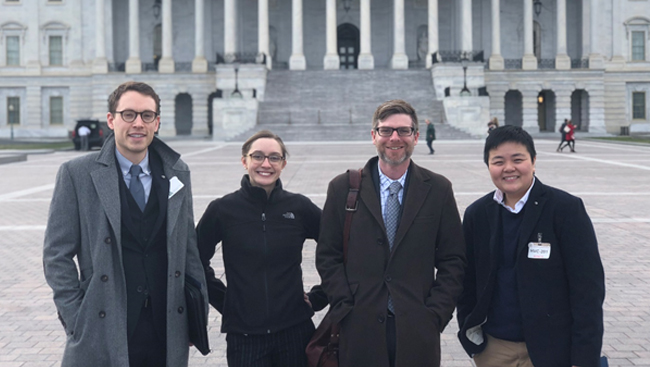 Article AdvocacyJoe Luchsinger started conducting science advocacy because he was passionate about an issue that affected scientists. Now, he regularly hosts lab tours and shares how others can talk with their local policymakers. Read his story and listen to part of his presentation at the Neuroscience 2018 Advocacy Reception, “Engaging Local Policymakers: Strategies for Scientists,” to start making a difference in science policy no matter your level of advocacy experience.Apr 16, 2019
 -
 Podcast Scientific ResearchIn this Meet the Expert, Chenghua Gu discusses new tools and methods her lab is using to study the blood brain barrier in vivo — particularly the relationship between neurons and endothelial cells. The blood brain barrier functions as the gatekeeper of the CNS and the barrier that prevents most drugs from passing from the bloodstream into the CNS. The Gu Lab seeks to investigate the fundamental cellular and molecular mechanisms that govern the formation and regulation of the blood brain barrier, as well as how neural and vascular systems work together to ensure proper brain function. Increased understanding of the mechanisms and functional aspects of neurovascular interactions has potential to enable bidirectional manipulation of the blood brain barrier.Apr 9, 2019
 -
Journal ArticlePrincipal neurons (PNs) of the lateral superior olive (LSO) are a critical component of brain circuits that compare information between the two ears to extract sound source-location-related cues. LSO PNs are not a homogenous group but differ in their transmitter type, intrinsic membrane properties, and projection pattern to higher processing centers in the inferior colliculus. Glycinergic inhibitory LSO PNs have higher input resistance than glutamatergic excitatory LSO PNs (∼double). This suggests that the inhibitory cell type has a lower minimum input or signal intensity required to produce an output (activation threshold) which may impact how they integrate binaural inputs. However, cell type-specific differences in the strength of synaptic drive could offset or accentuate differences in intrinsic excitability and have not been assessed. To evaluate this possibility, we used a knock-in mouse model to examine spontaneous and electrically stimulated (evoked) synaptic events in LSO PN types using voltage-cl...Apr 25, 2025
-
Journal ArticleInvestigating Mechanically Activated Currents from Trigeminal Neurons of Non-Human Primates | eNeuroPain sensation often involves mechanical modalities. Mechanically activated (MA) ion channels on sensory neurons underly responsiveness to mechanical stimuli. MA current properties have mainly been derived from rodent sensory neurons. This study aimed to address gaps in knowledge regarding MA current properties in trigeminal (TG) neurons of a higher order species, common marmoset non-human primates (NHP). MA currents triggered by a piezo-actuator were recorded in patch clamp configuration . MA responses were associated with action potential (AP) properties, such as width, dV/dt on the falling phase, and presence/absence of AP firing in NHP TG neurons. According to responsiveness to mechanical stimuli and AP properties, marmoset TG neurons were clustered into 4 S-type and 5 M-type groups. S-type TG neurons had broader AP with two dV/dt peaks on the AP falling phase. Only one S-type group of NHP TG neurons produced small MA currents. M-type TG neurons had narrow AP without two dV/dt peaks on the AP falling p...Apr 25, 2025
-
 Article Scientific ResearchAll nervous systems adapt to changes in the environment and the internal state of the animal. Such flexibility is essential to producing behaviors in different contexts. Much of this plasticity arises through the actions of neuromodulators, which actively reshape the activity and output of neuronal circuits by modifying neuronal excitability and synaptic transmission, typically by activating distinct G protein-coupled receptor-mediated pathways. Prominent examples include modulatory actions mediating distinct brain or behavioral states, such as the function of serotonin in regulating mood, or the sleep-wake cycles mediated by monoamines and peptides, such as orexin. Although it is tempting to equate the actions of individual neuromodulators with specific behaviors or even brain states, neural circuits are not exposed to neuromodulators one at a time.Apr 4, 2019
 -
 Article Career PathsWhat value do neuroscientists offer to the policy making process? A scientific approach creates quality legislation by adding a critical filter to analyses and by contributing to a general regard that conclusions must be backed up independently. A Senator in the state of California represents nearly one million constituents and votes on more than 5,000 bills every two-year cycle. In such a fast-paced environment, legislators rely on a system of information delivery that takes the form of timely, packaged ideas gleaned from news articles, the legislator’s own staff or personal network, advocacy groups, think tanks, and lobbyists. Lobbying firms, considered the “Third House” of the legislative branch, hold particular power because they have the means to constantly present information to decision-makers and their staff at the right time, with clear context and vision, and with a sophisticated strategy for enacting legislation. Government plays a role in creating the conditions necessary for scientific progress, primarily via public funding and patterns of regulation. However, scientific progress needs scientists at each step of the research pipeline, from extracting experimental data to fostering market and legal viability. Applying my scientific training often takes the form of evaluating statements of variable credibility, Googling like an expert, and communicating recommendations. A rigorous process akin to bench research is not always possible, often for reasons such as urgent timing or a simple lack of data, but the more policy is based in fact, the stronger it will be.Apr 3, 2019
 -
 Video Annual Meeting Scientific ResearchSex is an important biological variable to account for in experiments. Watch this short course from Neuroscience 2018 to become familiar with the mechanisms underlying molecular, neural circuit, and behavioral differences between the sexes to help you better incorporate both sexes into your preclinical research. Learn about fundamental concepts and hypotheses that have contributed to the current understanding of sex differences in the brain, as well as some of the latest discoveries related to the developmental origins of sex differences, gonadal steroid hormones, stress and vulnerability, reward and affective behaviors, and adolescence. Speakers discuss sex differences in stress responses and how they may result in different disease pathologies, activation by single hormones of multiple physiological endpoints, latent sex and population differences, reorganization of reward circuity during adolescence, molecular genetic tools for investigating neural circuits that may contribute to sex differences seen at the behavioral level, and more.Apr 2, 2019




